 Bird Album
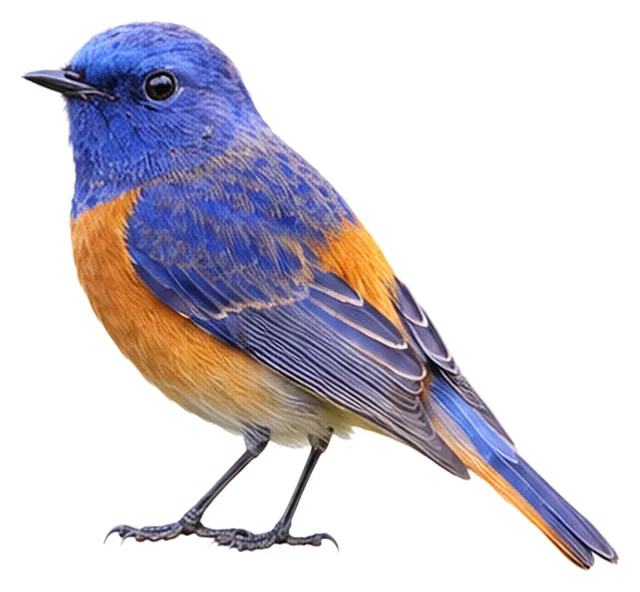
Blue-fronted Redstart
Phoenicurus frontalis Vigors, 1831
≈15 cmLength16 gWeight
This redstart breeds in the Himalayas and central China, with some birds moving south for the winter.
Busiest months: November–April · Most records: China, Bhutan, Nepal
How to identify
Male, female and young
Female brownish-gray, with paler underparts.
Where and when it's recorded
Busiest months: November–April · Most records: China, Bhutan, Nepal

Blue-fronted Redstart has been recorded at 378 of the 8,276 birding hotspots we track, in 7 countries and regions.
Records by month Northern Hemisphere
Where it's recorded most
- ChelelaBhutan332 records
- SattalIndia283 records
- Dochula – Royal Botanical ParkBhutan274 records
More places
- Balang Shan [General Area]China213 records
- Baihualing [General Area]China213 records
- PelelaBhutan202 records
- PangotIndia200 records
- Balang Shan – Tunnel AreaChina196 records
- Munsyari – Bheema WodeyarIndia160 records
- Balang Shan PassChina158 records
Countries and regions with the most records
eBird records via GBIF up to 2024-12-31. A record means someone listed it; more records partly mean more birders, not more birds.
About
The blue-fronted redstart (Phoenicurus frontalis) is a species of bird in the family Muscicapidae, the Old World flycatchers. It breeds in central China and the Himalayas (where it winters in the southern foothills, as well as in southern Yunnan, the Patkai and northern Indochina. Its natural habitat is temperate forests.
Excerpt from Wikipedia, CC BY-SA 4.0 · authors · Read more on Wikipedia
Questions
How big is the Blue-fronted Redstart?
The Blue-fronted Redstart is about ≈15 cm long and weighs around 16 g.
Where does the Blue-fronted Redstart live?
Its breeding range: Oriental: eastern Afghanistan to central China. It is most often recorded in China, Bhutan and Nepal.
When is the best time to see the Blue-fronted Redstart?
At the hotspots we track, it is recorded most in January, February, March, April, November and December (Northern Hemisphere).
Is the Blue-fronted Redstart endangered?
The IUCN Red List classifies the Blue-fronted Redstart as Least Concern.
What does the Blue-fronted Redstart eat?
Main food: Insects & other invertebrates.
What family is the Blue-fronted Redstart in?
It belongs to the family Chats, Old World Flycatchers (Muscicapidae), order Passerines (Passeriformes).
At a glance
- Length
- ≈15 cm
- Weight
- 16 g
- Habitat
- Forest
- Diet
- Insects & other invertebrates
- Lifestyle
- Perches in trees
- Migration
- Partial migrant
- Conservation
- Least Concern
More measurements
- Wing
- 84 mm
- Tail
- 69 mm
- Bill
- 13 mm
- Tarsus
- 22 mm
Averages from the AVONET dataset; length from field guides where available.
Range
Oriental: eastern Afghanistan to central China
Breeding range, IOC World Bird List 15.2
Classification
- Order
- Passerines Passeriformes
- Family
- Chats, Old World Flycatchers Muscicapidae
- Genus
- Phoenicurus
Other birds in the genus Phoenicurus
 Eversmann's RedstartPhoenicurus erythronotus
 Blue-capped RedstartPhoenicurus coeruleocephala
 White-throated RedstartPhoenicurus schisticeps
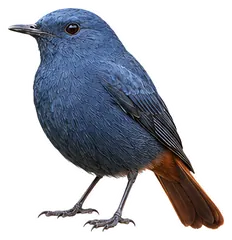 Plumbeous Water RedstartPhoenicurus fuliginosus
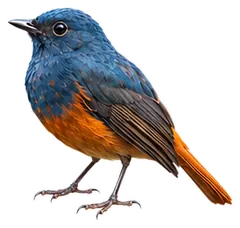 Luzon Water RedstartPhoenicurus bicolor
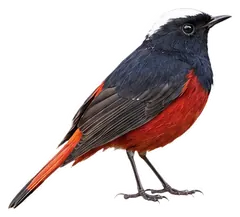 White-capped RedstartPhoenicurus leucocephalus
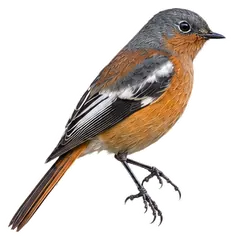 Przevalski's RedstartPhoenicurus alaschanicus
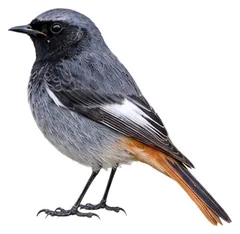 Black RedstartPhoenicurus ochruros
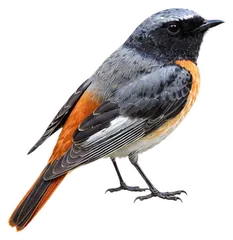 Common RedstartPhoenicurus phoenicurus
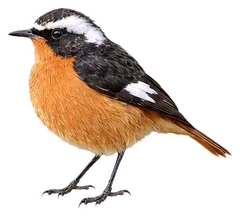 Moussier's RedstartPhoenicurus moussieri
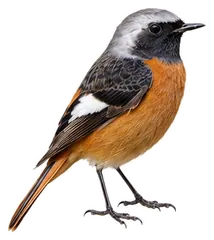 Daurian RedstartPhoenicurus auroreus
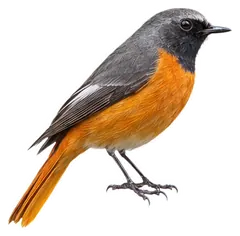 Hodgson's RedstartPhoenicurus hodgsoni
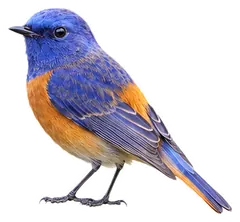
Download illustration
Free to use with credit: “Illustration: Bird Album (birdalbum.com)”. Drawn by AI from a reference photo by Prateik Kulkarni. ↗

Heard it but can't see it? Mingji identifies birds by sound and photo, on your phone.
In other languages
- EnglishBlue-fronted Redstart
- 简体中文蓝额红尾鸲
- 繁體中文藍額紅尾鴝
- 日本語ルリビタイジョウビタキ
- DeutschBlaustirn-Rotschwanz
- FrançaisRougequeue à front bleu
- EspañolColirrojo frentiazul
- Portuguêsrabirruivo-de-testa-azul
- ItalianoCodirosso fronteblu
- NederlandsHimalayaroodstaart
- РусскийСинелобая горихвостка
- Svenskablåstrupig rödstjärt
- DanskBlåpandet Rødstjert
- Polskipleszka modra