 Bird Album
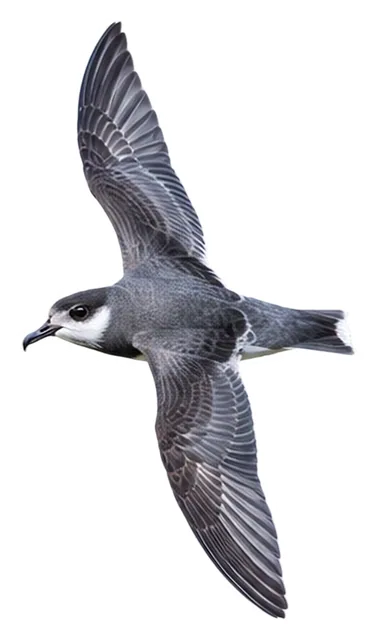
Blue Petrel
Halobaena caerulea (Gmelin, JF, 1789)
202 gWeight
The blue petrel (Halobaena caerulea) is a small seabird in the shearwater and petrel family, Procellariidae.
Busiest months: November · Most records: Australia, Antarctica, South Georgia & South Sandwich Islands
Where and when it's recorded

Blue Petrel has been recorded at 27 of the 8,171 birding hotspots we track, in 8 countries and regions.
Records by month Southern Hemisphere
Where it's recorded most
- Eaglehawk Neck Pelagic TripAustralia297 records
- Drake PassageAntarctica168 records
- Cooper BaySouth Georgia & South Sandwich Islands31 records
More places
- Gold HarbourSouth Georgia & South Sandwich Islands21 records
- GrytvikenSouth Georgia & South Sandwich Islands19 records
- Salisbury PlainSouth Georgia & South Sandwich Islands17 records
- Port-aux-FrançaisFrench Southern Territories15 records
- Canal BeagleArgentina15 records
- Ile MayèsFrench Southern Territories14 records
- St Andrew's BaySouth Georgia & South Sandwich Islands12 records
Countries and regions with the most records
eBird records via GBIF up to 2024-12-31. A record means someone listed it; more records partly mean more birders, not more birds.
About
The blue petrel (Halobaena caerulea) is a small seabird in the shearwater and petrel family, Procellariidae. This small petrel is the only member of the genus Halobaena, but is closely allied to the prions. It is distributed across the Southern Ocean but breeds at a few island sites, all close to the Antarctic Convergence zone.
Excerpt from Wikipedia, CC BY-SA 4.0 · authors · Read more on Wikipedia
Questions
How big is the Blue Petrel?
The Blue Petrel weighs around 202 g.
Where does the Blue Petrel live?
Its breeding range: Southern Ocean: islands of subantarctic Atlantic and Indian oceans mostly south of Antarctic Convergence from Diego Ramirez (south of Tierra del Fuego) and Cape Horn (southern South America) to Macquarie (far southeast of Australia). It is most often recorded in Australia, Antarctica and South Georgia & South Sandwich Islands.
When is the best time to see the Blue Petrel?
At the hotspots we track, it is recorded most in November (Southern Hemisphere).
Is the Blue Petrel endangered?
The IUCN Red List classifies the Blue Petrel as Least Concern.
What does the Blue Petrel eat?
Main food: Fish, shrimp & shellfish.
What family is the Blue Petrel in?
It belongs to the family Petrels, Shearwaters, Diving Petrels (Procellariidae), order Procellariiformes.
At a glance
- Weight
- 202 g
- Habitat
- Ocean
- Diet
- Fish, shrimp & shellfish
- Lifestyle
- Varied
- Migration
- Partial migrant
- Conservation
- Least Concern
More measurements
- Wing
- 206 mm
- Tail
- 77 mm
- Bill
- 30 mm
- Tarsus
- 32 mm
Averages from the AVONET dataset; length from field guides where available.
Range
Southern Ocean: islands of subantarctic Atlantic and Indian oceans mostly south of Antarctic Convergence from Diego Ramirez (south of Tierra del Fuego) and Cape Horn (southern South America) to Macquarie (far southeast of Australia)
Breeding range, IOC World Bird List 15.2
Classification
- Order
- Procellariiformes
- Family
- Petrels, Shearwaters, Diving Petrels Procellariidae
- Genus
- Halobaena
More from the family Petrels, Shearwaters, Diving Petrels
 Southern Giant PetrelMacronectes giganteus
 Northern Giant PetrelMacronectes halli
 Northern FulmarFulmarus glacialis
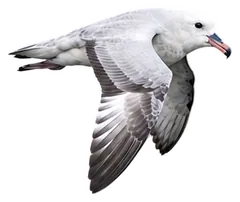 Southern FulmarFulmarus glacialoides
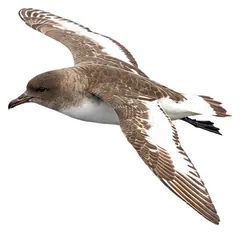 Antarctic PetrelThalassoica antarctica
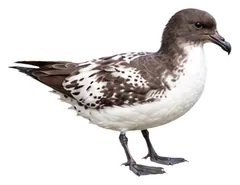 Pintado PetrelDaption capense
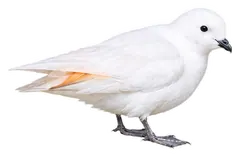 Snow PetrelPagodroma nivea
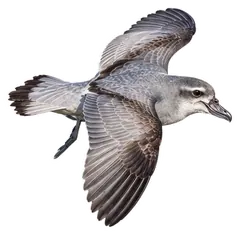 Broad-billed PrionPachyptila vittata
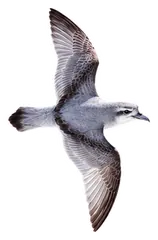 Salvin's PrionPachyptila salvini
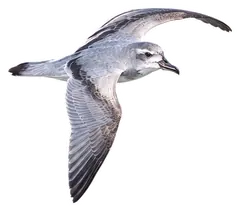 MacGillivray's PrionPachyptila macgillivrayi
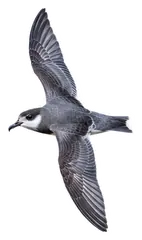
Download illustration
Free to use with credit: “Illustration: Bird Album (birdalbum.com)”. Drawn by AI from a reference photo by Ben Ackerley. ↗
Heard it but can't see it? Mingji identifies birds by sound and photo, on your phone.