 Bird Album
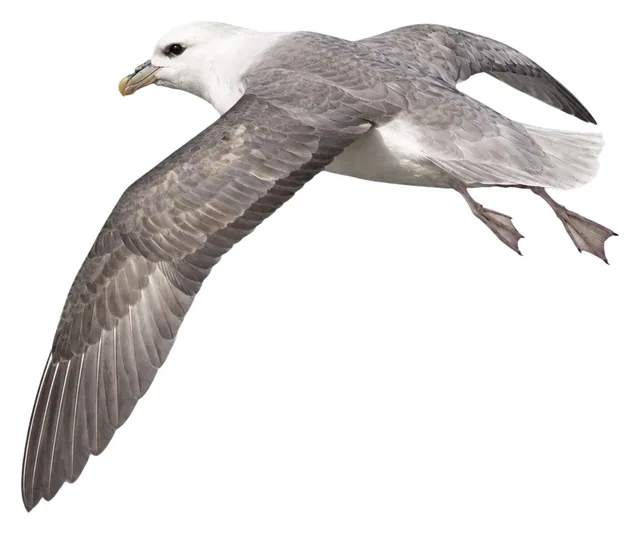
Northern Fulmar
Fulmarus glacialis (Linnaeus, 1761)
46 cmLength107 cmWingspan612 gWeight
It has a short, stout bill, a thick neck and wings that look very stiff in flapping flight.
Busiest months: June and November · Most records: United States, United Kingdom, Iceland
How to identify
Field marks
- Bill pale yellow, short and stout
- Nostrils on top of upper mandible
- Pale morph with white head and body, gray wings and tail
- Dark morph gray overall
Voice
Gives purring and clucking sounds while feeding, and guttural calls in the breeding season.
Where and when it's recorded
Busiest months: June and November · Most records: United States, United Kingdom, Iceland

Northern Fulmar has been recorded at 275 of the 8,276 birding hotspots we track, in 24 countries and regions.
Records by month Northern Hemisphere
Where it's recorded most
- Pt. Pinos – seawatch onlyUnited States8,999 records
- St. Paul IslandUnited States5,045 records
- Southeast Farallon IslandUnited States3,497 records
More places
- GambellUnited States3,383 records
- Húsavík – hafnarsvæðiIceland3,363 records
- Bempton Cliffs RSPB ReserveUnited Kingdom3,158 records
- North ForelandUnited Kingdom2,202 records
- Whitburn Coastal ParkUnited Kingdom1,689 records
- Portland BillUnited Kingdom1,151 records
- Fair IsleUnited Kingdom1,021 records
Countries and regions with the most records
eBird records via GBIF up to 2024-12-31. A record means someone listed it; more records partly mean more birders, not more birds.
About
The northern fulmar, Arctic fulmar, or simply fulmar (Fulmarus glacialis) is an abundant seabird found primarily in subarctic regions of the North Atlantic and North Pacific oceans. There has been one confirmed sighting in the Southern Hemisphere, with a single bird seen south of New Zealand. Fulmars come in one of two colour morphs; a light one in temperate populations, with white head and body and grey wings and tail, and a dark one in arctic populations, which is uniformly grey; intermediate birds are common.
Excerpt from Wikipedia, CC BY-SA 4.0 · authors · Read more on Wikipedia
Questions
How big is the Northern Fulmar?
The Northern Fulmar is about 46 cm long, with a wingspan of 107 cm and weighs around 612 g.
Where does the Northern Fulmar live?
Its breeding range: North America, Palearctic: islands and coasts of North Atlantic, bays between Arctic and North Atlantic, and North Pacific including Sea of Okhotsk and Bering Sea. It is most often recorded in United States, United Kingdom and Iceland.
When is the best time to see the Northern Fulmar?
At the hotspots we track, it is recorded most in June and November (Northern Hemisphere).
Is the Northern Fulmar endangered?
The IUCN Red List classifies the Northern Fulmar as Least Concern.
What does the Northern Fulmar eat?
Main food: Fish, shrimp & shellfish.
What family is the Northern Fulmar in?
It belongs to the family Petrels, Shearwaters, Diving Petrels (Procellariidae), order Procellariiformes.
At a glance
- Length
- 46 cm
- Wingspan
- 107 cm
- Weight
- 612 g
- Habitat
- Ocean
- Diet
- Fish, shrimp & shellfish
- Lifestyle
- On the water surface
- Migration
- Migratory
- Conservation
- Least Concern
More measurements
- Wing
- 321 mm
- Tail
- 135 mm
- Bill
- 41 mm
- Tarsus
- 49 mm
Averages from the AVONET dataset; length from field guides where available.
Range
North America, Palearctic: islands and coasts of North Atlantic, bays between Arctic and North Atlantic, and North Pacific including Sea of Okhotsk and Bering Sea
Breeding range, IOC World Bird List 15.2
Classification
- Order
- Procellariiformes
- Family
- Petrels, Shearwaters, Diving Petrels Procellariidae
- Genus
- Fulmarus
Other birds in the genus Fulmarus
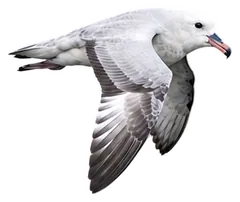 Southern FulmarFulmarus glacialoides
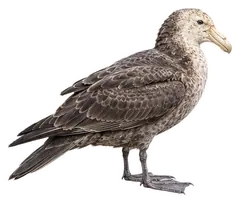 Southern Giant PetrelMacronectes giganteus
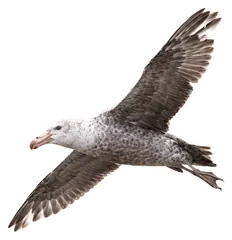 Northern Giant PetrelMacronectes halli
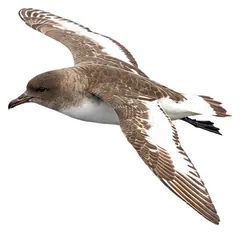 Antarctic PetrelThalassoica antarctica
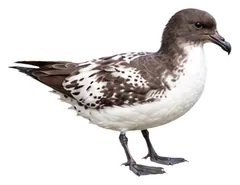 Pintado PetrelDaption capense
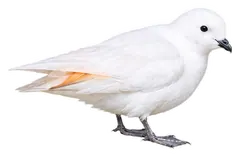 Snow PetrelPagodroma nivea
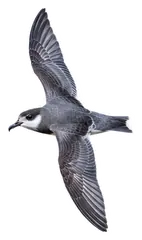 Blue PetrelHalobaena caerulea
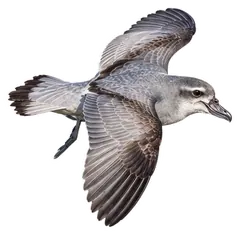 Broad-billed PrionPachyptila vittata
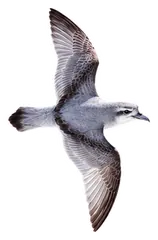 Salvin's PrionPachyptila salvini
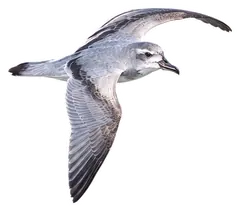 MacGillivray's PrionPachyptila macgillivrayi
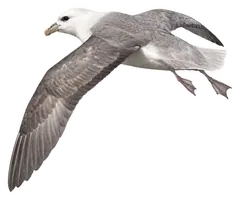
Download illustration
Free to use with credit: “Illustration: Bird Album (birdalbum.com)”. Drawn by AI from a reference photo by Andrew P. Aldrich. ↗
Heard it but can't see it? Mingji identifies birds by sound and photo, on your phone.