 Bird Album
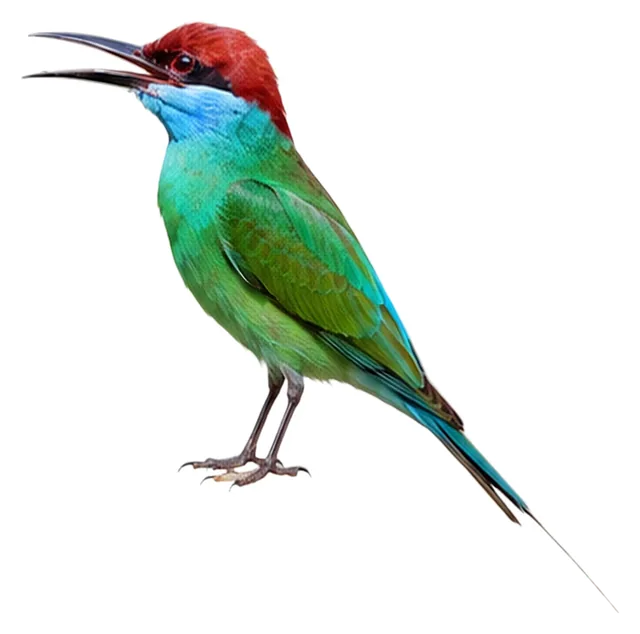
Blue-throated Bee-eater
Merops viridis Linnaeus, 1758
≈22 cmLength35 gWeight
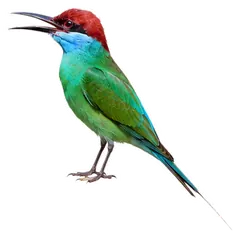
It has a reddish-brown crown, a blue throat, and a green body, with elongated central tail feathers in the adult.
Busiest months: March, July–August and October · Most records: Singapore, Malaysia, Thailand
How to identify
Field marks
- Throat blue
- Crown and nape reddish-brown
- Wings dark green; breast and belly pale green
- Adult: central tail feathers particularly long
Male, female and young
Juvenile is mostly green overall, with dark green head and wings, and lacks the adult’s elongated central tail feathers.
Voice
Varied calls include long calls, alarm calls, short chirps, gurgles, and trills.
Where and when it's recorded

Blue-throated Bee-eater has been recorded at 370 of the 8,276 birding hotspots we track, in 9 countries and regions.
Records by month Northern Hemisphere
Where it's recorded most
- Sepilok – Rainforest Discovery CenterMalaysia1,911 records
- Singapore Botanic GardensSingapore1,677 records
- Kranji MarshSingapore1,011 records
More places
- Dairy Farm Nature ParkSingapore760 records
- Danum Valley Borneo Rainforest LodgeMalaysia755 records
- Jurong Lake GardensSingapore692 records
- Sungei Buloh Wetland ReserveSingapore638 records
- Kinabatangan River – SukauMalaysia633 records
- Central Catchment Nature ReserveSingapore609 records
- Gunung Panti Recreational Forest – Panti Bird Sanctuary and North AreaMalaysia584 records
Countries and regions with the most records
eBird records via GBIF up to 2024-12-31. A record means someone listed it; more records partly mean more birders, not more birds.
About
The blue-throated bee-eater (Merops viridis) is a species of bird in the bee-eater family. It is found in much of southeast Asia, in subtropical or tropical mangrove forests. Their diet consists mostly of bees, wasps, and dragonflies.
Excerpt from Wikipedia, CC BY-SA 4.0 · authors · Read more on Wikipedia
Questions
How big is the Blue-throated Bee-eater?
The Blue-throated Bee-eater is about ≈22 cm long and weighs around 35 g.
Where does the Blue-throated Bee-eater live?
Its breeding range: Oriental: southern China to Sumatra, Nias (west of northern Sumatra), Riau Islands (east of central Sumatra), Bangka and Belitung (east of southern Sumatra), Java, northern Natuna Islands (northwest of Borneo) and Borneo. It is most often recorded in Singapore, Malaysia and Thailand.
When is the best time to see the Blue-throated Bee-eater?
At the hotspots we track, it is recorded most in March, July, August and October (Northern Hemisphere).
Is the Blue-throated Bee-eater endangered?
The IUCN Red List classifies the Blue-throated Bee-eater as Least Concern.
What does the Blue-throated Bee-eater eat?
Main food: Insects & other invertebrates.
What family is the Blue-throated Bee-eater in?
It belongs to the family Bee-eaters (Meropidae), order Coraciiformes.
At a glance
- Length
- ≈22 cm
- Weight
- 35 g
- Habitat
- Woodland
- Diet
- Insects & other invertebrates
- Lifestyle
- Perches in trees
- Migration
- Resident (barely migrates)
- Conservation
- Least Concern
More measurements
- Wing
- 112 mm
- Tail
- 76 mm
- Bill
- 35 mm
- Tarsus
- 10 mm
Averages from the AVONET dataset; length from field guides where available.
Range
Oriental: southern China to Sumatra, Nias (west of northern Sumatra), Riau Islands (east of central Sumatra), Bangka and Belitung (east of southern Sumatra), Java, northern Natuna Islands (northwest of Borneo) and Borneo
Breeding range, IOC World Bird List 15.2
Classification
- Order
- Coraciiformes
- Family
- Bee-eaters Meropidae
- Genus
- Merops
Other birds in the genus Merops
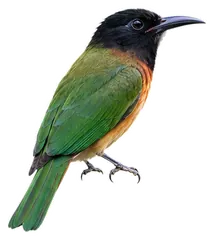 Black-headed Bee-eaterMerops breweri
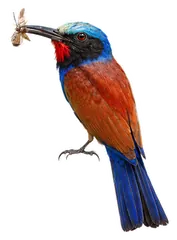 Blue-headed Bee-eaterMerops muelleri
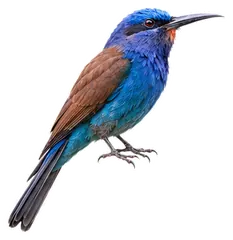 Blue-moustached Bee-eaterMerops mentalis
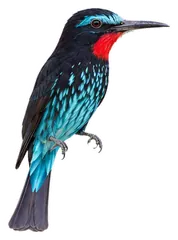 Black Bee-eaterMerops gularis
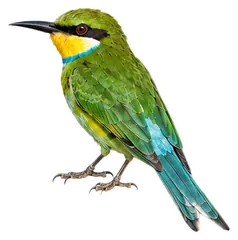 Swallow-tailed Bee-eaterMerops hirundineus
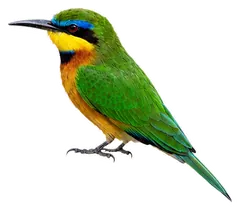 Little Bee-eaterMerops pusillus
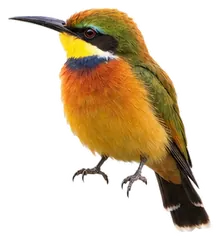 Blue-breasted Bee-eaterMerops variegatus
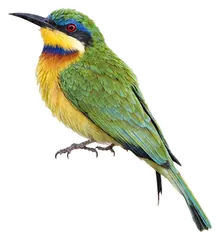 Ethiopian Bee-eaterMerops lafresnayii
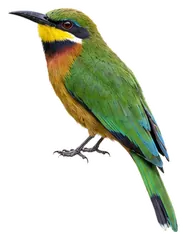 Cinnamon-chested Bee-eaterMerops oreobates
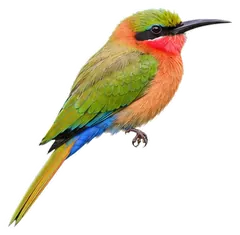 Red-throated Bee-eaterMerops bulocki
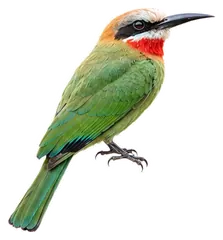 White-fronted Bee-eaterMerops bullockoides
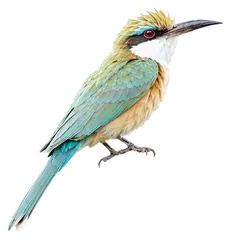 Somali Bee-eaterMerops revoilii
Download illustration
Free to use with credit: “Illustration: Bird Album (birdalbum.com)”. Drawn by AI from a reference photo by Charles J. Sharp. ↗

Heard it but can't see it? Mingji identifies birds by sound and photo, on your phone.
In other languages
- EnglishBlue-throated Bee-eater
- 简体中文蓝喉蜂虎
- 繁體中文藍喉栗頭蜂虎
- 日本語ルリノドハチクイ
- DeutschMalaienspint
- FrançaisGuêpier à gorge bleue
- EspañolAbejaruco gorjiazul
- Portuguêsabelharuco-de-garganta-azul
- ItalianoGruccione golazzurra
- NederlandsMaleise Bijeneter
- РусскийМалайская щурка
- Svenskablåstrupig biätare
- DanskBrunnakket Biæder
- Polskiżołna modrogardła