 Bird Album
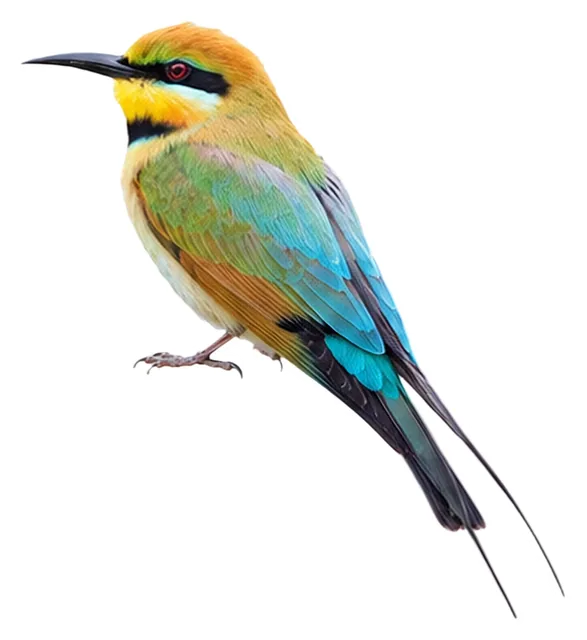
Rainbow Bee-eater
Merops ornatus Latham, 1801
23–28 cmLength30 gWeight
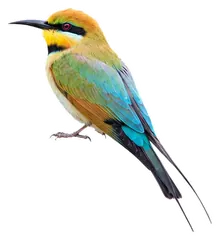
The adult has red eyes crossed by a black stripe, a black throat crescent, and elongated central tail feathers.
Busiest months: July–October · Most records: Australia, Papua New Guinea, Indonesia
How to identify
Field marks
- Black eyestripe crosses red eye and is edged blue
- Adult: black crescent-shaped band on throat
- Upper back and upperwing green; lower back bright blue
- Adult: two central tail feathers elongated
Male, female and young
Male has longer tail feathers than female; juvenile has a greenish crown and lacks the throat band and elongated tail feathers.
Voice
A series of loud, melodious “pir-r-r” notes, rapidly quavering and high-pitched, mostly given in flight.
Where and when it's recorded

Rainbow Bee-eater has been recorded at 237 of the 8,171 birding hotspots we track, in 6 countries and regions.
Records by month Southern Hemisphere
Where it's recorded most
- Sandy Camp Road WetlandsAustralia4,226 records
- Townsville Town Common Conservation ParkAustralia3,485 records
- Oxley Creek CommonAustralia2,474 records
More places
- Broome Bird ObservatoryAustralia2,462 records
- Cattana WetlandsAustralia1,713 records
- Tinchi Tamba Wetlands ReserveAustralia1,532 records
- Bowra Wildlife SanctuaryAustralia1,458 records
- Cairns Botanical Gardens and Centenary LakesAustralia1,419 records
- Carlyle Gardens Retirement Resort, TownsvilleAustralia1,356 records
- Buffalo CreekAustralia1,230 records
Countries and regions with the most records
eBird records via GBIF up to 2024-12-31. A record means someone listed it; more records partly mean more birders, not more birds.
Questions
How big is the Rainbow Bee-eater?
The Rainbow Bee-eater is about 23–28 cm long and weighs around 30 g.
Where does the Rainbow Bee-eater live?
Its breeding range: Australasia: Australia (except Tasmania). It is most often recorded in Australia, Papua New Guinea and Indonesia.
When is the best time to see the Rainbow Bee-eater?
At the hotspots we track, it is recorded most in July, August, September and October (Southern Hemisphere).
Is the Rainbow Bee-eater endangered?
The IUCN Red List classifies the Rainbow Bee-eater as Least Concern.
What does the Rainbow Bee-eater eat?
Main food: Insects & other invertebrates.
What family is the Rainbow Bee-eater in?
It belongs to the family Bee-eaters (Meropidae), order Coraciiformes.
At a glance
- Length
- 23–28 cm
- Weight
- 30 g
- Habitat
- Woodland
- Diet
- Insects & other invertebrates
- Lifestyle
- Perches in trees
- Migration
- Migratory
- Conservation
- Least Concern
More measurements
- Wing
- 108 mm
- Tail
- 107 mm
- Bill
- 37 mm
- Tarsus
- 11 mm
Averages from the AVONET dataset; length from field guides where available.
Range
Australasia: Australia (except Tasmania)
Breeding range, IOC World Bird List 15.2
Classification
- Order
- Coraciiformes
- Family
- Bee-eaters Meropidae
- Genus
- Merops
Other birds in the genus Merops
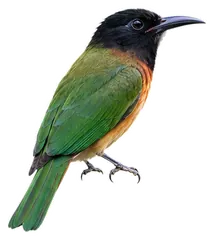 Black-headed Bee-eaterMerops breweri
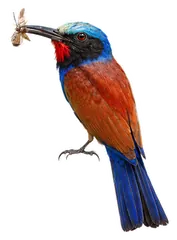 Blue-headed Bee-eaterMerops muelleri
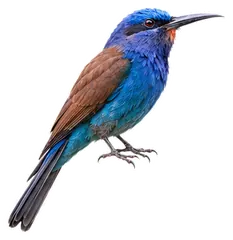 Blue-moustached Bee-eaterMerops mentalis
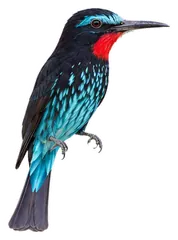 Black Bee-eaterMerops gularis
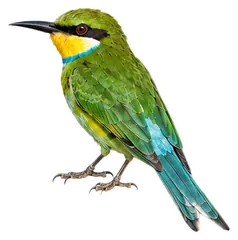 Swallow-tailed Bee-eaterMerops hirundineus
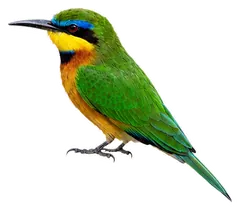 Little Bee-eaterMerops pusillus
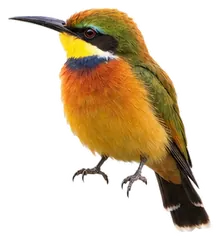 Blue-breasted Bee-eaterMerops variegatus
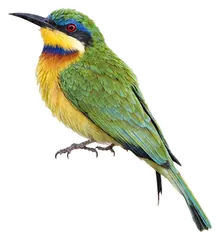 Ethiopian Bee-eaterMerops lafresnayii
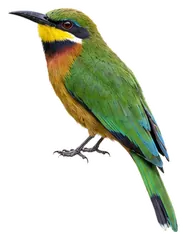 Cinnamon-chested Bee-eaterMerops oreobates
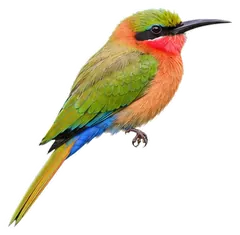 Red-throated Bee-eaterMerops bulocki
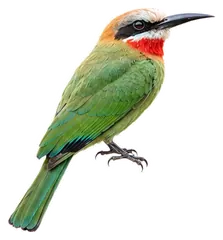 White-fronted Bee-eaterMerops bullockoides
 Somali Bee-eaterMerops revoilii
Download illustration
Free to use with credit: “Illustration: Bird Album (birdalbum.com)”. Drawn by AI from a reference photo by JJ Harrison ( https://www.jjharrison.com.au/ ). ↗

Heard it but can't see it? Mingji identifies birds by sound and photo, on your phone.