 Bird Album
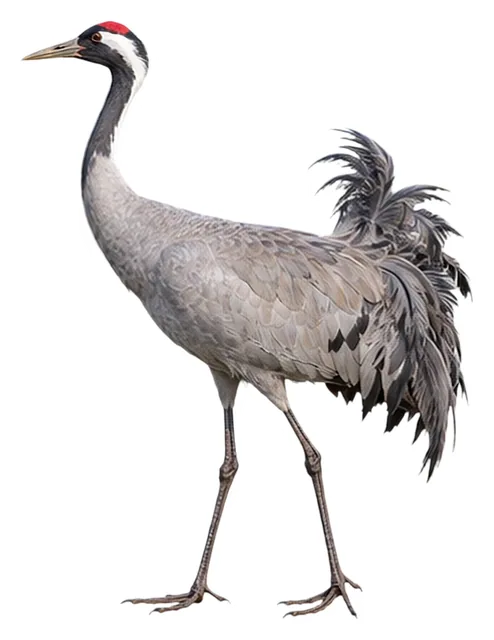
Common Crane
Grus grus (Linnaeus, 1758)
100–130 cmLength222 cmWingspan5.5 kgWeight
This pale gray crane has a black head and neck, a white stripe running from behind the eye to the nape, and a small red patch on the crown.
Busiest months: October–December · Most records: Spain, Poland, Sweden
How to identify
Field marks
- Head and neck gray-black or black, with a white stripe from behind the eye to the nape
- One small patch of red bare skin on the crown
- Mainly gray overall
- Loose feather tufts hang over the tail when standing
Male, female and young
Sexes have the same plumage, with male usually larger; immature mostly yellowish-brown, with a dark brown crown and no black-and-white stripes on the neck.
Voice
High-pitched, loud and trumpet-like, given both in flight and during display.
Where and when it's recorded

Common Crane has been recorded at 1,114 of the 8,171 birding hotspots we track, in 80 countries and regions.
Records by month Northern Hemisphere
Where it's recorded most
- El Oso – Laguna y entornoSpain1,882 records
- WWT Slimbridge Wetland CentreUnited Kingdom1,658 records
- LindusSpain1,410 records
More places
- Hula Valley – Lake AgmonIsrael1,018 records
- Azud de RiolobosSpain914 records
- Hjälstaviken NRSweden872 records
- Laguna de Gallocanta RN – ÁreaSpain823 records
- Thol Bird SanctuaryIndia803 records
- La Janda – ÁreaSpain777 records
- Lagunas de Villafáfila RNat – ÁreaSpain765 records
Countries and regions with the most records
eBird records via GBIF up to 2024-12-31. A record means someone listed it; more records partly mean more birders, not more birds.
About
The common crane (Grus grus), also known as the Eurasian crane, is a bird of the family Gruidae, the cranes. A medium-sized species, it is the only crane commonly found in Europe besides the demoiselle crane (Grus virgo) and the Siberian crane (Leucogeranus leucogeranus) that only are regular in the far eastern part of the continent. Along with the sandhill crane (Antigone canadensis), demoiselle crane and the brolga (Antigone rubicunda), it is one of only four crane species not currently classified as threatened with extinction or conservation dependent on the species level.
Excerpt from Wikipedia, CC BY-SA 4.0 · authors · Read more on Wikipedia
Questions
How big is the Common Crane?
The Common Crane is about 100–130 cm long, with a wingspan of 222 cm and weighs around 5.5 kg.
Where does the Common Crane live?
Its breeding range: Palearctic: widespread. It is most often recorded in Spain, Poland and Sweden.
When is the best time to see the Common Crane?
At the hotspots we track, it is recorded most in October, November and December (Northern Hemisphere).
Is the Common Crane endangered?
The IUCN Red List classifies the Common Crane as Least Concern.
What does the Common Crane eat?
Main food: Omnivore.
What family is the Common Crane in?
It belongs to the family Cranes (Gruidae), order Gruiformes.
At a glance
- Length
- 100–130 cm
- Wingspan
- 222 cm
- Weight
- 5.5 kg
- Habitat
- Wetland
- Diet
- Omnivore
- Lifestyle
- Active on the ground
- Migration
- Migratory
- Conservation
- Least Concern
More measurements
- Wing
- 541 mm
- Tail
- 193 mm
- Bill
- 108 mm
- Tarsus
- 234 mm
Averages from the AVONET dataset; length from field guides where available.
Range
Palearctic: widespread
Breeding range, IOC World Bird List 15.2
Classification
- Order
- Gruiformes
- Family
- Cranes Gruidae
- Genus
- Grus
Other birds in the genus Grus
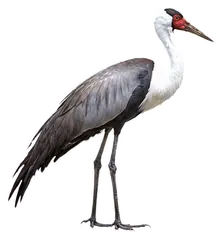 Wattled CraneGrus carunculata
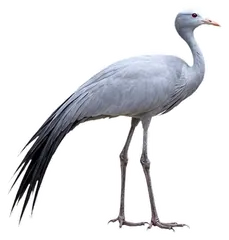 Blue CraneGrus paradisea
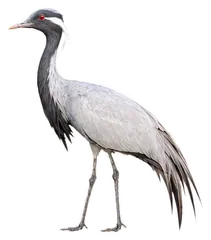 Demoiselle CraneGrus virgo
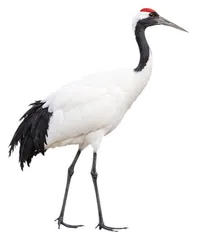 Red-crowned CraneGrus japonensis
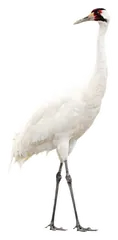 Whooping CraneGrus americana
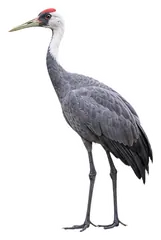 Hooded CraneGrus monacha
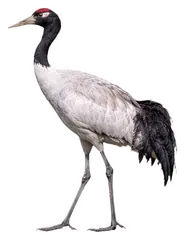 Black-necked CraneGrus nigricollis
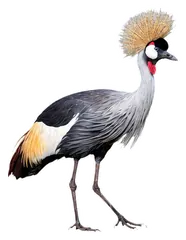 Grey Crowned CraneBalearica regulorum
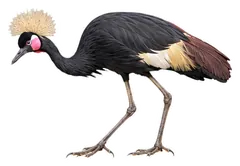 Black Crowned CraneBalearica pavonina
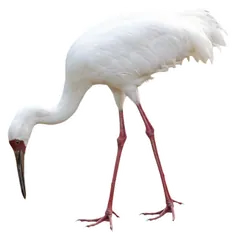 Siberian CraneLeucogeranus leucogeranus
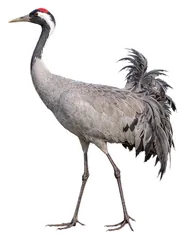
Download illustration
Free to use with credit: “Illustration: Bird Album (birdalbum.com)”. Drawn by AI from a reference photo by Andreas Trepte. ↗

Heard it but can't see it? Mingji identifies birds by sound and photo, on your phone.