 Bird Album
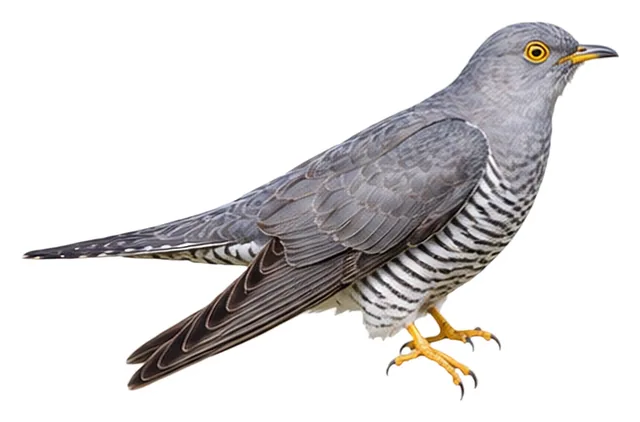
Common Cuckoo
Cuculus canorus Linnaeus, 1758
≈32 cmLength58 cmWingspan111 gWeight
It has a slender gray body and a very long tail, resembling Eurasian Sparrowhawk in flight.
Busiest months: May · Most records: United Kingdom, China, Spain
Looks like Oriental Cuckoo
How to identify
Field marks
- Adult male slate-gray
- Adult male has gray throat and breast, sharply set off from the barred underparts
- Iris, eye-ring, base of the bill, legs and feet yellow
- Often perches in the open during the breeding season, with wings drooped and tail cocked
Male, female and young
Females are mostly gray, occasionally of a reddish-brown color morph, which is more frequent among juveniles; juveniles are most clearly marked by a white patch on the nape and white feather edges.
Voice
The male gives “goo-ko”, mostly from an exposed perch; the female gives a loud bubbling call.
Similar species
Where and when it's recorded
Busiest months: May · Most records: United Kingdom, China, Spain

Common Cuckoo has been recorded at 2,646 of the 8,276 birding hotspots we track, in 116 countries and regions.
Records by month Northern Hemisphere
Where it's recorded most
- Amwell HMWT NRUnited Kingdom1,197 records
- Lakenheath Fen RSPB ReserveUnited Kingdom1,118 records
- Minsmere RSPB ReserveUnited Kingdom995 records
More places
- Aras Kuş Halkalama İstasyonuTürkiye993 records
- Otmoor RSPB ReserveUnited Kingdom822 records
- Sangla and AreaNepal781 records
- Fen Drayton Lakes RSPB ReserveUnited Kingdom746 records
- WagbachniederungGermany736 records
- Stodmarsh NNRUnited Kingdom674 records
- Titchwell Marsh RSPB ReserveUnited Kingdom623 records
Countries and regions with the most records
eBird records via GBIF up to 2024-12-31. A record means someone listed it; more records partly mean more birders, not more birds.
About
The cuckoo, common cuckoo, European cuckoo or Eurasian cuckoo (Cuculus canorus) is a member of the cuckoo order of birds, Cuculiformes, which includes the roadrunners, the anis and the coucals.
Excerpt from Wikipedia, CC BY-SA 4.0 · authors · Read more on Wikipedia
Questions
How big is the Common Cuckoo?
The Common Cuckoo is about ≈32 cm long, with a wingspan of 58 cm and weighs around 111 g.
Where does the Common Cuckoo live?
Its breeding range: Palearctic: widespread. It is most often recorded in United Kingdom, China and Spain.
When is the best time to see the Common Cuckoo?
At the hotspots we track, it is recorded most in May (Northern Hemisphere).
Is the Common Cuckoo endangered?
The IUCN Red List classifies the Common Cuckoo as Least Concern.
What does the Common Cuckoo eat?
Main food: Insects & other invertebrates.
What family is the Common Cuckoo in?
It belongs to the family Cuckoos (Cuculidae), order Cuculiformes.
At a glance
- Length
- ≈32 cm
- Wingspan
- 58 cm
- Weight
- 111 g
- Habitat
- Forest
- Diet
- Insects & other invertebrates
- Lifestyle
- Perches in trees
- Migration
- Migratory
- Conservation
- Least Concern
More measurements
- Wing
- 192 mm
- Tail
- 158 mm
- Bill
- 26 mm
- Tarsus
- 21 mm
Averages from the AVONET dataset; length from field guides where available.
Range
Palearctic: widespread
Breeding range, IOC World Bird List 15.2
Subspecies · 2
- Cuculus canorus canorus Europe and the Middle East to Kamchatka, Japan and n China | non-breeding: to s Africa and s Asia
- Cuculus canorus bakeri w China and n India to s China and nw Thailand | non-breeding: ne India and se Asia
Classification
- Order
- Cuculiformes
- Family
- Cuckoos Cuculidae
- Genus
- Cuculus
Other birds in the genus Cuculus
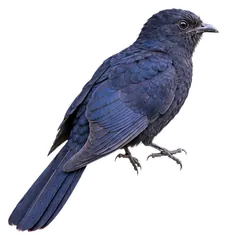 Black CuckooCuculus clamosus
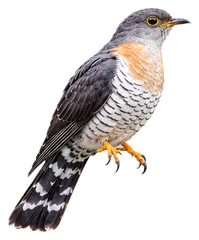 Red-chested CuckooCuculus solitarius
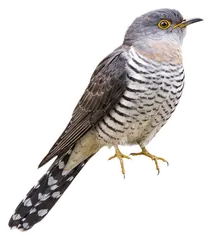 Lesser CuckooCuculus poliocephalus
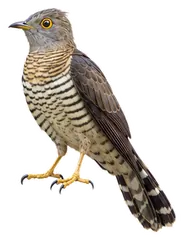 Sulawesi CuckooCuculus crassirostris
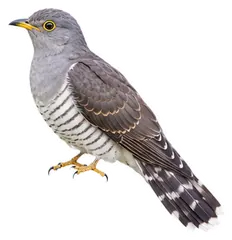 Indian CuckooCuculus micropterus
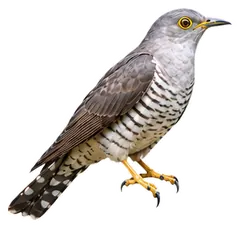 Madagascar CuckooCuculus rochii
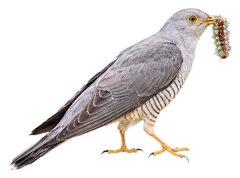 African CuckooCuculus gularis
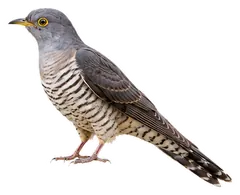 Himalayan CuckooCuculus saturatus
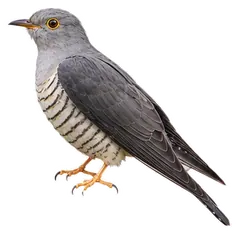 Oriental CuckooCuculus optatus
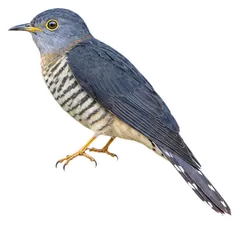 Sunda CuckooCuculus lepidus
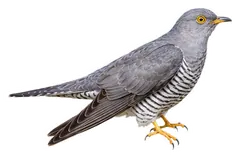
Download illustration
Free to use with credit: “Illustration: Bird Album (birdalbum.com)”. Drawn by AI from a reference photo by Andy Morffew. ↗

Heard it but can't see it? Mingji identifies birds by sound and photo, on your phone.