 Bird Album
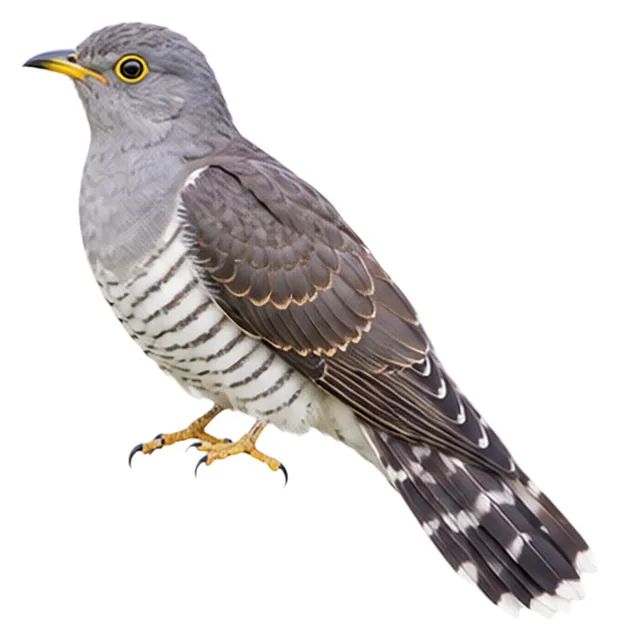
Indian Cuckoo
Cuculus micropterus Gould, 1838
≈32 cmLength89 gWeight
It has a gray back, broad black barring on the belly and a loud, four-note call.
Busiest months: May · Most records: China, India, Malaysia
How to identify
Field marks
- Upperparts gray
- Broad black barring on the belly
- Tail barred, with a broad dark band near the end and a white tip
- Eye-ring gray to yellow; iris pale rufous to red
Male, female and young
The female has a paler gray throat, more rufous breast and tail, and narrower barring on the belly; juveniles are more rufous, with broad white tips to the head and wing feathers.
Voice
Four loud notes, heard in Chinese as phrases meaning “a bachelor's life is hard”, “quick, quick, cut the wheat” and “peas and maize”, among others.
Where and when it's recorded
Busiest months: May · Most records: China, India, Malaysia

Indian Cuckoo has been recorded at 1,124 of the 8,276 birding hotspots we track, in 21 countries and regions.
Records by month Northern Hemisphere
Where it's recorded most
- Kanha NP – Mukki ZoneIndia1,749 records
- Kanha Tiger Reserve – Mukki GateIndia817 records
- Sepilok – Rainforest Discovery CenterMalaysia647 records
More places
- Mai Po Nature ReserveHong Kong (China)611 records
- Kanha NP – Kanha ZoneIndia419 records
- KalatangIndia398 records
- Wildlife Institute of IndiaIndia336 records
- Po ToiHong Kong (China)328 records
- Danum Valley Field CentreMalaysia310 records
- Gunung Panti Recreational Forest – Panti Bird Sanctuary and North AreaMalaysia308 records
Countries and regions with the most records
eBird records via GBIF up to 2024-12-31. A record means someone listed it; more records partly mean more birders, not more birds.
About
The Indian cuckoo or short-winged cuckoo (Cuculus micropterus) is a member of the cuckoo order of birds, the Cuculiformes, that is found in the Indian subcontinent and Southeast Asia. It ranges from India, Bangladesh, Bhutan, Nepal and Sri Lanka east to Indonesia and north to China and Russia. It is a solitary and shy bird, found in forests and open woodland at up to 3,600 m (11,800 ft).
Excerpt from Wikipedia, CC BY-SA 4.0 · authors · Read more on Wikipedia
Questions
How big is the Indian Cuckoo?
The Indian Cuckoo is about ≈32 cm long and weighs around 89 g.
Where does the Indian Cuckoo live?
Its breeding range: Oriental, Palearctic: widespread India through southeastern, Northeast Asia to Greater Sundas. It is most often recorded in China, India and Malaysia.
When is the best time to see the Indian Cuckoo?
At the hotspots we track, it is recorded most in May (Northern Hemisphere).
Is the Indian Cuckoo endangered?
The IUCN Red List classifies the Indian Cuckoo as Least Concern.
What does the Indian Cuckoo eat?
Main food: Insects & other invertebrates.
What family is the Indian Cuckoo in?
It belongs to the family Cuckoos (Cuculidae), order Cuculiformes.
At a glance
- Length
- ≈32 cm
- Weight
- 89 g
- Habitat
- Forest
- Diet
- Insects & other invertebrates
- Lifestyle
- Perches in trees
- Migration
- Resident (barely migrates)
- Conservation
- Least Concern
More measurements
- Wing
- 196 mm
- Tail
- 146 mm
- Bill
- 30 mm
- Tarsus
- 20 mm
Averages from the AVONET dataset; length from field guides where available.
Range
Oriental, Palearctic: widespread India through southeastern, Northeast Asia to Greater Sundas
Breeding range, IOC World Bird List 15.2
Subspecies · 1
- Cuculus micropterus micropterus India to se Siberia, ne China, se Asia and nw, ec, s Philippines | non-breeding: to Philippines and Greater Sundas
Classification
- Order
- Cuculiformes
- Family
- Cuckoos Cuculidae
- Genus
- Cuculus
Other birds in the genus Cuculus
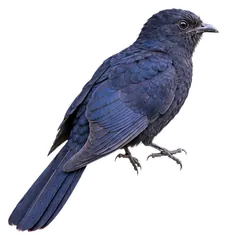 Black CuckooCuculus clamosus
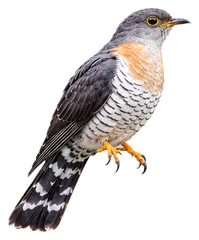 Red-chested CuckooCuculus solitarius
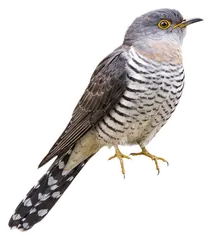 Lesser CuckooCuculus poliocephalus
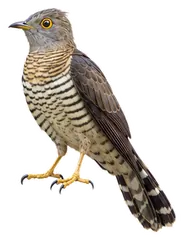 Sulawesi CuckooCuculus crassirostris
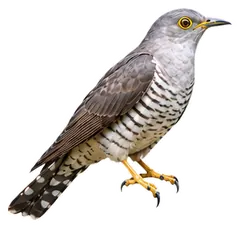 Madagascar CuckooCuculus rochii
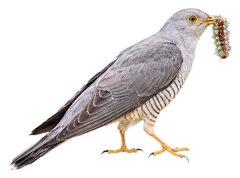 African CuckooCuculus gularis
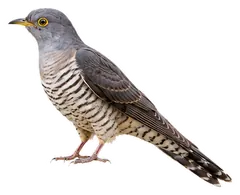 Himalayan CuckooCuculus saturatus
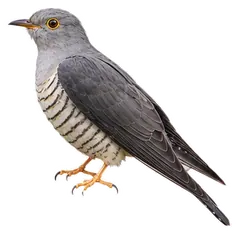 Oriental CuckooCuculus optatus
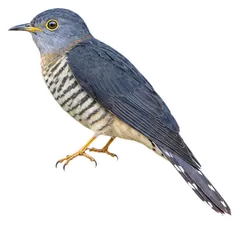 Sunda CuckooCuculus lepidus
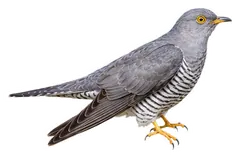 Common CuckooCuculus canorus
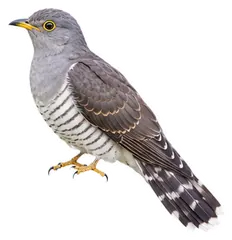
Download illustration
Free to use with credit: “Illustration: Bird Album (birdalbum.com)”. Drawn by AI from a reference photo by Creepanta. ↗

Heard it but can't see it? Mingji identifies birds by sound and photo, on your phone.