 Bird Album
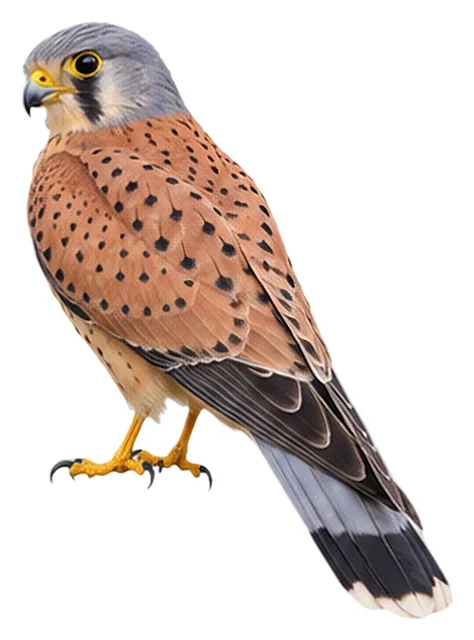
Common Kestrel
Falco tinnunculus Linnaeus, 1758
32–39 cmLength73 cmWingspan183 gWeight
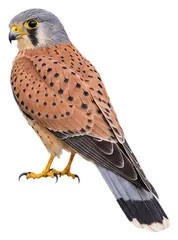
Pale chestnut with black spots on the back, it often hovers 10–20 m above the ground while searching for prey.
Busiest months: September–October · Most records: United Kingdom, Spain, Portugal
Looks like Lesser Kestrel
How to identify
Field marks
- A single prominent black cheek stripe
- Pale chestnut, with black spots on the back
- Underparts pale brown, with fine black streaks
- Cere, legs and feet and the ring around the eye bright yellow
Male, female and young
The male has a blue-gray crown and tail and fewer black spots; the female is larger and has a rufous tail with black barring; juveniles resemble the female.
Similar species
Where and when it's recorded

Common Kestrel has been recorded at 3,522 of the 8,171 birding hotspots we track, in 132 countries and regions.
Records by month Northern Hemisphere
Where it's recorded most
- Desembocadura del Guadalhorce – ÁreaSpain4,325 records
- Lezíria Grande de Vila Franca de Xira – área geralPortugal4,240 records
- Beddington FarmlandsUnited Kingdom3,738 records
More places
- Titchwell Marsh RSPB ReserveUnited Kingdom3,530 records
- Private estate near Green MubazzarahUnited Arab Emirates3,323 records
- LindusSpain3,232 records
- El Oso – Laguna y entornoSpain3,196 records
- Amwell HMWT NRUnited Kingdom3,151 records
- Spurn Bird Observatory Recording AreaUnited Kingdom2,843 records
- PN Sudoeste Alentejano e Costa Vicentina – CabranosaPortugal2,747 records
Countries and regions with the most records
eBird records via GBIF up to 2024-12-31. A record means someone listed it; more records partly mean more birders, not more birds.
About
The common kestrel (Falco tinnunculus), also known as the European kestrel, Eurasian kestrel, Old World kestrel, is a species of predatory bird belonging to the kestrel group of the falcon family Falconidae. In the United Kingdom, where no other kestrel species commonly occurs, it is generally just called the "kestrel".
Excerpt from Wikipedia, CC BY-SA 4.0 · authors · Read more on Wikipedia
Questions
How big is the Common Kestrel?
The Common Kestrel is about 32–39 cm long, with a wingspan of 73 cm and weighs around 183 g.
Where does the Common Kestrel live?
Its breeding range: Palearctic, Africa: widespread. It is most often recorded in United Kingdom, Spain and Portugal.
When is the best time to see the Common Kestrel?
At the hotspots we track, it is recorded most in September and October (Northern Hemisphere).
Is the Common Kestrel endangered?
The IUCN Red List classifies the Common Kestrel as Least Concern.
What does the Common Kestrel eat?
Main food: Vertebrate prey.
What family is the Common Kestrel in?
It belongs to the family Caracaras, Falcons (Falconidae), order Falconiformes.
At a glance
- Length
- 32–39 cm
- Wingspan
- 73 cm
- Weight
- 183 g
- Habitat
- Shrubland
- Diet
- Vertebrate prey
- Lifestyle
- Feeds in the air
- Migration
- Migratory
- Conservation
- Least Concern
More measurements
- Wing
- 242 mm
- Tail
- 158 mm
- Bill
- 21 mm
- Tarsus
- 38 mm
Averages from the AVONET dataset; length from field guides where available.
Range
Palearctic, Africa: widespread
Breeding range, IOC World Bird List 15.2
Subspecies · 1
- Falco tinnunculus perpallidus ne Siberia to ne China and Korean Pen. | non-breeding: e, se Asia
Classification
- Order
- Falconiformes
- Family
- Caracaras, Falcons Falconidae
- Genus
- Falco
Other birds in the genus Falco
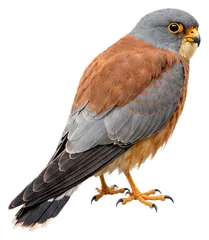 Lesser KestrelFalco naumanni
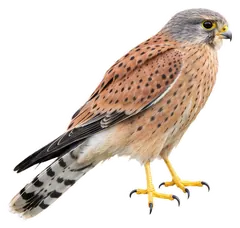 Rock KestrelFalco rupicolus
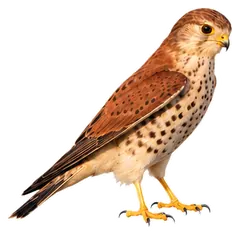 Malagasy KestrelFalco newtoni
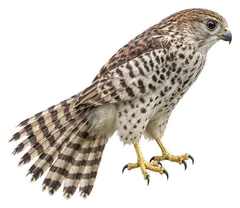 Mauritius KestrelFalco punctatus
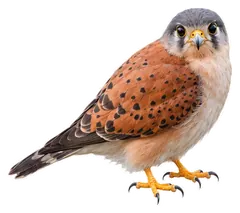 Seychelles KestrelFalco araeus
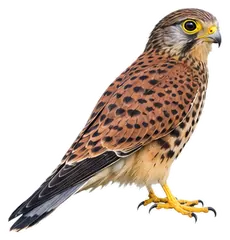 Spotted KestrelFalco moluccensis
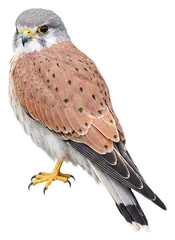 Nankeen KestrelFalco cenchroides
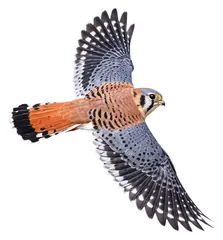 American KestrelFalco sparverius
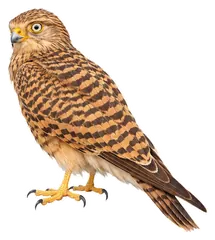 Greater KestrelFalco rupicoloides
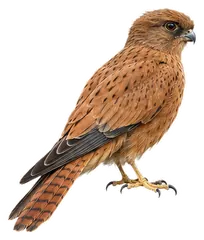 Fox KestrelFalco alopex
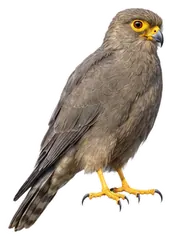 Grey KestrelFalco ardosiaceus
 Dickinson's KestrelFalco dickinsoni
Download illustration
Free to use with credit: “Illustration: Bird Album (birdalbum.com)”. Drawn by AI from a reference photo by Andreas Trepte. ↗

Heard it but can't see it? Mingji identifies birds by sound and photo, on your phone.