 Bird Album
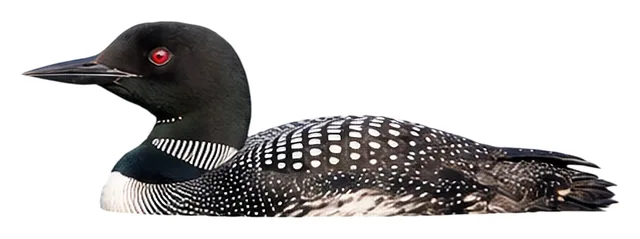
Common Loon
Gavia immer (Brünnich, 1764)
5 kgWeight
The common loon or great northern diver (Gavia immer) is a large member of the loon, or diver, family of birds.
Busiest months: April–May · Most records: United States, Canada, Spain
Where and when it's recorded

Common Loon has been recorded at 999 of the 8,171 birding hotspots we track, in 36 countries and regions.
Records by month Northern Hemisphere
Where it's recorded most
- Parker River NWRUnited States11,356 records
- Whitefish PointUnited States8,372 records
- Ocean City InletUnited States8,176 records
More places
- Barnegat Lighthouse SPUnited States6,944 records
- Hammonasset Beach SPUnited States6,782 records
- Point Pelee National ParkCanada5,924 records
- Pt. Pinos – seawatch onlyUnited States5,860 records
- North Vancouver – Maplewood Flats Conservation AreaCanada5,770 records
- Sandy HookUnited States5,577 records
- Pillar Point HarborUnited States5,327 records
Countries and regions with the most records
eBird records via GBIF up to 2024-12-31. A record means someone listed it; more records partly mean more birders, not more birds.
About
The common loon or great northern diver (Gavia immer) is a large member of the loon, or diver, family of birds. Breeding adults have a plumage that includes a broad black head and neck with a greenish, purplish, or bluish sheen, blackish or blackish-grey upperparts, and pure white underparts except some black on the undertail coverts and vent. Non-breeding adults are brownish with a dark neck and head marked with dark grey-brown.
Excerpt from Wikipedia, CC BY-SA 4.0 · authors · Read more on Wikipedia
Questions
How big is the Common Loon?
The Common Loon weighs around 5 kg.
Where does the Common Loon live?
Its breeding range: North America, Palearctic: western, southeastern Greenland, Iceland; subarctic to temperate northern North America: western Alaska mainland to northern tier of contiguous USA, across subarctic Canada to southern Baffin Island and New England. It is most often recorded in United States, Canada and Spain.
When is the best time to see the Common Loon?
At the hotspots we track, it is recorded most in April and May (Northern Hemisphere).
Is the Common Loon endangered?
The IUCN Red List classifies the Common Loon as Least Concern.
What does the Common Loon eat?
Main food: Fish, shrimp & shellfish.
What family is the Common Loon in?
It belongs to the family Loons (Gaviidae), order Gaviiformes.
At a glance
- Weight
- 5 kg
- Habitat
- Wetland
- Diet
- Fish, shrimp & shellfish
- Lifestyle
- On the water surface
- Migration
- Migratory
- Conservation
- Least Concern
More measurements
- Wing
- 365 mm
- Tail
- 59 mm
- Bill
- 97 mm
- Tarsus
- 86 mm
Averages from the AVONET dataset; length from field guides where available.
Range
North America, Palearctic: western, southeastern Greenland, Iceland; subarctic to temperate northern North America: western Alaska mainland to northern tier of contiguous USA, across subarctic Canada to southern Baffin Island and New England
Breeding range, IOC World Bird List 15.2
Classification
- Order
- Gaviiformes
- Family
- Loons Gaviidae
- Genus
- Gavia
Other birds in the genus Gavia
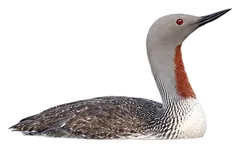 Red-throated LoonGavia stellata
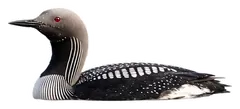 Black-throated LoonGavia arctica
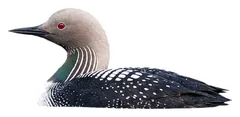 Pacific LoonGavia pacifica
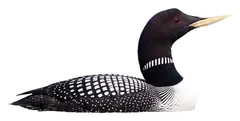 Yellow-billed LoonGavia adamsii
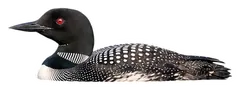
Download illustration
Free to use with credit: “Illustration: Bird Album (birdalbum.com)”. Drawn by AI from a reference photo by Titouan Roguet. ↗
Heard it but can't see it? Mingji identifies birds by sound and photo, on your phone.