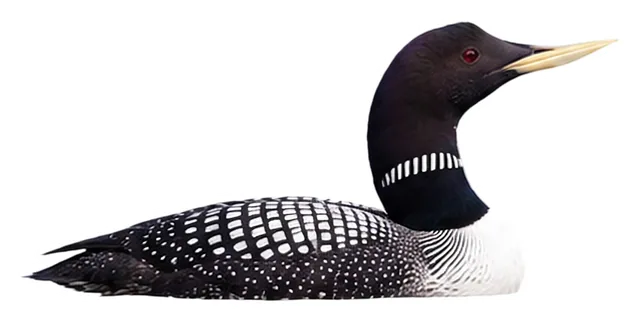
Yellow-billed Loon
Gavia adamsii (Gray, GR, 1859)
77–100 cmLength145 cmWingspan4.9 kgWeight
The largest loon, it has an ivory-colored, upturned bill.
Busiest months: May–June · Most records: United States, Norway, Canada
How to identify
Field marks
- Bill ivory-colored and upturned, with a pale midline on the upper mandible
- White collar
- Iris red; legs and feet black
Voice
Calls sound like both crying and laughter; silent at sea, it gives falsetto shrieks on the breeding grounds.
Where and when it's recorded
Busiest months: May–June · Most records: United States, Norway, Canada

Yellow-billed Loon has been recorded at 113 of the 8,276 birding hotspots we track, in 20 countries and regions.
Records by month Northern Hemisphere
Where it's recorded most
- GambellUnited States2,007 records
- St. Paul IslandUnited States723 records
- Lista FyrNorway188 records
More places
- Cherry Creek SPUnited States111 records
- HamningbergNorway103 records
- Vardø – uspesifisertNorway96 records
- Southeast Farallon IslandUnited States89 records
- Bodega Bay – harbor and immediate vicinityUnited States80 records
- Blackie SpitCanada71 records
- Point No PointUnited States42 records
Countries and regions with the most records
eBird records via GBIF up to 2024-12-31. A record means someone listed it; more records partly mean more birders, not more birds.
About
The yellow-billed loon (Gavia adamsii), also known as the white-billed diver, is the largest member of the loon or diver family. Breeding adults have a black head, white underparts and a chequered black-and-white mantle. Non-breeding plumage is drabber with the chin and foreneck white.
Excerpt from Wikipedia, CC BY-SA 4.0 · authors · Read more on Wikipedia
Questions
How big is the Yellow-billed Loon?
The Yellow-billed Loon is about 77–100 cm long, with a wingspan of 145 cm and weighs around 4.9 kg.
Where does the Yellow-billed Loon live?
Its breeding range: North America, Palearctic: Arctic northwestern Russia from Novaya Zemlya to Chukotka Peninsula; northwestern, northern Alaska and northern Canada to Nunavut (east-central Canada). It is most often recorded in United States, Norway and Canada.
When is the best time to see the Yellow-billed Loon?
At the hotspots we track, it is recorded most in May and June (Northern Hemisphere).
Is the Yellow-billed Loon endangered?
The IUCN Red List classifies the Yellow-billed Loon as Near Threatened.
What does the Yellow-billed Loon eat?
Main food: Fish, shrimp & shellfish.
What family is the Yellow-billed Loon in?
It belongs to the family Loons (Gaviidae), order Gaviiformes.
At a glance
- Length
- 77–100 cm
- Wingspan
- 145 cm
- Weight
- 4.9 kg
- Habitat
- Wetland
- Diet
- Fish, shrimp & shellfish
- Lifestyle
- On the water surface
- Migration
- Migratory
- Conservation
- Near Threatened
More measurements
- Wing
- 371 mm
- Tail
- 61 mm
- Bill
- 105 mm
- Tarsus
- 85 mm
Averages from the AVONET dataset; length from field guides where available.
Range
North America, Palearctic: Arctic northwestern Russia from Novaya Zemlya to Chukotka Peninsula; northwestern, northern Alaska and northern Canada to Nunavut (east-central Canada)
Breeding range, IOC World Bird List 15.2
Classification
- Order
- Gaviiformes
- Family
- Loons Gaviidae
- Genus
- Gavia
Other birds in the genus Gavia
 Red-throated LoonGavia stellata
 Black-throated LoonGavia arctica
 Pacific LoonGavia pacifica
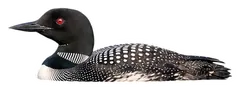 Common LoonGavia immer
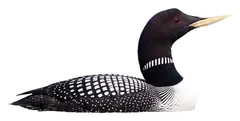
Download illustration
Free to use with credit: “Illustration: Bird Album (birdalbum.com)”. Drawn by AI from a reference photo by Jessie Aguilar. ↗
Heard it but can't see it? Mingji identifies birds by sound and photo, on your phone.
In other languages
- EnglishYellow-billed Loon
- 简体中文黄嘴潜鸟
- 繁體中文白嘴潛鳥
- 日本語ハシジロアビ
- 한국어흰부리아비
- DeutschGelbschnabeltaucher
- FrançaisPlongeon à bec blanc
- EspañolColimbo de Adams
- Portuguêsmobelha-de-bico-amarelo
- ItalianoStrolaga beccogiallo
- NederlandsGeelsnavelduiker
- РусскийБелоклювая гагара
- Svenskavitnäbbad islom
- DanskHvidnæbbet Lom
- Polskinur białodzioby