 Bird Album
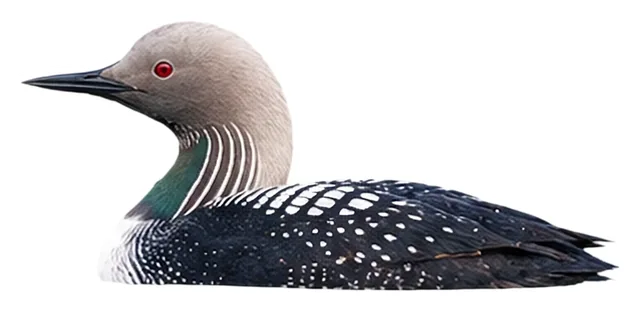
Pacific Loon
Gavia pacifica (Lawrence, 1858)
58–74 cmLength110–128 cmWingspan2.3 kgWeight
In breeding plumage, it has a gray head, black throat and a back patterned like a black-and-white chessboard.
Busiest months: November · Most records: United States, Canada, Mexico
How to identify
Field marks
- Head gray and throat black in breeding plumage
- Back black-and-white checkered and underparts white in breeding plumage
- No white patches on the flanks
- Chin and front of neck white in non-breeding plumage
Male, female and young
Immature has dark gray-brown upperparts, with a little white on the feather edges.
Voice
Gives a short shriek while hunting; also gives loud wails in the breeding season.
Where and when it's recorded
Busiest months: November · Most records: United States, Canada, Mexico

Pacific Loon has been recorded at 248 of the 8,276 birding hotspots we track, in 11 countries and regions.
Records by month Northern Hemisphere
Where it's recorded most
- Pt. Pinos – seawatch onlyUnited States13,393 records
- Southeast Farallon IslandUnited States6,451 records
- GambellUnited States3,421 records
More places
- Point No PointUnited States3,338 records
- Pt. Reyes – Fish DocksUnited States2,008 records
- Gardiner BeachUnited States1,910 records
- Teslin Lake – Teslin Lake Bird ObservatoryCanada1,577 records
- Clover PointCanada1,416 records
- Pt. PinosUnited States1,284 records
- Edmonds WaterfrontUnited States1,194 records
Countries and regions with the most records
eBird records via GBIF up to 2024-12-31. A record means someone listed it; more records partly mean more birders, not more birds.
Questions
How big is the Pacific Loon?
The Pacific Loon is about 58–74 cm long, with a wingspan of 110–128 cm and weighs around 2.3 kg.
Where does the Pacific Loon live?
Its breeding range: North America, Palearctic: high Arctic to subarctic: Yana and Indigirka rivers east to Chukotka (north-central, northeastern Siberia), Wrangel Island (north of northeastern Siberia), Alaska, west-central British Columbia, and northern Canada to Baffin Island and James Bay (northeastern, southeastern Canada). It is most often recorded in United States, Canada and Mexico.
When is the best time to see the Pacific Loon?
At the hotspots we track, it is recorded most in November (Northern Hemisphere).
Is the Pacific Loon endangered?
The IUCN Red List classifies the Pacific Loon as Least Concern.
What does the Pacific Loon eat?
Main food: Fish, shrimp & shellfish.
What family is the Pacific Loon in?
It belongs to the family Loons (Gaviidae), order Gaviiformes.
At a glance
- Length
- 58–74 cm
- Wingspan
- 110–128 cm
- Weight
- 2.3 kg
- Habitat
- Wetland
- Diet
- Fish, shrimp & shellfish
- Lifestyle
- On the water surface
- Migration
- Migratory
- Conservation
- Least Concern
More measurements
- Wing
- 291 mm
- Tail
- 48 mm
- Bill
- 72 mm
- Tarsus
- 73 mm
Averages from the AVONET dataset; length from field guides where available.
Range
North America, Palearctic: high Arctic to subarctic: Yana and Indigirka rivers east to Chukotka (north-central, northeastern Siberia), Wrangel Island (north of northeastern Siberia), Alaska, west-central British Columbia, and northern Canada to Baffin Island and James Bay (northeastern, southeastern Canada)
Breeding range, IOC World Bird List 15.2
Classification
- Order
- Gaviiformes
- Family
- Loons Gaviidae
- Genus
- Gavia
Other birds in the genus Gavia
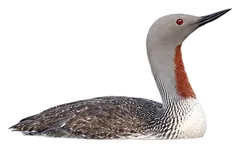 Red-throated LoonGavia stellata
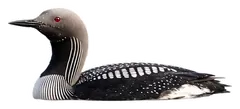 Black-throated LoonGavia arctica
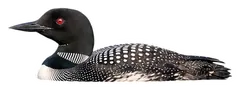 Common LoonGavia immer
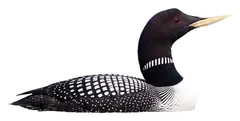 Yellow-billed LoonGavia adamsii
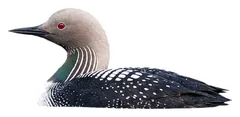
Download illustration
Free to use with credit: “Illustration: Bird Album (birdalbum.com)”. Drawn by AI from a reference photo by Declan Troy. ↗
Heard it but can't see it? Mingji identifies birds by sound and photo, on your phone.
In other languages
- EnglishPacific Loon
- 简体中文太平洋潜鸟
- 繁體中文太平洋潛鳥
- 日本語シロエリオオハム
- 한국어회색머리아비
- DeutschPazifiktaucher
- FrançaisPlongeon du Pacifique
- EspañolColimbo del Pacífico
- Portuguêsmobelha-do-pacífico
- ItalianoStrolaga del Pacifico
- NederlandsPacifische Parelduiker
- РусскийБелошейная гагара
- Svenskastillahavslom
- DanskStillehavslom
- Polskinur pacyficzny