 Bird Album
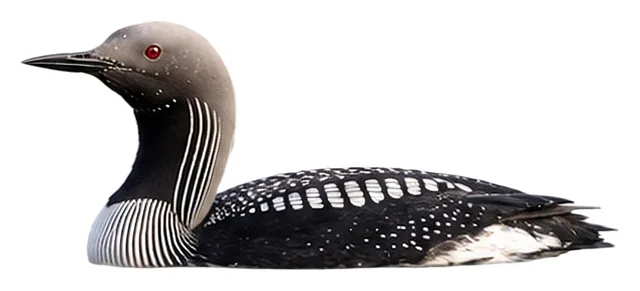
Black-throated Loon
Gavia arctica (Linnaeus, 1758)
63–75 cmLength120 cmWingspan2.3 kgWeight
In the breeding season, this loon has a gray head, black throat, white belly and white squares on the back.
Busiest months: May · Most records: United Kingdom, Sweden, United States
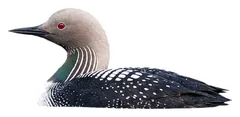
Looks like Pacific Loon
How to identify
Field marks
- Head gray, throat black and belly white in the breeding season
- Rows of white squares on the back in the breeding season
- Bill straight and gray-black
- Black throat patch is replaced by white in the non-breeding season
Male, female and young
Sexes similar; juvenile resembles an adult in non-breeding plumage, but is browner overall.
Voice
Gives a barking “kwow” in flight, and also a drawn-out wail, “áááh-oo”.
Similar species
Where and when it's recorded

Black-throated Loon has been recorded at 547 of the 8,171 birding hotspots we track, in 53 countries and regions.
Records by month Northern Hemisphere
Where it's recorded most
- GambellUnited States766 records
- Maridalen – uspesifisertNorway452 records
- Ottenby – södra uddeSweden370 records
More places
- Falsterbonäset – NabbenSweden361 records
- VN RozkošCzechia335 records
- Kirkkonummi – Porkkala PampskatanFinland309 records
- SkatuddenSweden303 records
- Grenen, SkagenDenmark296 records
- Frank G. Bonelli RP/Puddingstone Reservoir and vicinityUnited States279 records
- Jezero MostCzechia271 records
Countries and regions with the most records
eBird records via GBIF up to 2024-12-31. A record means someone listed it; more records partly mean more birders, not more birds.
About
The black-throated loon (Gavia arctica), also known as the Arctic loon and the black-throated diver, is a migratory aquatic bird found in the Northern Hemisphere, primarily breeding in freshwater lakes in northern Europe and Asia. It winters along sheltered, ice-free coasts of the north-east Atlantic Ocean and the eastern and western Pacific Ocean. This loon was first described by Carl Linnaeus in 1758 and has two subspecies.
Excerpt from Wikipedia, CC BY-SA 4.0 · authors · Read more on Wikipedia
Questions
How big is the Black-throated Loon?
The Black-throated Loon is about 63–75 cm long, with a wingspan of 120 cm and weighs around 2.3 kg.
Where does the Black-throated Loon live?
Its breeding range: Palearctic, North America: Arctic to temperate northern, central Eurasia and far western Alaska. It is most often recorded in United Kingdom, Sweden and United States.
When is the best time to see the Black-throated Loon?
At the hotspots we track, it is recorded most in May (Northern Hemisphere).
Is the Black-throated Loon endangered?
The IUCN Red List classifies the Black-throated Loon as Least Concern.
What does the Black-throated Loon eat?
Main food: Fish, shrimp & shellfish.
What family is the Black-throated Loon in?
It belongs to the family Loons (Gaviidae), order Gaviiformes.
At a glance
- Length
- 63–75 cm
- Wingspan
- 120 cm
- Weight
- 2.3 kg
- Habitat
- Wetland
- Diet
- Fish, shrimp & shellfish
- Lifestyle
- On the water surface
- Migration
- Migratory
- Conservation
- Least Concern
More measurements
- Wing
- 286 mm
- Tail
- 45 mm
- Bill
- 71 mm
- Tarsus
- 73 mm
Averages from the AVONET dataset; length from field guides where available.
Range
Palearctic, North America: Arctic to temperate northern, central Eurasia and far western Alaska
Breeding range, IOC World Bird List 15.2
Classification
- Order
- Gaviiformes
- Family
- Loons Gaviidae
- Genus
- Gavia
Other birds in the genus Gavia
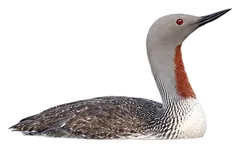 Red-throated LoonGavia stellata
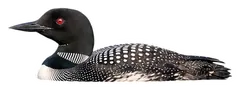 Common LoonGavia immer
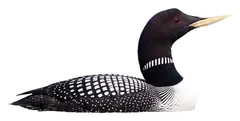 Yellow-billed LoonGavia adamsii
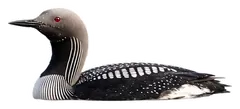
Download illustration
Free to use with credit: “Illustration: Bird Album (birdalbum.com)”. Drawn by AI from a reference photo by Андрей Деев. ↗
Heard it but can't see it? Mingji identifies birds by sound and photo, on your phone.