 Bird Album
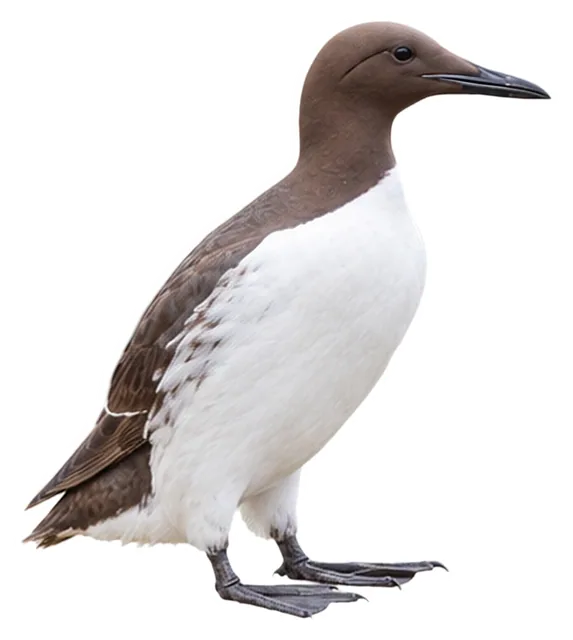
Common Murre
Uria aalge (Pontoppidan, 1763)
38–46 cmLength71 cmWingspan992 gWeight
It propels itself through the sea with its wings, as if flying underwater.
Busiest months: September–November · Most records: United States, United Kingdom, Canada
How to identify
Field marks
- Slender, dark bill with a pointed tip
- Small, rounded black tail
- Nominate subspecies has a black head, back and wings in breeding plumage
- After the post-breeding molt, face white with a dark stripe behind the eye
Male, female and young
Sexes are difficult to distinguish in the field; first-winter juveniles have the same plumage as adults in winter plumage.
Voice
Adults mainly give a growling “murrrr”; juveniles give shrill whistles when begging for food.
Where and when it's recorded

Common Murre has been recorded at 364 of the 8,276 birding hotspots we track, in 31 countries and regions.
Records by month Northern Hemisphere
Where it's recorded most
- Southeast Farallon IslandUnited States15,974 records
- Pt. Pinos – seawatch onlyUnited States14,448 records
- St. Paul IslandUnited States4,374 records
More places
- Rocky Point Bird ObservatoryCanada3,991 records
- GambellUnited States3,676 records
- Rodeo LagoonUnited States3,399 records
- Bempton Cliffs RSPB ReserveUnited Kingdom3,192 records
- Point No PointUnited States3,087 records
- Pillar Point HarborUnited States2,928 records
- Clover PointCanada1,983 records
Countries and regions with the most records
eBird records via GBIF up to 2024-12-31. A record means someone listed it; more records partly mean more birders, not more birds.
About
The common murre or common guillemot (Uria aalge) is a large auk, one of several species called murre or guillemot. It has a circumpolar distribution, occurring in low-Arctic and boreal waters in the North Atlantic and North Pacific. It spends most of its time at sea, only coming to land to breed on rocky cliff shores or islands.
Excerpt from Wikipedia, CC BY-SA 4.0 · authors · Read more on Wikipedia
Questions
How big is the Common Murre?
The Common Murre is about 38–46 cm long, with a wingspan of 71 cm and weighs around 992 g.
Where does the Common Murre live?
Its breeding range: North America, Palearctic: subarctic to temperate (locally Arctic) northern coasts. It is most often recorded in United States, United Kingdom and Canada.
When is the best time to see the Common Murre?
At the hotspots we track, it is recorded most in September, October and November (Northern Hemisphere).
Is the Common Murre endangered?
The IUCN Red List classifies the Common Murre as Least Concern.
What does the Common Murre eat?
Main food: Fish, shrimp & shellfish.
What family is the Common Murre in?
It belongs to the family Auks (Alcidae), order Charadriiformes.
At a glance
- Length
- 38–46 cm
- Wingspan
- 71 cm
- Weight
- 992 g
- Habitat
- Ocean
- Diet
- Fish, shrimp & shellfish
- Lifestyle
- On the water surface
- Migration
- Migratory
- Conservation
- Least Concern
More measurements
- Wing
- 196 mm
- Tail
- 50 mm
- Bill
- 57 mm
- Tarsus
- 36 mm
Averages from the AVONET dataset; length from field guides where available.
Range
North America, Palearctic: subarctic to temperate (locally Arctic) northern coasts
Breeding range, IOC World Bird List 15.2
Classification
- Order
- Charadriiformes
- Family
- Auks Alcidae
- Genus
- Uria
Other birds in the genus Uria
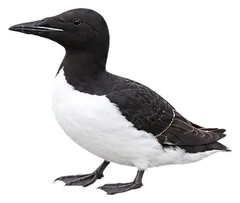 Thick-billed MurreUria lomvia
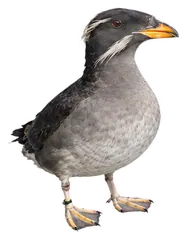 Rhinoceros AukletCerorhinca monocerata
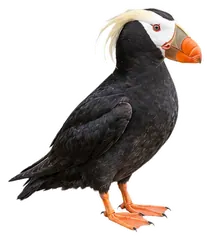 Tufted PuffinFratercula cirrhata
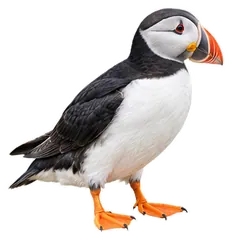 Atlantic PuffinFratercula arctica
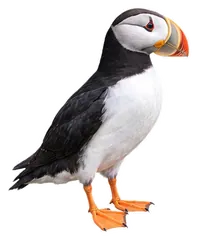 Horned PuffinFratercula corniculata
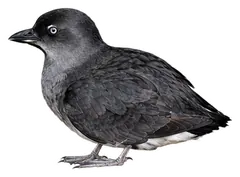 Cassin's AukletPtychoramphus aleuticus
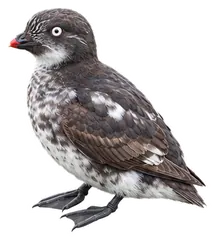 Least AukletAethia pusilla
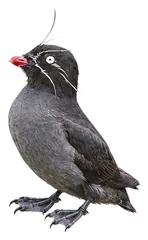 Whiskered AukletAethia pygmaea
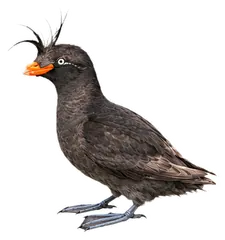 Crested AukletAethia cristatella
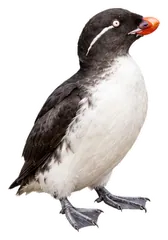 Parakeet AukletAethia psittacula
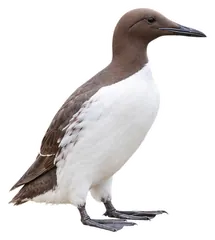
Download illustration
Free to use with credit: “Illustration: Bird Album (birdalbum.com)”. Drawn by AI from a reference photo by Thorbjørn Brunander Sund. ↗
Heard it but can't see it? Mingji identifies birds by sound and photo, on your phone.