 Bird Album
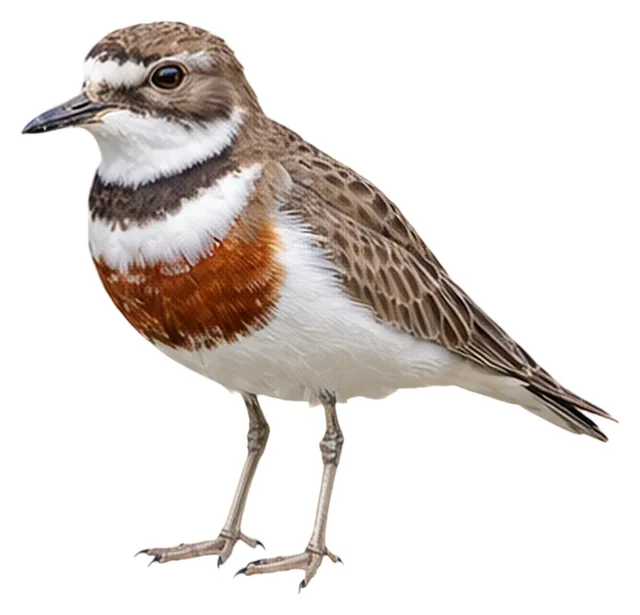
Double-banded Plover
Anarhynchus bicinctus (Jardine & Selby, 1827)
Busiest months: January–March · Most records: New Zealand, Australia, Norfolk Island
Where and when it's recorded

Double-banded Plover has been recorded at 124 of the 8,171 birding hotspots we track, in 4 countries and regions.
Records by month Southern Hemisphere
Where it's recorded most
- Western Treatment PlantAustralia1,077 records
- Ashley Estuary south endNew Zealand813 records
- Ashley River EstuaryNew Zealand736 records
More places
- Stockyard PointAustralia590 records
- Miranda – main hide/LimeworksNew Zealand586 records
- Lake Ellesmere (Te Waihora) – Embankment RoadNew Zealand490 records
- Miranda Shorebird CentreNew Zealand440 records
- Foxton Beach – Manawatu estuaryNew Zealand421 records
- Long Reef Aquatic ReserveAustralia402 records
- Shoalhaven Heads InletAustralia396 records
Countries and regions with the most records
eBird records via GBIF up to 2024-12-31. A record means someone listed it; more records partly mean more birders, not more birds.
Questions
Where does the Double-banded Plover live?
Its breeding range: Australasia: North, South, Stewart, Chatham (east of South Island) and Auckland islands (south of South Island; New Zealand). It is most often recorded in New Zealand, Australia and Norfolk Island.
When is the best time to see the Double-banded Plover?
At the hotspots we track, it is recorded most in January, February and March (Southern Hemisphere).
Is the Double-banded Plover endangered?
The IUCN Red List classifies the Double-banded Plover as Near Threatened.
What family is the Double-banded Plover in?
It belongs to the family Plovers (Charadriidae), order Charadriiformes.
At a glance
- Conservation
- Near Threatened
Range
Australasia: North, South, Stewart, Chatham (east of South Island) and Auckland islands (south of South Island; New Zealand)
Breeding range, IOC World Bird List 15.2
Classification
- Order
- Charadriiformes
- Family
- Plovers Charadriidae
- Genus
- Anarhynchus
Other birds in the genus Anarhynchus
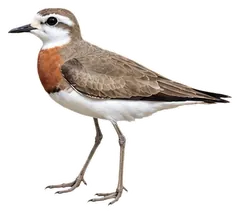 Caspian PloverAnarhynchus asiaticus
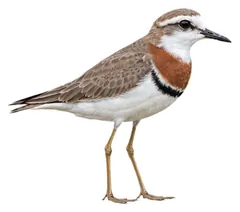 Oriental PloverAnarhynchus veredus
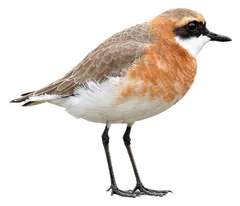 Tibetan Sand PloverAnarhynchus atrifrons
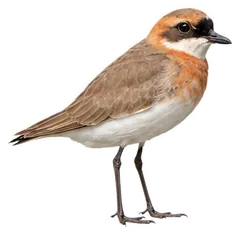 Siberian Sand PloverAnarhynchus mongolus
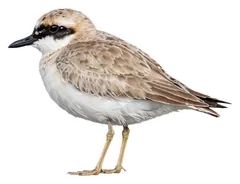 Greater Sand PloverAnarhynchus leschenaultii
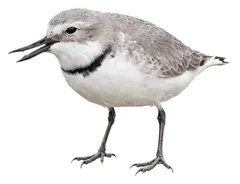 WrybillAnarhynchus frontalis
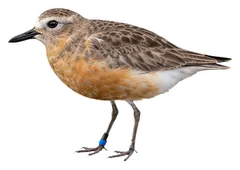 New Zealand PloverAnarhynchus obscurus
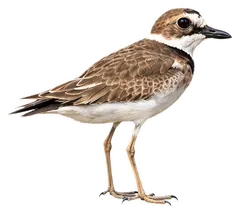 Wilson's PloverAnarhynchus wilsonia
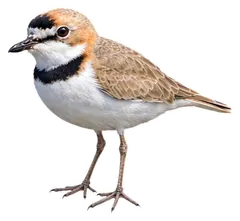 Collared PloverAnarhynchus collaris
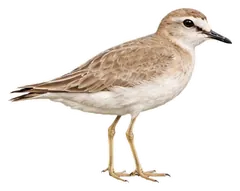 Mountain PloverAnarhynchus montanus
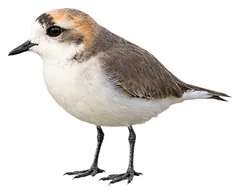 Puna PloverAnarhynchus alticola
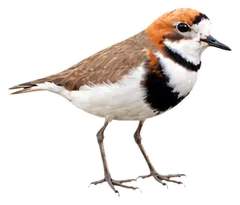 Two-banded PloverAnarhynchus falklandicus
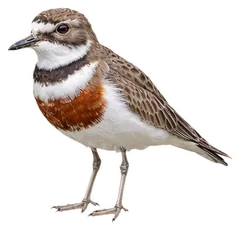
Download illustration
Free to use with credit: “Illustration: Bird Album (birdalbum.com)”. Drawn by AI from a reference photo by Samuel Amaris. ↗
Heard it but can't see it? Mingji identifies birds by sound and photo, on your phone.
In other languages
- EnglishDouble-banded Plover
- 简体中文栗胸鸻
- 繁體中文栗斑鴴
- 日本語チャオビチドリ
- DeutschDoppelband-Regenpfeifer
- FrançaisPluvier à double collier
- EspañolChorlitejo bicinchado
- Portuguêsborrelho-de-cinta-ruiva
- ItalianoCorriere doppiabanda
- NederlandsDubbelbandplevier
- РусскийДвухполосый зуёк
- Svenskatvåbandad strandpipare
- DanskDobbeltbåndet Præstekrave
- Polskisieweczka ozdobna