 Bird Album
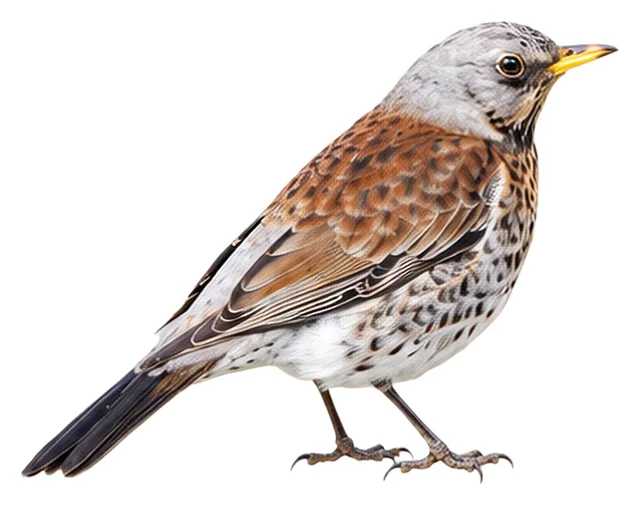
Fieldfare
Turdus pilaris Linnaeus, 1758
25 cmLength42 cmWingspan106 gWeight
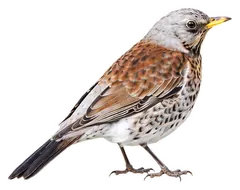
It is a thrush with a gray head and rump, large bold spots on the breast, and a body length of about 25 cm.
Busiest months: January and October–November · Most records: United Kingdom, Germany, Czechia
How to identify
Field marks
- Slate-gray head, nape and rump
- Dark brown back; blackish tail
- Large, conspicuous spots on the breast
- White underwing conspicuous in flight
Male, female and young
The female has slightly browner upperparts and fewer, smaller markings on the throat and breast; juveniles are duller than adults.
Voice
Usually gives a harsh “tsak tsak tsuk” in flight.
Where and when it's recorded

Fieldfare has been recorded at 1,056 of the 8,171 birding hotspots we track, in 68 countries and regions.
Records by month Northern Hemisphere
Where it's recorded most
- VN RozkošCzechia939 records
- Spurn Bird Observatory Recording AreaUnited Kingdom847 records
- Elton ReservoirUnited Kingdom819 records
More places
- Rutland WaterUnited Kingdom795 records
- Canons FarmUnited Kingdom785 records
- Brent ReservoirUnited Kingdom702 records
- Wanstead FlatsUnited Kingdom672 records
- ØstensjøvannetNorway659 records
- Lotoshino Fish FarmRussia620 records
- Amwell HMWT NRUnited Kingdom611 records
Countries and regions with the most records
eBird records via GBIF up to 2024-12-31. A record means someone listed it; more records partly mean more birders, not more birds.
About
The fieldfare (Turdus pilaris) is a member of the thrush family Turdidae. It breeds in woodland and scrub in northern Europe and across the Palearctic. It is strongly migratory, with many northern birds moving south during the winter.
Excerpt from Wikipedia, CC BY-SA 4.0 · authors · Read more on Wikipedia
Questions
How big is the Fieldfare?
The Fieldfare is about 25 cm long, with a wingspan of 42 cm and weighs around 106 g.
Where does the Fieldfare live?
Its breeding range: Palearctic: western Europe through eastern Russia. It is most often recorded in United Kingdom, Germany and Czechia.
When is the best time to see the Fieldfare?
At the hotspots we track, it is recorded most in January, October and November (Northern Hemisphere).
Is the Fieldfare endangered?
The IUCN Red List classifies the Fieldfare as Least Concern.
What does the Fieldfare eat?
Main food: Insects & other invertebrates.
What family is the Fieldfare in?
It belongs to the family Thrushes (Turdidae), order Passerines (Passeriformes).
At a glance
- Length
- 25 cm
- Wingspan
- 42 cm
- Weight
- 106 g
- Habitat
- Forest
- Diet
- Insects & other invertebrates
- Lifestyle
- Varied
- Migration
- Migratory
- Conservation
- Least Concern
More measurements
- Wing
- 144 mm
- Tail
- 106 mm
- Bill
- 25 mm
- Tarsus
- 33 mm
Averages from the AVONET dataset; length from field guides where available.
Range
Palearctic: western Europe through eastern Russia
Breeding range, IOC World Bird List 15.2
Classification
- Order
- Passerines Passeriformes
- Family
- Thrushes Turdidae
- Genus
- Turdus
Other birds in the genus Turdus
 Ethiopian ThrushTurdus simensis
 Groundscraper ThrushTurdus litsitsirupa
 Chinese ThrushTurdus mupinensis
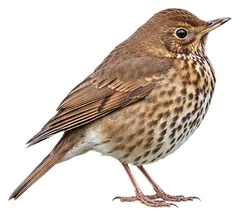 Song ThrushTurdus philomelos
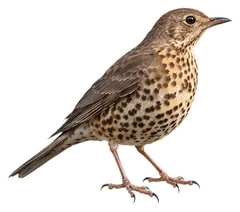 Mistle ThrushTurdus viscivorus
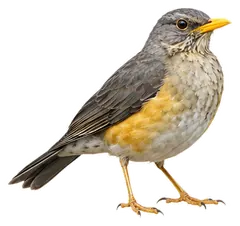 African ThrushTurdus pelios
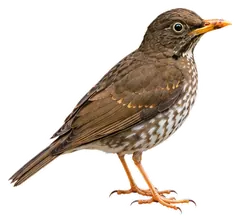 Principe ThrushTurdus xanthorhynchus
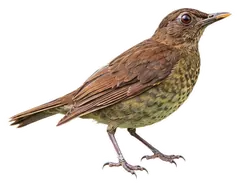 Sao Tome ThrushTurdus olivaceofuscus
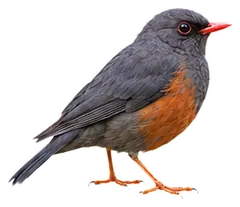 Abyssinian ThrushTurdus abyssinicus
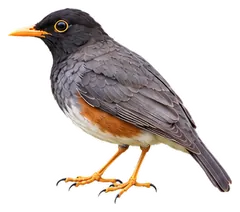 Taita ThrushTurdus helleri
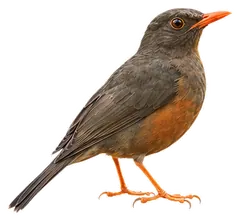 Usambara ThrushTurdus roehli
 Olive ThrushTurdus olivaceus
Download illustration
Free to use with credit: “Illustration: Bird Album (birdalbum.com)”. Drawn by AI from a reference photo by František Bednár. ↗
Heard it but can't see it? Mingji identifies birds by sound and photo, on your phone.