 Bird Album
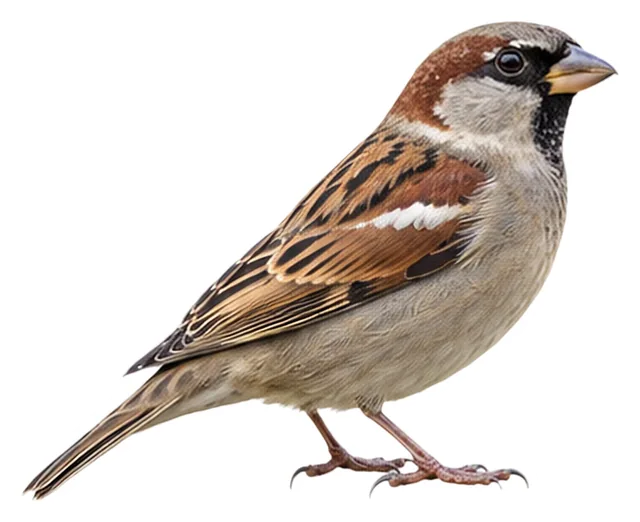
House Sparrow
Passer domesticus (Linnaeus, 1758)
16 cmLength23–24 cmWingspan26 gWeight
This sparrow lives alongside people, and the male has a gray head and black throat and breast.
Busiest months: May · Most records: United States, Canada, Spain
Looks like Eurasian Tree Sparrow, Spanish Sparrow
How to identify
Field marks
- Male's crown gray with chestnut-brown sides
- Male's throat and upper breast black
- Male also black between eye and bill
- Male's bill black in breeding season
Male, female and young
The female has no black patches on the head or throat, and the head is not gray; juveniles resemble the female but have darker brown underparts and a yellowish bill.
Voice
Mostly short, frequent twitters, transcribed as “chirrup”, “tschilp” or “philip”.
Similar species
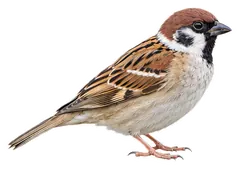
Eurasian Tree Sparrow is slightly smaller, with a chestnut rather than gray head, two white feather markings on the wings and one black patch on each cheek; sexes are almost alike.
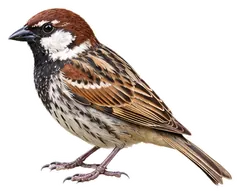
Male Spanish Sparrow is distinguished by its chestnut crown; male House Sparrow has a gray crown. Females are almost impossible to separate.
Where and when it's recorded
Busiest months: May · Most records: United States, Canada, Spain

House Sparrow has been recorded at 4,712 of the 8,276 birding hotspots we track, in 191 countries and regions.
Records by month Northern Hemisphere
Where it's recorded most
- Montrose Point Bird Sanctuary, Lincoln Park, ChicagoUnited States39,816 records
- Central ParkUnited States38,410 records
- Prospect ParkUnited States36,654 records
More places
- Riparian Preserve at Gilbert Water RanchUnited States22,222 records
- Estero Llano Grande SP WBCUnited States21,395 records
- Central Park – The RambleUnited States18,163 records
- Reifel Bird SanctuaryCanada17,402 records
- Toronto – Colonel Samuel Smith ParkCanada13,209 records
- Horn Pond Recreation AreaUnited States12,242 records
- Toronto – High ParkCanada12,014 records
Countries and regions with the most records
eBird records via GBIF up to 2024-12-31. A record means someone listed it; more records partly mean more birders, not more birds.
About
The house sparrow (Passer domesticus) is a bird of the sparrow family Passeridae, found in most parts of the world. It is a small bird that has a typical length of 16 cm (6.3 in) and a mass of 24–39.5 g (0.85–1.39 oz). Females and young birds are coloured pale brown and grey, and males have brighter black, white, and brown markings.
Excerpt from Wikipedia, CC BY-SA 4.0 · authors · Read more on Wikipedia
Questions
How big is the House Sparrow?
The House Sparrow is about 16 cm long, with a wingspan of 23–24 cm and weighs around 26 g.
Where does the House Sparrow live?
Its breeding range: Palearctic, Oriental, Africa: mainly subarctic to subtropical Palearctic and Oriental region in anthropogenic habitats: Faroe and British Isles, northern Scandinavia east through subarctic Russia to Kamchatka; in south through Iberian Peninsula, northern Africa including Nile Valley, northern Eritrea, Arabian Peninsula, India and Sri Lanka, through northern, central Southeast Asia; introduced nearly worldwide. It is most often recorded in United States, Canada and Spain.
When is the best time to see the House Sparrow?
At the hotspots we track, it is recorded most in May (Northern Hemisphere).
Is the House Sparrow endangered?
The IUCN Red List classifies the House Sparrow as Least Concern.
What does the House Sparrow eat?
Main food: Seeds.
What family is the House Sparrow in?
It belongs to the family Old World Sparrows, Snowfinches (Passeridae), order Passerines (Passeriformes).
At a glance
- Length
- 16 cm
- Wingspan
- 23–24 cm
- Weight
- 26 g
- Habitat
- Towns & farmland
- Diet
- Seeds
- Lifestyle
- Active on the ground
- Migration
- Resident (barely migrates)
- Conservation
- Least Concern
More measurements
- Wing
- 75 mm
- Tail
- 57 mm
- Bill
- 14 mm
- Tarsus
- 18 mm
Averages from the AVONET dataset; length from field guides where available.
Range
Palearctic, Oriental, Africa: mainly subarctic to subtropical Palearctic and Oriental region in anthropogenic habitats: Faroe and British Isles, northern Scandinavia east through subarctic Russia to Kamchatka; in south through Iberian Peninsula, northern Africa including Nile Valley, northern Eritrea, Arabian Peninsula, India and Sri Lanka, through northern, central Southeast Asia; introduced nearly worldwide
Breeding range, IOC World Bird List 15.2
Subspecies · 1
- Passer domesticus bactrianus w Turkmenistan and ne Iran to w China and nw Pakistan
Classification
- Order
- Passerines Passeriformes
- Family
- Old World Sparrows, Snowfinches Passeridae
- Genus
- Passer
Other birds in the genus Passer
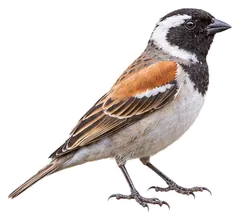 Cape SparrowPasser melanurus
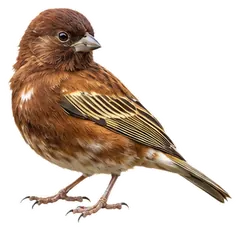 Chestnut SparrowPasser eminibey
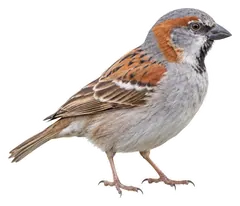 Kordofan SparrowPasser cordofanicus
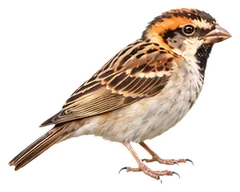 Shelley's SparrowPasser shelleyi
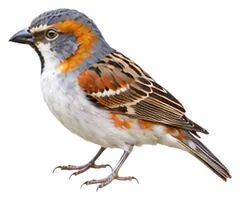 Kenya SparrowPasser rufocinctus
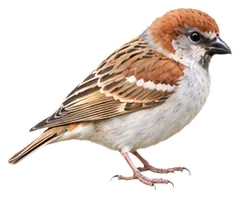 Great SparrowPasser motitensis
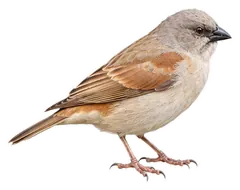 Northern Grey-headed SparrowPasser griseus
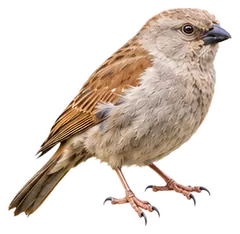 Swainson's SparrowPasser swainsonii
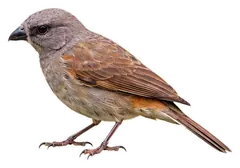 Swahili SparrowPasser suahelicus
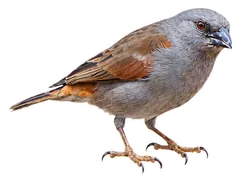 Parrot-billed SparrowPasser gongonensis
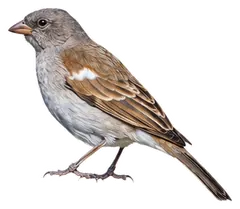 Southern Grey-headed SparrowPasser diffusus
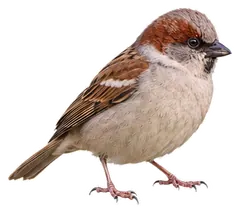 Sind SparrowPasser pyrrhonotus
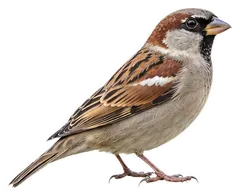
Download illustration
Free to use with credit: “Illustration: Bird Album (birdalbum.com)”. Drawn by AI from a reference photo by Rhododendrites. ↗

Heard it but can't see it? Mingji identifies birds by sound and photo, on your phone.