 Bird Album
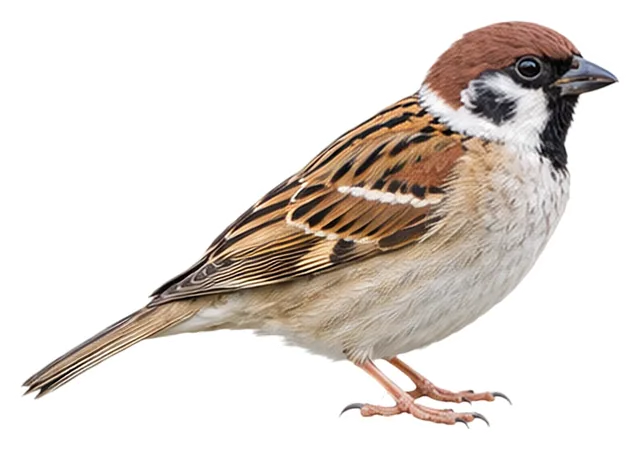
Eurasian Tree Sparrow
Passer montanus (Linnaeus, 1758)
12–14 cmLength21 cmWingspan21 gWeight
This small bird has a black patch on each white cheek, and both sexes look alike.
Busiest months: April–May and October · Most records: China, Spain, Japan
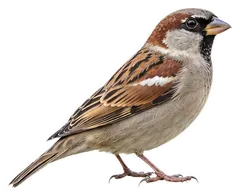
Looks like House Sparrow
How to identify
Field marks
- One black patch on each white cheek
- Crown and nape chestnut
- Upperparts brown with black markings; two dirty-white wing patches
- Bill stout and conical
Male, female and young
Sexes do not differ in plumage; juveniles resemble adults but are usually duller.
Voice
It has no true song. Unpaired or courting males give repeated “tschip” calls; the flight call is a grating “teck”.
Similar species
Where and when it's recorded

Eurasian Tree Sparrow has been recorded at 3,644 of the 8,171 birding hotspots we track, in 95 countries and regions.
Records by month Northern Hemisphere
Where it's recorded most
- Taipei – Tianliaoyang WetlandTaiwan (China)5,173 records
- Taipei – National Taiwan University Main CampusTaiwan (China)5,072 records
- Riverlands Migratory Bird SanctuaryUnited States4,715 records
More places
- Huajiang IBA – Huajiang Wild Duck Nature Park (Huajiang to Zhongxing Bridge)Taiwan (China)3,695 records
- Bempton Cliffs RSPB ReserveUnited Kingdom3,484 records
- Taipei – Taipei Botanical GardenTaiwan (China)3,127 records
- El Oso – Laguna y entornoSpain2,657 records
- Chiayi – NCYU Lantan CampusTaiwan (China)2,590 records
- Horseshoe Lake State ParkUnited States2,573 records
- Nanhui DongtanChina2,495 records
Countries and regions with the most records
eBird records via GBIF up to 2024-12-31. A record means someone listed it; more records partly mean more birders, not more birds.
About
The tree sparrow (Passer montanus Latin pronunciation: [pas.ser mon.ta.nus]) is a passerine bird in the sparrow family with a rich chestnut crown and nape and a black patch on each pure white cheek. This sparrow breeds across much of temperate Eurasia and Southeast Asia and has been introduced elsewhere, including the United States, where it is known as the Eurasian tree sparrow or German sparrow to differentiate it from the native American tree sparrow.
Excerpt from Wikipedia, CC BY-SA 4.0 · authors · Read more on Wikipedia
Questions
How big is the Eurasian Tree Sparrow?
The Eurasian Tree Sparrow is about 12–14 cm long, with a wingspan of 21 cm and weighs around 21 g.
Where does the Eurasian Tree Sparrow live?
Its breeding range: Palearctic, Oriental: subarctic to tropics of Palearctic and Oriental regions in farms, parks, cities: British Isles, southern Scandinavia, southeastern Murmansk east to southern Chukotka, Kamchatka, and Commander Islands (northwestern to northeastern Russia), in south to Iberian Peninsula, Gran Canaria (central Canary Islands, Macaronesia, west of northern Africa), Mediterranean islands through Turkey, northern Iran, south-central Pakistan, Tibet, central, eastern Himalayas through Southeast Asia, eastern Asian islands from Kuril Islands, all Japan, Taiwan (China), all Philippines and Indonesian Archipelago; introduced many other places. It is most often recorded in China, Spain and Japan.
When is the best time to see the Eurasian Tree Sparrow?
At the hotspots we track, it is recorded most in April, May and October (Northern Hemisphere).
Is the Eurasian Tree Sparrow endangered?
The IUCN Red List classifies the Eurasian Tree Sparrow as Least Concern.
What does the Eurasian Tree Sparrow eat?
Main food: Seeds.
What family is the Eurasian Tree Sparrow in?
It belongs to the family Old World Sparrows, Snowfinches (Passeridae), order Passerines (Passeriformes).
At a glance
- Length
- 12–14 cm
- Wingspan
- 21 cm
- Weight
- 21 g
- Habitat
- Woodland
- Diet
- Seeds
- Lifestyle
- Active on the ground
- Migration
- Resident (barely migrates)
- Conservation
- Least Concern
More measurements
- Wing
- 68 mm
- Tail
- 51 mm
- Bill
- 13 mm
- Tarsus
- 16 mm
Averages from the AVONET dataset; length from field guides where available.
Range
Palearctic, Oriental: subarctic to tropics of Palearctic and Oriental regions in farms, parks, cities: British Isles, southern Scandinavia, southeastern Murmansk east to southern Chukotka, Kamchatka, and Commander Islands (northwestern to northeastern Russia), in south to Iberian Peninsula, Gran Canaria (central Canary Islands, Macaronesia, west of northern Africa), Mediterranean islands through Turkey, northern Iran, south-central Pakistan, Tibet, central, eastern Himalayas through Southeast Asia, eastern Asian islands from Kuril Islands, all Japan, Taiwan (China), all Philippines and Indonesian Archipelago; introduced many other places
Breeding range, IOC World Bird List 15.2
Subspecies · 7
- Passer montanus dybowskii se Siberia, ne China and n Korea
- Passer montanus kansuensis nc China
- Passer montanus dilutus s Kazakhstan and e Iran to nw China and s Mongolia
- Passer montanus tibetanus Tibet to c China
- Passer montanus saturatus Sakhalin and Kuril Is. and Japan through e China to Taiwan (China) and n Philippines
- Passer montanus hepaticus ne India (ne Arunachal Pradesh), se Tibet and nw Myanmar
- Passer montanus malaccensis w Nepal to Bhutan and ne India (Assam), s China, se Asia, Indonesian Arch. and s Philippines
Classification
- Order
- Passerines Passeriformes
- Family
- Old World Sparrows, Snowfinches Passeridae
- Genus
- Passer
Other birds in the genus Passer
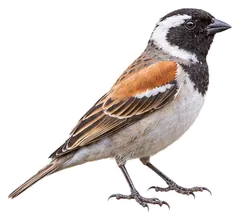 Cape SparrowPasser melanurus
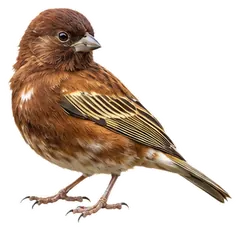 Chestnut SparrowPasser eminibey
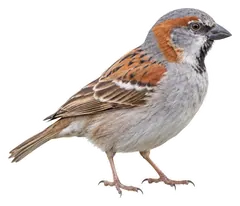 Kordofan SparrowPasser cordofanicus
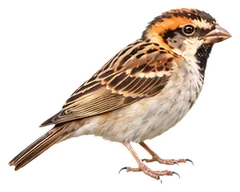 Shelley's SparrowPasser shelleyi
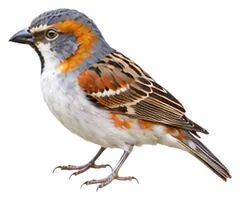 Kenya SparrowPasser rufocinctus
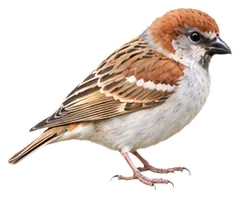 Great SparrowPasser motitensis
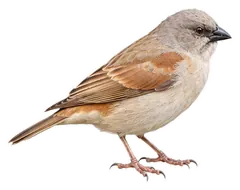 Northern Grey-headed SparrowPasser griseus
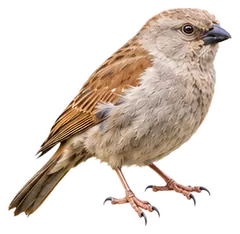 Swainson's SparrowPasser swainsonii
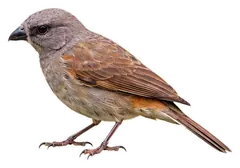 Swahili SparrowPasser suahelicus
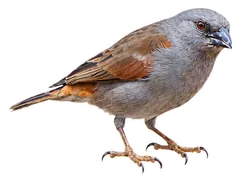 Parrot-billed SparrowPasser gongonensis
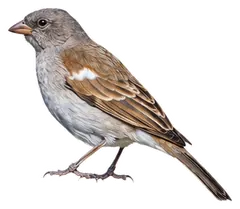 Southern Grey-headed SparrowPasser diffusus
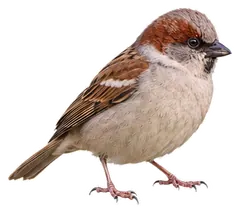 Sind SparrowPasser pyrrhonotus
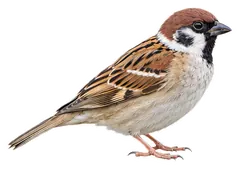
Download illustration
Free to use with credit: “Illustration: Bird Album (birdalbum.com)”. Drawn by AI from a reference photo by Laitche. ↗

Heard it but can't see it? Mingji identifies birds by sound and photo, on your phone.