 Bird Album
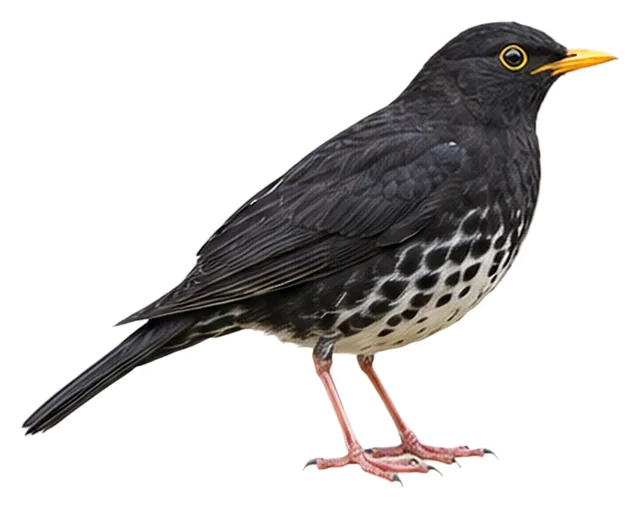
Japanese Thrush
Turdus cardis Temminck, 1831
21 cmLength59 gWeight
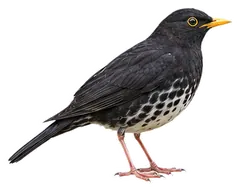
The male is readily recognized by the sharp contrast between its black upper breast and white underparts.
Busiest months: April and November–December · Most records: China, Japan, Vietnam
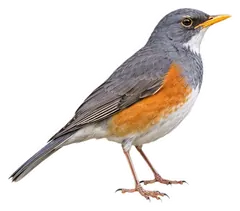
Looks like Grey-backed Thrush
How to identify
Field marks
- Male has a black head, breast, back, wings and tail
- White underparts with black spots on upper belly and flanks
- Male has a yellow bill and thin yellow eye-ring
Male, female and young
Female has brown upperparts, a white throat, breast and belly, and rusty-orange flanks with black spots; first-winter male has deep blue-gray upperparts and throat.
Similar species
Where and when it's recorded
Busiest months: April and November–December · Most records: China, Japan, Vietnam

Japanese Thrush has been recorded at 381 of the 8,276 birding hotspots we track, in 6 countries and regions.
Records by month Northern Hemisphere
Where it's recorded most
- Po ToiHong Kong (China)454 records
- Yeliu IBATaiwan (China)413 records
- Nanhui DongtanChina389 records
More places
- Pak Sha OHong Kong (China)383 records
- Cuc Phuong NPVietnam353 records
- Tai Po Kau Nature ReserveHong Kong (China)243 records
- Niigata – Nishikaigan ParkJapan156 records
- Wajima – Hegurajima (island)Japan146 records
- Tai Lam Country ParkHong Kong (China)144 records
- Matsu – DongyinChina121 records
Countries and regions with the most records
eBird records via GBIF up to 2024-12-31. A record means someone listed it; more records partly mean more birders, not more birds.
About
The Japanese thrush (Turdus cardis) is a species of bird in the thrush family Turdidae. The species is also known as the grey thrush or the Japanese grey thrush. The species was once split into two subspecies, with birds breeding in China being treated as the subspecies T. c. lateus,, but today differences are attributed to natural variation and the species is treated as being monotypic.
Excerpt from Wikipedia, CC BY-SA 4.0 · authors · Read more on Wikipedia
Questions
How big is the Japanese Thrush?
The Japanese Thrush is about 21 cm long and weighs around 59 g.
Where does the Japanese Thrush live?
Its breeding range: Palearctic: central China and Hokkaido to Kyushu (northern to southern Japan). It is most often recorded in China, Japan and Vietnam.
When is the best time to see the Japanese Thrush?
At the hotspots we track, it is recorded most in April, November and December (Northern Hemisphere).
Is the Japanese Thrush endangered?
The IUCN Red List classifies the Japanese Thrush as Least Concern.
What does the Japanese Thrush eat?
Main food: Insects & other invertebrates.
What family is the Japanese Thrush in?
It belongs to the family Thrushes (Turdidae), order Passerines (Passeriformes).
At a glance
- Length
- 21 cm
- Weight
- 59 g
- Habitat
- Forest
- Diet
- Insects & other invertebrates
- Lifestyle
- Active on the ground
- Migration
- Migratory
- Conservation
- Least Concern
More measurements
- Wing
- 115 mm
- Tail
- 77 mm
- Bill
- 24 mm
- Tarsus
- 29 mm
Averages from the AVONET dataset; length from field guides where available.
Range
Palearctic: central China and Hokkaido to Kyushu (northern to southern Japan)
Breeding range, IOC World Bird List 15.2
Classification
- Order
- Passerines Passeriformes
- Family
- Thrushes Turdidae
- Genus
- Turdus
Other birds in the genus Turdus
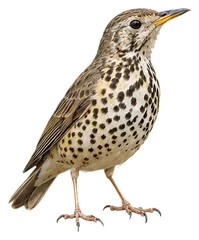 Ethiopian ThrushTurdus simensis
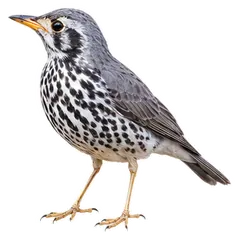 Groundscraper ThrushTurdus litsitsirupa
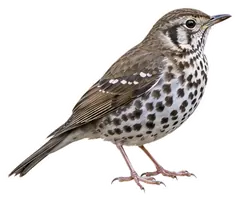 Chinese ThrushTurdus mupinensis
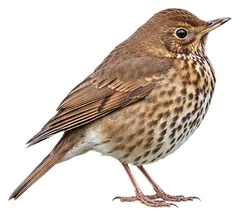 Song ThrushTurdus philomelos
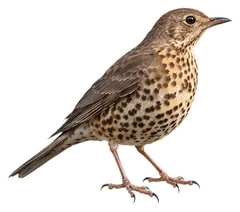 Mistle ThrushTurdus viscivorus
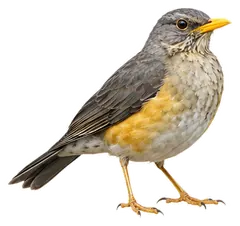 African ThrushTurdus pelios
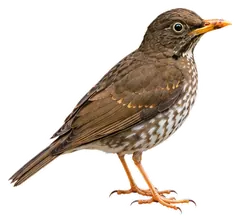 Principe ThrushTurdus xanthorhynchus
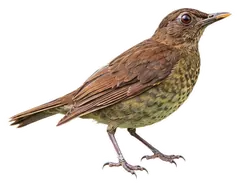 Sao Tome ThrushTurdus olivaceofuscus
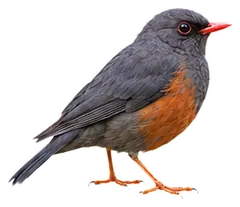 Abyssinian ThrushTurdus abyssinicus
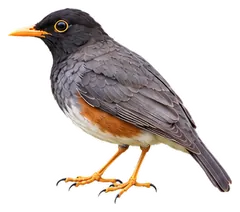 Taita ThrushTurdus helleri
 Usambara ThrushTurdus roehli
 Olive ThrushTurdus olivaceus
Download illustration
Free to use with credit: “Illustration: Bird Album (birdalbum.com)”. Drawn by AI from a reference photo by Alnus. ↗

Heard it but can't see it? Mingji identifies birds by sound and photo, on your phone.