 Bird Album
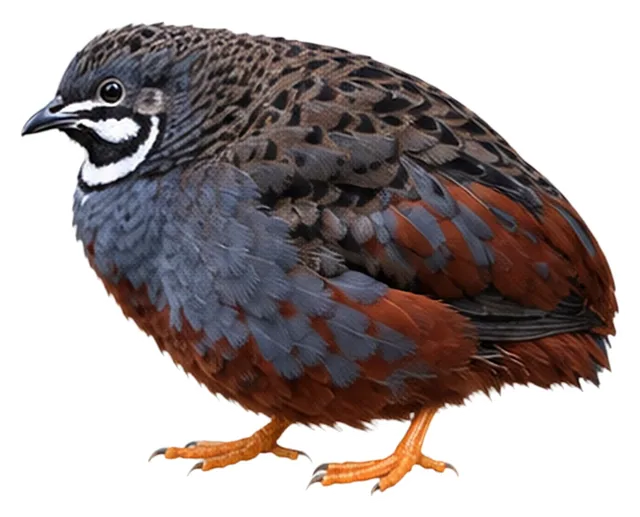
King Quail
Synoicus chinensis (Linnaeus, 1766)
≈14 cmLength40 gWeight
It is the smallest member of the pheasant family, and the male has a blue-gray neck and flanks and reddish-brown underparts.
Most records: Australia, India, Cambodia
How to identify
Field marks
- Male has a deep blue-gray neck and flanks
- Male has a dark brown back and wings and reddish-brown underparts
- Male has a black chin, a white band below it, and black-and-white markings below the eye
- Legs and feet orange
Male, female and young
Female much plainer, reddish-brown overall, with only the belly paler.
Voice
Flute-like whistles, sounding like “ti-yu” or “ti-ti-yu”; gives thin, high-pitched chattering when flushed.
Where and when it's recorded

King Quail has been recorded at 189 of the 8,171 birding hotspots we track, in 19 countries and regions.
Records by month Southern Hemisphere
Where it's recorded most
- Lake Samsonvale – Golds Scrub LaneAustralia457 records
- Lake Samsonvale – Postmans TrackAustralia306 records
- Baruipur MarshesIndia150 records
More places
- Bengal Florican ReserveCambodia99 records
- Bislig lowlands – Old AirportPhilippines94 records
- Partridge CreekAustralia87 records
- Numondo Cattle FarmPapua New Guinea75 records
- Danzhou Bay [historical – General Area]China72 records
- Kedron Brook Wetlands ReserveAustralia55 records
- Heneng VillageChina35 records
Countries and regions with the most records
eBird records via GBIF up to 2024-12-31. A record means someone listed it; more records partly mean more birders, not more birds.
About
The king quail (Synoicus chinensis), also known as the Asian blue quail, blue-breasted quail, Chinese painted quail, button quail, or Chung-Chi, is a very small, diminutive galliform of the tribe Coturnicini in the subfamily Phasianinae. They are the smallest member in this subfamily and the family Phasianidae, as well as being the smallest and lightest member of the order Galliformes. It is quite common in aviculture worldwide, where it is sometimes referred to as the "button quail", although it is not closely related to the family of birds called buttonquails.
Excerpt from Wikipedia, CC BY-SA 4.0 · authors · Read more on Wikipedia
Questions
How big is the King Quail?
The King Quail is about ≈14 cm long and weighs around 40 g.
Where does the King Quail live?
Its breeding range: Oriental, Australasia: widespread. It is most often recorded in Australia, India and Cambodia.
Is the King Quail endangered?
The IUCN Red List classifies the King Quail as Least Concern.
What does the King Quail eat?
Main food: Omnivore.
What family is the King Quail in?
It belongs to the family Pheasants & Allies (Phasianidae), order Galliformes.
At a glance
- Length
- ≈14 cm
- Weight
- 40 g
- Habitat
- Grassland
- Diet
- Omnivore
- Lifestyle
- Active on the ground
- Migration
- Resident (barely migrates)
- Conservation
- Least Concern
More measurements
- Wing
- 70 mm
- Tail
- 27 mm
- Bill
- 13 mm
- Tarsus
- 19 mm
Averages from the AVONET dataset; length from field guides where available.
Range
Oriental, Australasia: widespread
Breeding range, IOC World Bird List 15.2
Subspecies · 1
- Synoicus chinensis chinensis India to Sri Lanka, Malay Pen., Sumatra, Java, Indochina, se China and Taiwan (China)
Classification
- Order
- Galliformes
- Family
- Pheasants & Allies Phasianidae
- Genus
- Synoicus
Other birds in the genus Synoicus
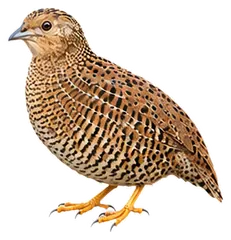 Brown QuailSynoicus ypsilophorus
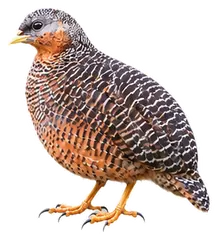 Snow Mountain QuailSynoicus monorthonyx
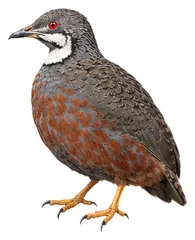 Blue QuailSynoicus adansonii
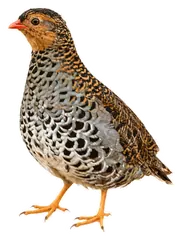 Udzungwa Forest PartridgeXenoperdix udzungwensis
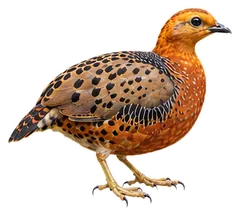 Ferruginous PartridgeCaloperdix oculeus
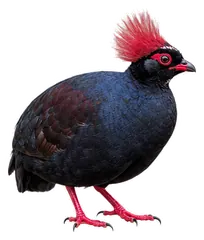 Crested PartridgeRollulus rouloul
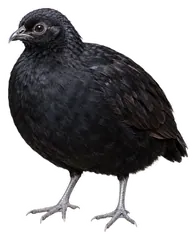 Black PartridgeMelanoperdix niger
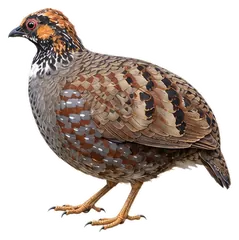 Hill PartridgeArborophila torqueola
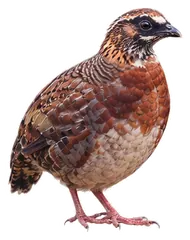 Sichuan PartridgeArborophila rufipectus
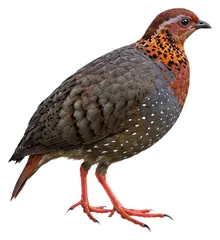 Chestnut-breasted PartridgeArborophila mandellii
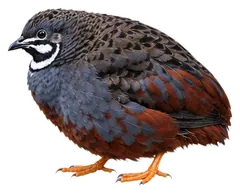
Download illustration
Free to use with credit: “Illustration: Bird Album (birdalbum.com)”. Drawn by AI from a reference photo by Jade Neo GC. ↗
Heard it but can't see it? Mingji identifies birds by sound and photo, on your phone.