 Bird Album
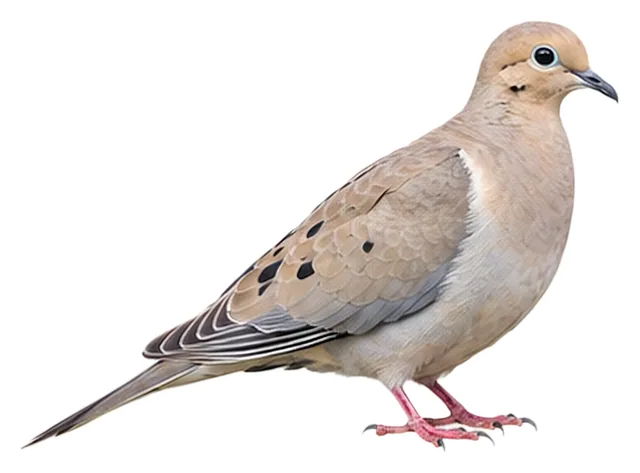
Mourning Dove
Zenaida macroura (Linnaeus, 1758)
31 cmLength119 gWeight
The mourning dove (Zenaida macroura) is a member of the dove family, Columbidae.
Busiest months: May · Most records: United States, Canada, Mexico
Where and when it's recorded

Mourning Dove has been recorded at 1,057 of the 8,171 birding hotspots we track, in 22 countries and regions.
Records by month Northern Hemisphere
Where it's recorded most
- Prospect ParkUnited States34,336 records
- Central ParkUnited States33,537 records
- Sweetwater WetlandsUnited States31,130 records
More places
- Riparian Preserve at Gilbert Water RanchUnited States25,175 records
- Parker River NWRUnited States23,378 records
- Madera Canyon – Santa Rita LodgeUnited States22,925 records
- Magee Marsh – BoardwalkUnited States21,285 records
- Point Pelee National ParkCanada20,267 records
- Cape Island – South Cape May MeadowsUnited States19,152 records
- Estero Llano Grande SP WBCUnited States17,355 records
Countries and regions with the most records
eBird records via GBIF up to 2024-12-31. A record means someone listed it; more records partly mean more birders, not more birds.
About
The mourning dove (Zenaida macroura) is a member of the dove family, Columbidae. The bird is also known as the American mourning dove, the rain dove, and colloquially as the turtle dove, and it was once known as the Carolina pigeon and Carolina turtledove. It is one of the most abundant and widespread North American birds and a popular gamebird, with more than 20 million birds (up to 70 million in some years) shot annually in the U.S., both for sport and meat.
Excerpt from Wikipedia, CC BY-SA 4.0 · authors · Read more on Wikipedia
Questions
How big is the Mourning Dove?
The Mourning Dove is about 31 cm long and weighs around 119 g.
Where does the Mourning Dove live?
Its breeding range: North America, Middle America: widespread. It is most often recorded in United States, Canada and Mexico.
When is the best time to see the Mourning Dove?
At the hotspots we track, it is recorded most in May (Northern Hemisphere).
Is the Mourning Dove endangered?
The IUCN Red List classifies the Mourning Dove as Least Concern.
What does the Mourning Dove eat?
Main food: Seeds.
What family is the Mourning Dove in?
It belongs to the family Pigeons, Doves (Columbidae), order Columbiformes.
At a glance
- Length
- 31 cm
- Weight
- 119 g
- Habitat
- Towns & farmland
- Diet
- Seeds
- Lifestyle
- Active on the ground
- Migration
- Resident (barely migrates)
- Conservation
- Least Concern
More measurements
- Wing
- 144 mm
- Tail
- 122 mm
- Bill
- 20 mm
- Tarsus
- 20 mm
Averages from the AVONET dataset; length from field guides where available.
Range
North America, Middle America: widespread
Breeding range, IOC World Bird List 15.2
Classification
- Order
- Columbiformes
- Family
- Pigeons, Doves Columbidae
- Genus
- Zenaida
Other birds in the genus Zenaida
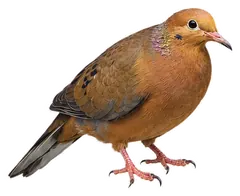 Socorro DoveZenaida graysoni
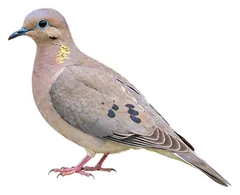 Eared DoveZenaida auriculata
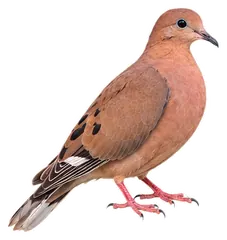 Zenaida DoveZenaida aurita
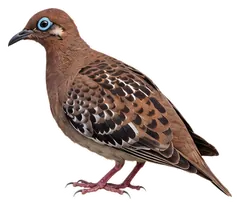 Galapagos DoveZenaida galapagoensis
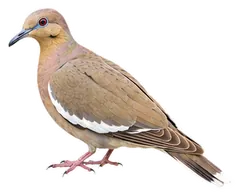 White-winged DoveZenaida asiatica
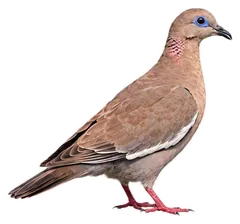 West Peruvian DoveZenaida meloda
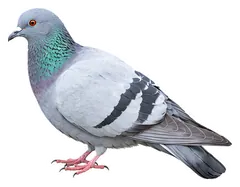 Rock DoveColumba livia
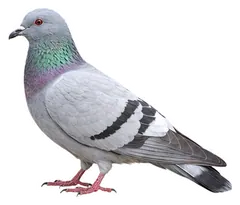 Hill PigeonColumba rupestris
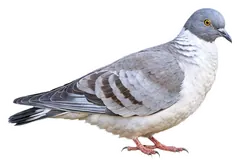 Snow PigeonColumba leuconota
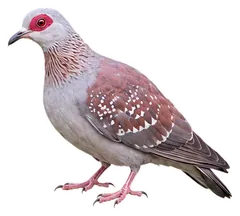 Speckled PigeonColumba guinea
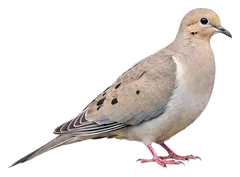
Download illustration
Free to use with credit: “Illustration: Bird Album (birdalbum.com)”. Drawn by AI from a reference photo by Donna Pomeroy. ↗
Heard it but can't see it? Mingji identifies birds by sound and photo, on your phone.