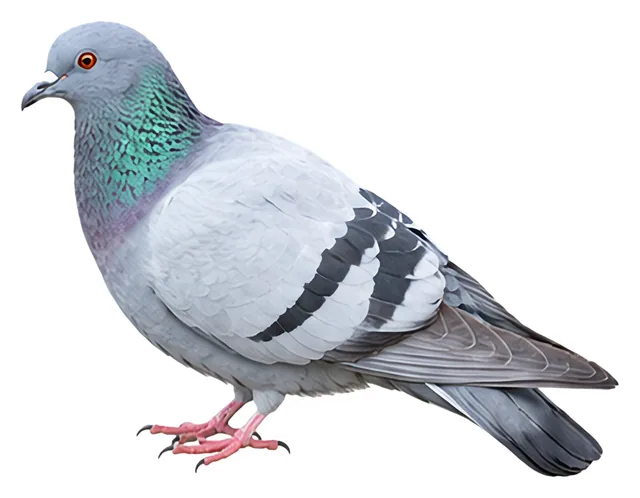
Rock Dove
Columba livia Gmelin, JF, 1789
30–35 cmLength69 cmWingspan354 gWeight
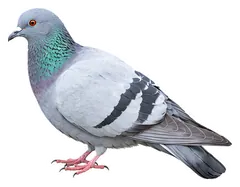
Slate-gray with a metallic gloss on the neck and breast, it is the ancestor of domestic pigeons.
Busiest months: April–May and September–October · Most records: United States, Canada, India
How to identify
Field marks
- Slate-gray overall
- Neck and breast with a metallic gloss shifting between green, blue, and purple
- Two black bands on wings; black band at tail tip
- Purebred Rock Dove has a white lower back
Male, female and young
Sexes look almost identical; female has a weaker metallic gloss on the neck, while male has a broad scapular region, a large rounded head, and a short, thick neck.
Voice
Soft cooing with a slight trill, rendered as “crruoo-u”.
Where and when it's recorded
Busiest months: April–May and September–October · Most records: United States, Canada, India

Rock Dove has been recorded at 6,591 of the 8,276 birding hotspots we track, in 224 countries and regions.
Records by month Northern Hemisphere
Where it's recorded most
- Central ParkUnited States32,874 records
- Prospect ParkUnited States25,255 records
- GKVK CampusIndia15,071 records
More places
- Reifel Bird SanctuaryCanada14,818 records
- Riparian Preserve at Gilbert Water RanchUnited States12,083 records
- Central Park – The RambleUnited States11,547 records
- Salmon Arm BayCanada10,749 records
- Fergusson College CampusIndia10,603 records
- Montrose Point Bird Sanctuary, Lincoln Park, ChicagoUnited States10,421 records
- Reserva Ecológica Costanera SurArgentina10,418 records
Countries and regions with the most records
eBird records via GBIF up to 2024-12-31. A record means someone listed it; more records partly mean more birders, not more birds.
About
The rock dove (Columba livia), also known as the common pigeon or rock pigeon (but see also Petrophassa), is a member of the bird family Columbidae (doves and pigeons). In common usage, it is often simply referred to as the "pigeon", although the rock dove is the wild form of the bird; the pigeons familiar to most people are the domesticated forms of the wild rock dove.
Excerpt from Wikipedia, CC BY-SA 4.0 · authors · Read more on Wikipedia
Questions
How big is the Rock Dove?
The Rock Dove is about 30–35 cm long, with a wingspan of 69 cm and weighs around 354 g.
Where does the Rock Dove live?
Its breeding range: Worldwide: worldwide due largely to introductions; native to southern Eurasia, northern Africa to India. It is most often recorded in United States, Canada and India.
When is the best time to see the Rock Dove?
At the hotspots we track, it is recorded most in April, May, September and October (Northern Hemisphere).
Is the Rock Dove endangered?
The IUCN Red List classifies the Rock Dove as Least Concern.
What does the Rock Dove eat?
Main food: Seeds.
What family is the Rock Dove in?
It belongs to the family Pigeons, Doves (Columbidae), order Columbiformes.
At a glance
- Length
- 30–35 cm
- Wingspan
- 69 cm
- Weight
- 354 g
- Habitat
- Towns & farmland
- Diet
- Seeds
- Lifestyle
- Active on the ground
- Migration
- Resident (barely migrates)
- Conservation
- Least Concern
More measurements
- Wing
- 220 mm
- Tail
- 106 mm
- Bill
- 23 mm
- Tarsus
- 26 mm
Averages from the AVONET dataset; length from field guides where available.
Range
Worldwide: worldwide due largely to introductions; native to southern Eurasia, northern Africa to India
Breeding range, IOC World Bird List 15.2
Classification
- Order
- Columbiformes
- Family
- Pigeons, Doves Columbidae
- Genus
- Columba
Other birds in the genus Columba
 Hill PigeonColumba rupestris
 Snow PigeonColumba leuconota
 Speckled PigeonColumba guinea
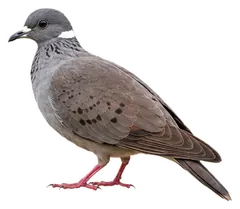 White-collared PigeonColumba albitorques
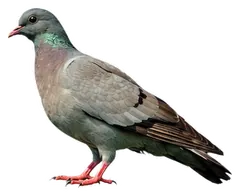 Stock DoveColumba oenas
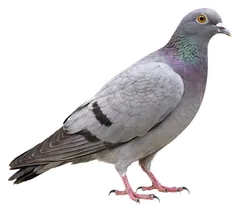 Yellow-eyed PigeonColumba eversmanni
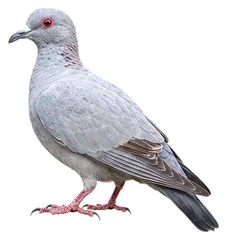 Somali PigeonColumba oliviae
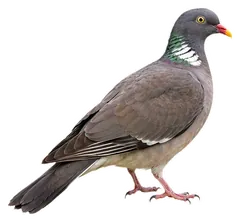 Common Wood PigeonColumba palumbus
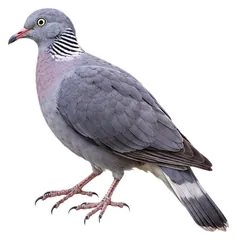 Trocaz PigeonColumba trocaz
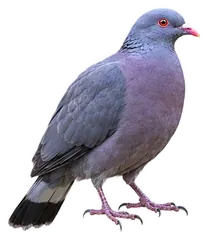 Bolle's PigeonColumba bollii
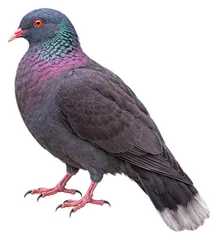 Laurel PigeonColumba junoniae
 Afep PigeonColumba unicincta
Download illustration
Free to use with credit: “Illustration: Bird Album (birdalbum.com)”. Drawn by AI from a reference photo by william_stephens. ↗

Heard it but can't see it? Mingji identifies birds by sound and photo, on your phone.