 Bird Album
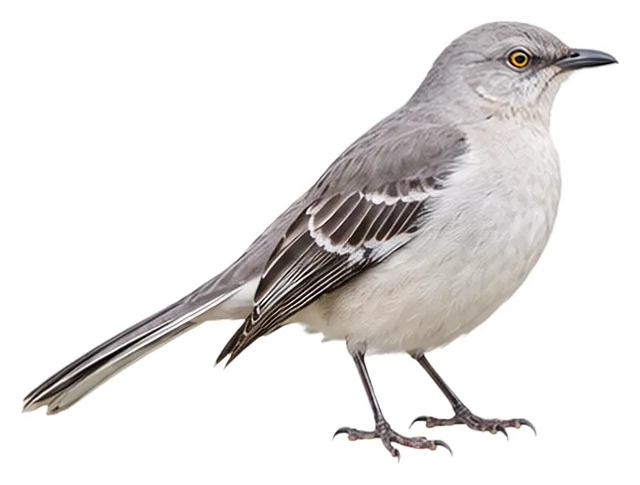
Northern Mockingbird
Mimus polyglottos (Linnaeus, 1758)
48 gWeight
The northern mockingbird (Mimus polyglottos) is a mockingbird commonly found in North America, of the family Mimidae.
Busiest months: April · Most records: United States, Canada, Puerto Rico
Where and when it's recorded

Northern Mockingbird has been recorded at 877 of the 8,171 birding hotspots we track, in 18 countries and regions.
Records by month Northern Hemisphere
Where it's recorded most
- Estero Llano Grande SP WBCUnited States27,322 records
- Parker River NWRUnited States25,218 records
- Riparian Preserve at Gilbert Water RanchUnited States23,698 records
More places
- Fort De Soto ParkUnited States18,509 records
- Cape Island – Cape May Point SPUnited States17,943 records
- Cape Island – South Cape May MeadowsUnited States16,634 records
- Green-Wood Cemetery, BrooklynUnited States16,319 records
- Hammonasset Beach SPUnited States14,051 records
- Bentsen-Rio Grande Val. SP WBC (Mission)United States13,872 records
- Sandy HookUnited States12,820 records
Countries and regions with the most records
eBird records via GBIF up to 2024-12-31. A record means someone listed it; more records partly mean more birders, not more birds.
About
The northern mockingbird (Mimus polyglottos) is a mockingbird commonly found in North America, of the family Mimidae. The species is also found in some parts of the Caribbean, as well as on the Hawaiian Islands. It is typically a permanent resident across much of its range, but northern mockingbirds may move farther south during inclement weather or prior to the onset of winter.
Excerpt from Wikipedia, CC BY-SA 4.0 · authors · Read more on Wikipedia
Questions
How big is the Northern Mockingbird?
The Northern Mockingbird weighs around 48 g.
Where does the Northern Mockingbird live?
Its breeding range: North America, Middle America: southern Canada to southern Mexico. It is most often recorded in United States, Canada and Puerto Rico.
When is the best time to see the Northern Mockingbird?
At the hotspots we track, it is recorded most in April (Northern Hemisphere).
Is the Northern Mockingbird endangered?
The IUCN Red List classifies the Northern Mockingbird as Least Concern.
What does the Northern Mockingbird eat?
Main food: Omnivore.
What family is the Northern Mockingbird in?
It belongs to the family Mockingbirds, Thrashers (Mimidae), order Passerines (Passeriformes).
At a glance
- Weight
- 48 g
- Habitat
- Shrubland
- Diet
- Omnivore
- Lifestyle
- Varied
- Migration
- Migratory
- Conservation
- Least Concern
More measurements
- Wing
- 112 mm
- Tail
- 118 mm
- Bill
- 22 mm
- Tarsus
- 32 mm
Averages from the AVONET dataset; length from field guides where available.
Range
North America, Middle America: southern Canada to southern Mexico
Breeding range, IOC World Bird List 15.2
Classification
- Order
- Passerines Passeriformes
- Family
- Mockingbirds, Thrashers Mimidae
- Genus
- Mimus
Other birds in the genus Mimus
 Tropical MockingbirdMimus gilvus
 Bahama MockingbirdMimus gundlachii
 Chilean MockingbirdMimus thenca
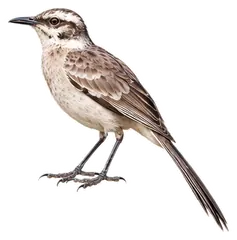 Long-tailed MockingbirdMimus longicaudatus
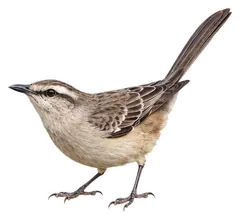 Chalk-browed MockingbirdMimus saturninus
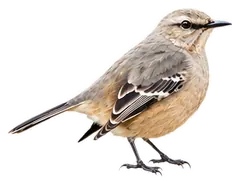 Patagonian MockingbirdMimus patagonicus
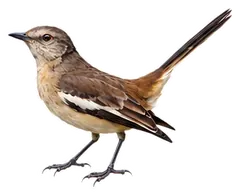 White-banded MockingbirdMimus triurus
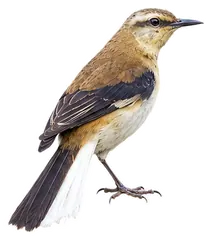 Brown-backed MockingbirdMimus dorsalis
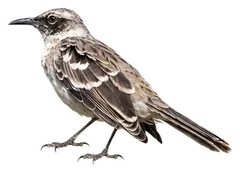 Galapagos MockingbirdMimus parvulus
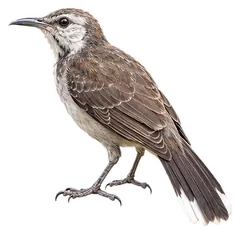 Floreana MockingbirdMimus trifasciatus
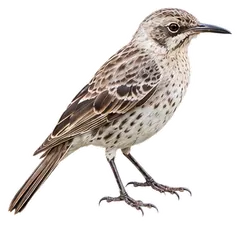 Espanola MockingbirdMimus macdonaldi
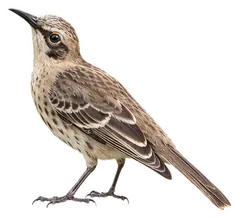 San Cristobal MockingbirdMimus melanotis
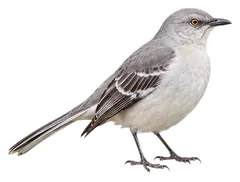
Download illustration
Free to use with credit: “Illustration: Bird Album (birdalbum.com)”. Drawn by AI from a reference photo by Kevin Milazzo. ↗
Heard it but can't see it? Mingji identifies birds by sound and photo, on your phone.
In other languages
- EnglishNorthern Mockingbird
- 简体中文小嘲鸫
- 繁體中文小嘲鶇
- 日本語マネシツグミ
- DeutschGartenspottdrossel
- FrançaisMoqueur polyglotte
- EspañolSinsonte norteño
- Portuguêstordo-imitador
- ItalianoMimo poliglotto
- NederlandsSpotlijster
- РусскийМногоголосый пересмешинк
- Svenskanordlig härmtrast
- DanskNordlig Spottedrossel
- Polskiprzedrzeźniacz północny