 Bird Album
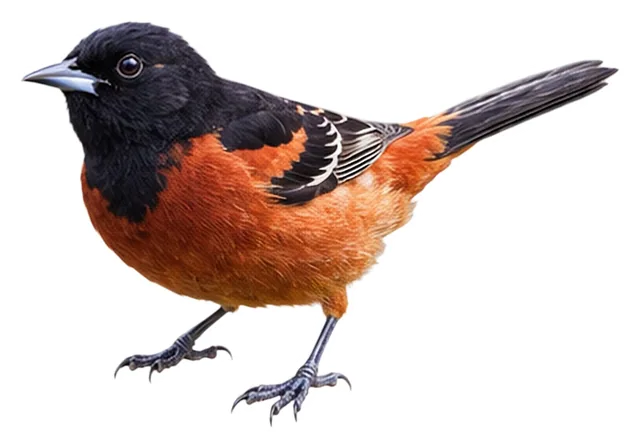
Orchard Oriole
Icterus spurius (Linnaeus, 1766)
15–18 cmLength19 gWeight
The orchard oriole (Icterus spurius) is the smallest species of icterid.
Busiest months: May · Most records: United States, Canada, Mexico
Where and when it's recorded
Busiest months: May · Most records: United States, Canada, Mexico

Orchard Oriole has been recorded at 856 of the 8,276 birding hotspots we track, in 17 countries and regions.
Records by month Northern Hemisphere
Where it's recorded most
- Point Pelee National ParkCanada13,064 records
- Sabine WoodsUnited States8,079 records
- Tawas Point SPUnited States7,037 records
More places
- High Island – Boy Scout WoodsUnited States5,840 records
- High Island – Smith Oaks SanctuaryUnited States5,621 records
- South Padre Is. – WBC/Conv. Center/Laguna Madre TrailUnited States5,198 records
- Jocelyn Nungaray NWR (Anahuac)United States4,642 records
- South Padre Is. – Valley Land Fund lotsUnited States4,051 records
- Bombay Hook National Wildlife RefugeUnited States3,935 records
- Galveston – Lafitte's CoveUnited States3,909 records
Countries and regions with the most records
eBird records via GBIF up to 2024-12-31. A record means someone listed it; more records partly mean more birders, not more birds.
About
The orchard oriole (Icterus spurius) is the smallest species of icterid. The subspecies of the Caribbean coast of Mexico, I. s. fuertesi, is sometimes considered a separate species, the ochre oriole or Fuertes's oriole.
Excerpt from Wikipedia, CC BY-SA 4.0 · authors · Read more on Wikipedia
Questions
How big is the Orchard Oriole?
The Orchard Oriole is about 15–18 cm long and weighs around 19 g.
Where does the Orchard Oriole live?
Its breeding range: North America, Middle America: southeastern Canada to central and eastern Mexico. It is most often recorded in United States, Canada and Mexico.
When is the best time to see the Orchard Oriole?
At the hotspots we track, it is recorded most in May (Northern Hemisphere).
Is the Orchard Oriole endangered?
The IUCN Red List classifies the Orchard Oriole as Least Concern.
What does the Orchard Oriole eat?
Main food: Insects & other invertebrates.
What family is the Orchard Oriole in?
It belongs to the family Oropendolas, New World Orioles, Blackbirds (Icteridae), order Passerines (Passeriformes).
At a glance
- Length
- 15–18 cm
- Weight
- 19 g
- Habitat
- Forest
- Diet
- Insects & other invertebrates
- Lifestyle
- Perches in trees
- Migration
- Migratory
- Conservation
- Least Concern
More measurements
- Wing
- 76 mm
- Tail
- 67 mm
- Bill
- 17 mm
- Tarsus
- 21 mm
Averages from the AVONET dataset; length from field guides where available.
Range
North America, Middle America: southeastern Canada to central and eastern Mexico
Breeding range, IOC World Bird List 15.2
Classification
- Order
- Passerines Passeriformes
- Family
- Oropendolas, New World Orioles, Blackbirds Icteridae
- Genus
- Icterus
Other birds in the genus Icterus
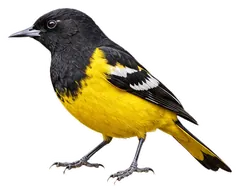 Scott's OrioleIcterus parisorum
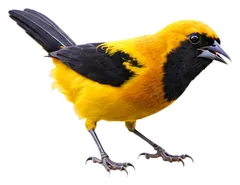 Yellow-backed OrioleIcterus chrysater
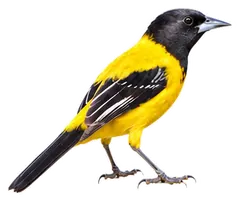 Audubon's OrioleIcterus graduacauda
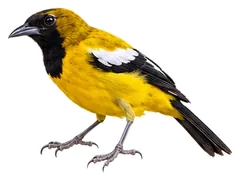 Jamaican OrioleIcterus leucopteryx
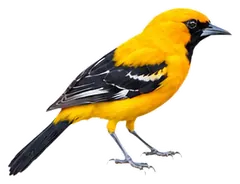 Orange OrioleIcterus auratus
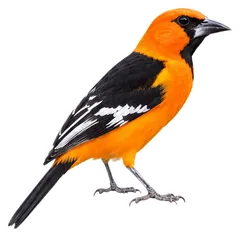 Altamira OrioleIcterus gularis
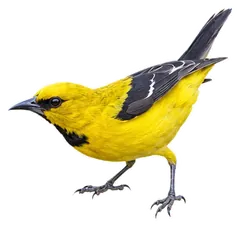 Yellow OrioleIcterus nigrogularis
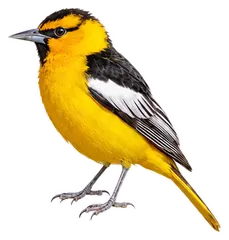 Bullock's OrioleIcterus bullockiorum
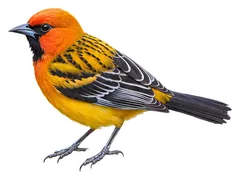 Streak-backed OrioleIcterus pustulatus
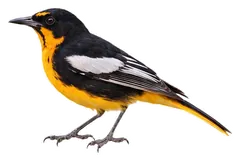 Black-backed OrioleIcterus abeillei
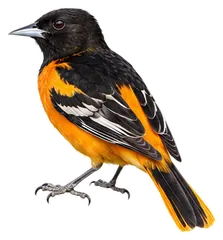 Baltimore OrioleIcterus galbula
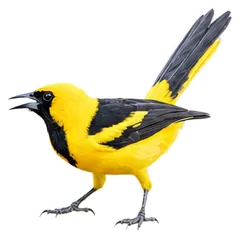 Yellow-tailed OrioleIcterus mesomelas
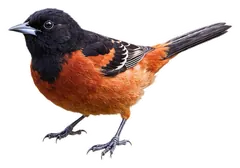
Download illustration
Free to use with credit: “Illustration: Bird Album (birdalbum.com)”. Drawn by AI from a reference photo by Dan Pancamo. ↗
Heard it but can't see it? Mingji identifies birds by sound and photo, on your phone.