 Bird Album
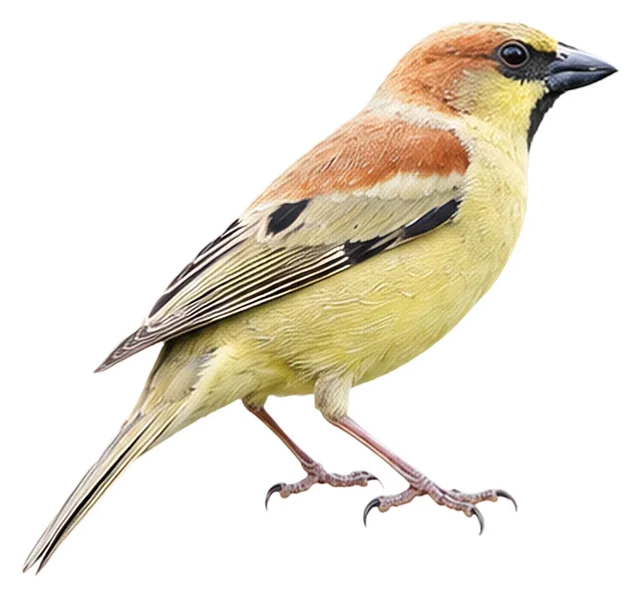
Plain-backed Sparrow
Passer flaveolus Blyth, 1845
19 gWeight
The plain-backed sparrow (Passer flaveolus), also called the Pegu sparrow or olive-backed sparrow, is a sparrow found in Southeast Asia.
Busiest months: January–March · Most records: Thailand, Cambodia, Myanmar (Burma)
Where and when it's recorded

Plain-backed Sparrow has been recorded at 184 of the 8,171 birding hotspots we track, in 6 countries and regions.
Records by month Northern Hemisphere
Where it's recorded most
- Benjakiti ParkThailand701 records
- Ang Trapeang ThmorCambodia559 records
- Phnom Krom – rice fieldsCambodia455 records
More places
- Khon Kaen University – WTPThailand444 records
- Mahidol University [Kanchanaburi Campus]Thailand402 records
- Pathum Thani Rice Research CenterThailand399 records
- Lat Krabang – Thap Yao paddies & aquaculture pondsThailand341 records
- Wang Luek – Nong TomThailand272 records
- SkylandCambodia267 records
- BaganMyanmar (Burma)249 records
Countries and regions with the most records
eBird records via GBIF up to 2024-12-31. A record means someone listed it; more records partly mean more birders, not more birds.
About
The plain-backed sparrow (Passer flaveolus), also called the Pegu sparrow or olive-backed sparrow, is a sparrow found in Southeast Asia. Its range spans from Myanmar to central Vietnam, and south to the western part of Peninsular Malaysia.
Excerpt from Wikipedia, CC BY-SA 4.0 · authors · Read more on Wikipedia
Questions
How big is the Plain-backed Sparrow?
The Plain-backed Sparrow weighs around 19 g.
Where does the Plain-backed Sparrow live?
Its breeding range: Oriental: subtropical to tropical Southeast Asia in open woodland and cultivation: central, southern Myanmar to central Malay Peninsula and central, southern Vietnam. It is most often recorded in Thailand, Cambodia and Myanmar (Burma).
When is the best time to see the Plain-backed Sparrow?
At the hotspots we track, it is recorded most in January, February and March (Northern Hemisphere).
Is the Plain-backed Sparrow endangered?
The IUCN Red List classifies the Plain-backed Sparrow as Least Concern.
What does the Plain-backed Sparrow eat?
Main food: Seeds.
What family is the Plain-backed Sparrow in?
It belongs to the family Old World Sparrows, Snowfinches (Passeridae), order Passerines (Passeriformes).
At a glance
- Weight
- 19 g
- Habitat
- Forest
- Diet
- Seeds
- Lifestyle
- Active on the ground
- Migration
- Resident (barely migrates)
- Conservation
- Least Concern
More measurements
- Wing
- 70 mm
- Tail
- 54 mm
- Bill
- 12 mm
- Tarsus
- 17 mm
Averages from the AVONET dataset; length from field guides where available.
Range
Oriental: subtropical to tropical Southeast Asia in open woodland and cultivation: central, southern Myanmar to central Malay Peninsula and central, southern Vietnam
Breeding range, IOC World Bird List 15.2
Classification
- Order
- Passerines Passeriformes
- Family
- Old World Sparrows, Snowfinches Passeridae
- Genus
- Passer
Other birds in the genus Passer
 Cape SparrowPasser melanurus
 Chestnut SparrowPasser eminibey
 Kordofan SparrowPasser cordofanicus
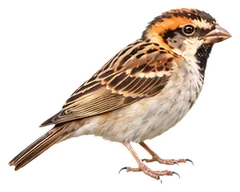 Shelley's SparrowPasser shelleyi
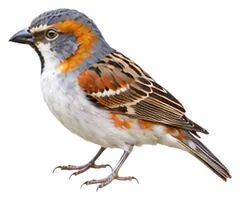 Kenya SparrowPasser rufocinctus
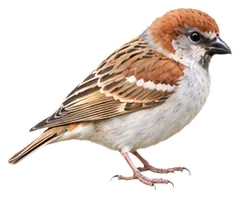 Great SparrowPasser motitensis
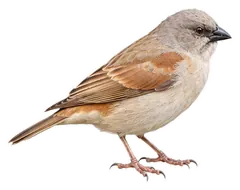 Northern Grey-headed SparrowPasser griseus
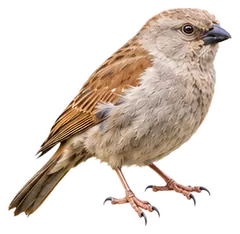 Swainson's SparrowPasser swainsonii
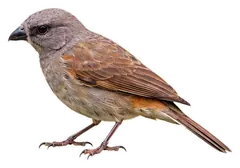 Swahili SparrowPasser suahelicus
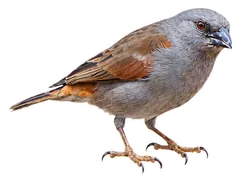 Parrot-billed SparrowPasser gongonensis
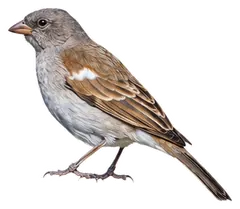 Southern Grey-headed SparrowPasser diffusus
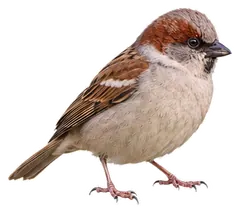 Sind SparrowPasser pyrrhonotus
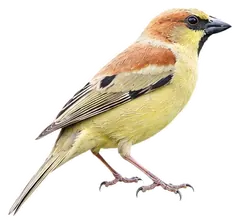
Download illustration
Free to use with credit: “Illustration: Bird Album (birdalbum.com)”. Drawn by AI from reference photos. ↗
Heard it but can't see it? Mingji identifies birds by sound and photo, on your phone.