 Bird Album
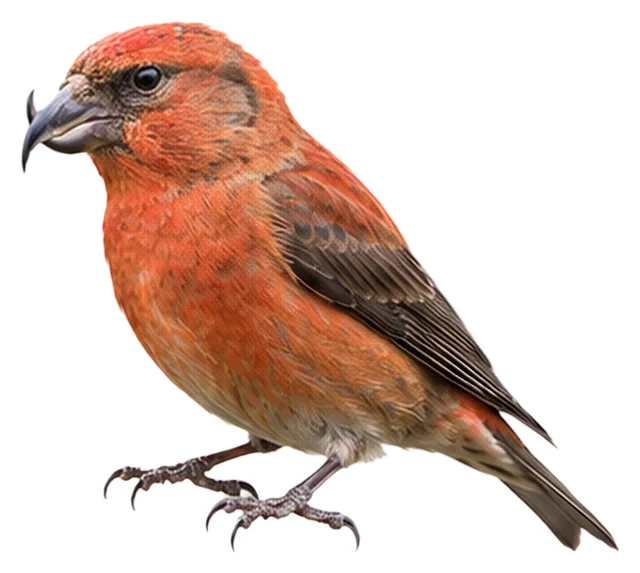
Red Crossbill
Loxia curvirostra Linnaeus, 1758
≈18 cmLength29 cmWingspan38 gWeight
Its crossed bill tips pry open the scales of conifer cones to extract seeds.
Busiest months: August · Most records: United States, Canada, United Kingdom
Looks like Two-barred Crossbill
How to identify
Field marks
- Bill tips crossed
- Male mainly red or orange
- Female mainly green or yellow
- Wings entirely rufous-black, without white wing patches
Male, female and young
Male mainly red or orange, female green or yellow; juvenile gray-green with streaks.
Voice
Often gives a single-note “chip”, with marked differences between forms.
Similar species
Where and when it's recorded
Busiest months: August · Most records: United States, Canada, United Kingdom

Red Crossbill has been recorded at 1,249 of the 8,276 birding hotspots we track, in 71 countries and regions.
Records by month Northern Hemisphere
Where it's recorded most
- Rocky Point Bird ObservatoryCanada4,508 records
- Metchosin – Pedder BayCanada2,320 records
- Intermountain Bird Observatory at Lucky PeakUnited States2,065 records
More places
- Whitefish PointUnited States1,963 records
- Algonquin Provincial Park – Visitor CentreCanada1,901 records
- North Vancouver – Maplewood Flats Conservation AreaCanada1,755 records
- Mt. Lemmon – Rose Canyon and LakeUnited States1,527 records
- Salisbury Beach State ReservationUnited States1,494 records
- 230 Goward RdCanada1,425 records
- Hawk Ridge Nature ReserveUnited States1,084 records
Countries and regions with the most records
eBird records via GBIF up to 2024-12-31. A record means someone listed it; more records partly mean more birders, not more birds.
About
The red crossbill or common crossbill (Loxia curvirostra) is a small passerine bird in the finch family Fringillidae. Crossbills have distinctive mandibles, crossed at the tips, which enable them to extract seeds from conifer cones and other fruits.
Excerpt from Wikipedia, CC BY-SA 4.0 · authors · Read more on Wikipedia
Questions
How big is the Red Crossbill?
The Red Crossbill is about ≈18 cm long, with a wingspan of 29 cm and weighs around 38 g.
Where does the Red Crossbill live?
Its breeding range: Palearctic, Oriental, North America, Middle America: subarctic to subtropical Holarctic conifer forest: British Isles, Scandinavia (except far northern) eastern across Russia to Sea of Okhotsk, Sakhalin and southern Kuril Islands (southeastern Russia), Hokkaido to central Honshu (northern, central Japan), northern Korean Peninsula, in south through Iberian Peninsula, Morocco to Tunisia (northwestern, north-central Africa), east through Mediterranean, Turkey, Caucasus, Altai of eastern Kyrgyzstan, eastern Kazakhstan, northwestern Xinjiang (northwestern China), southern, central Mongolia to Heilongjiang and Hebei (northeastern China); disjunctly west-central to eastern Himalayas, southeastern Tibet, Qinghai and Gansu to northwestern Yunnan; southern Vietnam; Luzon (northern Philippines); southeastern Alaska east to Newfoundland (northeastern Canada), south to northern Baja California (northwestern Mexico), Rocky and Appalachian mountains, south through Nicaragua. It is most often recorded in United States, Canada and United Kingdom.
When is the best time to see the Red Crossbill?
At the hotspots we track, it is recorded most in August (Northern Hemisphere).
Is the Red Crossbill endangered?
The IUCN Red List classifies the Red Crossbill as Least Concern.
What does the Red Crossbill eat?
Main food: Seeds.
What family is the Red Crossbill in?
It belongs to the family Finches, Euphonias (Fringillidae), order Passerines (Passeriformes).
At a glance
- Length
- ≈18 cm
- Wingspan
- 29 cm
- Weight
- 38 g
- Habitat
- Forest
- Diet
- Seeds
- Lifestyle
- Perches in trees
- Migration
- Partial migrant
- Conservation
- Least Concern
More measurements
- Wing
- 96 mm
- Tail
- 57 mm
- Bill
- 19 mm
- Tarsus
- 17 mm
Averages from the AVONET dataset; length from field guides where available.
Range
Palearctic, Oriental, North America, Middle America: subarctic to subtropical Holarctic conifer forest: British Isles, Scandinavia (except far northern) eastern across Russia to Sea of Okhotsk, Sakhalin and southern Kuril Islands (southeastern Russia), Hokkaido to central Honshu (northern, central Japan), northern Korean Peninsula, in south through Iberian Peninsula, Morocco to Tunisia (northwestern, north-central Africa), east through Mediterranean, Turkey, Caucasus, Altai of eastern Kyrgyzstan, eastern Kazakhstan, northwestern Xinjiang (northwestern China), southern, central Mongolia to Heilongjiang and Hebei (northeastern China); disjunctly west-central to eastern Himalayas, southeastern Tibet, Qinghai and Gansu to northwestern Yunnan; southern Vietnam; Luzon (northern Philippines); southeastern Alaska east to Newfoundland (northeastern Canada), south to northern Baja California (northwestern Mexico), Rocky and Appalachian mountains, south through Nicaragua
Breeding range, IOC World Bird List 15.2
Subspecies · 3
- Loxia curvirostra tianschanica se Kazakhstan to Tajikistan and nw China
- Loxia curvirostra himalayensis Himalayas to s China
- Loxia curvirostra japonica se Siberia to Sakhalin and Kuril Is., ne China, Korean Pen., Hokkaido and n, c Honshu (n, nc Japan)
Classification
- Order
- Passerines Passeriformes
- Family
- Finches, Euphonias Fringillidae
- Genus
- Loxia
Other birds in the genus Loxia
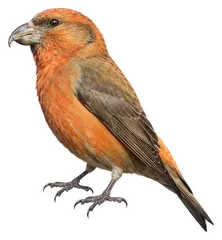 Parrot CrossbillLoxia pytyopsittacus
 Scottish CrossbillLoxia scotica
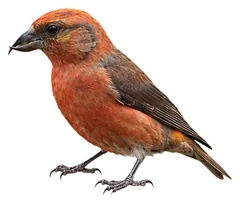 Cassia CrossbillLoxia sinesciuris
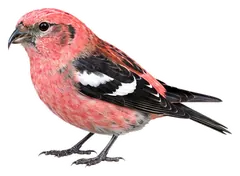 Two-barred CrossbillLoxia leucoptera
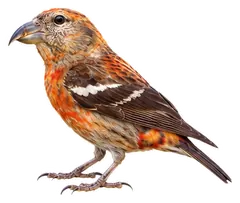 Hispaniolan CrossbillLoxia megaplaga
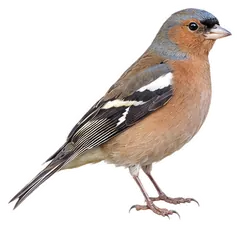 Eurasian ChaffinchFringilla coelebs
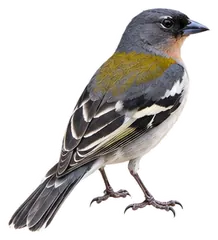 African ChaffinchFringilla spodiogenys
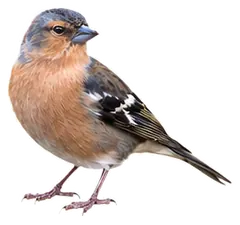 Azores ChaffinchFringilla moreletti
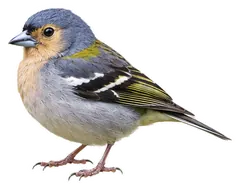 Madeira ChaffinchFringilla maderensis
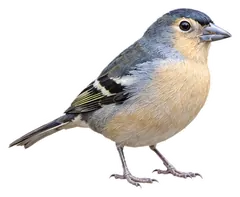 Canary Islands ChaffinchFringilla canariensis
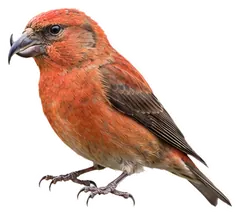
Download illustration
Free to use with credit: “Illustration: Bird Album (birdalbum.com)”. Drawn by AI from a reference photo by Elaine R. Wilson, www.naturespicsonline.com. ↗

Heard it but can't see it? Mingji identifies birds by sound and photo, on your phone.