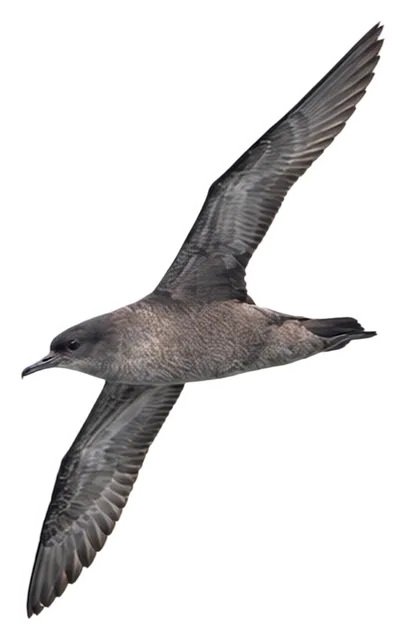
Short-tailed Shearwater
Ardenna tenuirostris (Temminck, 1836)
≈42 cmLength96 cmWingspan559 gWeight
It migrates back and forth across the Pacific between the Northern and Southern Hemispheres.
Most records: United States, Australia, New Zealand
How to identify
Field marks
- Tail tip relatively blunt
- Bill black
Male, female and young
Newly fledged juveniles may be heavier than their parents.
Where and when it's recorded
Most records: United States, Australia, New Zealand

Short-tailed Shearwater has been recorded at 105 of the 8,276 birding hotspots we track, in 20 countries and regions.
Records by month Northern Hemisphere
Where it's recorded most
- St. Paul IslandUnited States2,504 records
- GambellUnited States2,060 records
- Pt. Pinos – seawatch onlyUnited States1,785 records
More places
- Eaglehawk Neck Pelagic TripAustralia1,739 records
- Kaikoura – offshore – Albatross Encounter pelagicNew Zealand1,503 records
- Southeast Farallon IslandUnited States761 records
- Long Reef Aquatic ReserveAustralia162 records
- Po ToiHong Kong (China)133 records
- Poor Knights Shelf AreaNew Zealand132 records
- Rocky Point Bird ObservatoryCanada84 records
Countries and regions with the most records
eBird records via GBIF up to 2024-12-31. A record means someone listed it; more records partly mean more birders, not more birds.
About
The short-tailed shearwater or slender-billed shearwater (Ardenna tenuirostris), also called yula or moonbird, and commonly known as the muttonbird both in early Australia and in New Zealand, is the most abundant seabird species in Australian waters, and is one of the few Australian native birds in which the chicks are commercially harvested. It is a migratory species that breeds mainly on small islands in Bass Strait and Tasmania and migrates to the Northern Hemisphere for the boreal summer.
Excerpt from Wikipedia, CC BY-SA 4.0 · authors · Read more on Wikipedia
Questions
How big is the Short-tailed Shearwater?
The Short-tailed Shearwater is about ≈42 cm long, with a wingspan of 96 cm and weighs around 559 g.
Where does the Short-tailed Shearwater live?
Its breeding range: Pacific Ocean: islets off southern, southeastern Australia, Bass Strait and Tasmania (southeastern Australia). It is most often recorded in United States, Australia and New Zealand.
Is the Short-tailed Shearwater endangered?
The IUCN Red List classifies the Short-tailed Shearwater as Least Concern.
What does the Short-tailed Shearwater eat?
Main food: Fish, shrimp & shellfish.
What family is the Short-tailed Shearwater in?
It belongs to the family Petrels, Shearwaters, Diving Petrels (Procellariidae), order Procellariiformes.
At a glance
- Length
- ≈42 cm
- Wingspan
- 96 cm
- Weight
- 559 g
- Habitat
- Ocean
- Diet
- Fish, shrimp & shellfish
- Lifestyle
- Varied
- Migration
- Migratory
- Conservation
- Least Concern
More measurements
- Wing
- 262 mm
- Tail
- 83 mm
- Bill
- 37 mm
- Tarsus
- 49 mm
Averages from the AVONET dataset; length from field guides where available.
Range
Pacific Ocean: islets off southern, southeastern Australia, Bass Strait and Tasmania (southeastern Australia)
Breeding range, IOC World Bird List 15.2
Classification
- Order
- Procellariiformes
- Family
- Petrels, Shearwaters, Diving Petrels Procellariidae
- Genus
- Ardenna
Other birds in the genus Ardenna
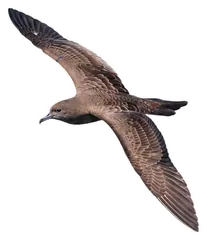 Wedge-tailed ShearwaterArdenna pacifica
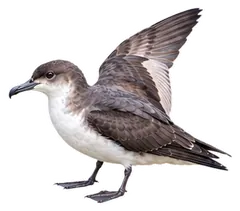 Buller's ShearwaterArdenna bulleri
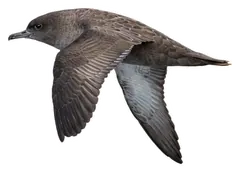 Sooty ShearwaterArdenna grisea
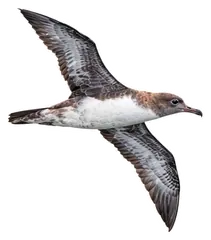 Pink-footed ShearwaterArdenna creatopus
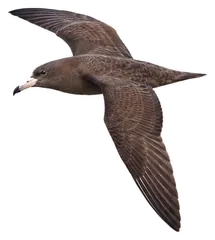 Flesh-footed ShearwaterArdenna carneipes
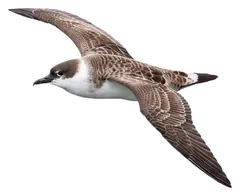 Great ShearwaterArdenna gravis
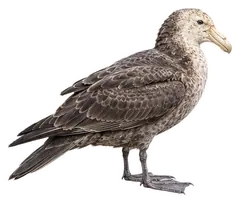 Southern Giant PetrelMacronectes giganteus
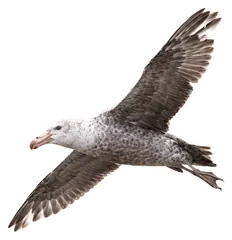 Northern Giant PetrelMacronectes halli
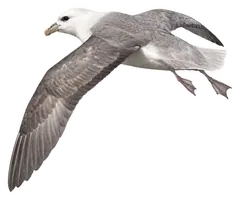 Northern FulmarFulmarus glacialis
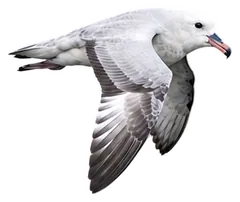 Southern FulmarFulmarus glacialoides
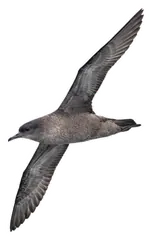
Download illustration
Free to use with credit: “Illustration: Bird Album (birdalbum.com)”. Drawn by AI from a reference photo by Oscar Thomas. ↗
Heard it but can't see it? Mingji identifies birds by sound and photo, on your phone.
In other languages
- EnglishShort-tailed Shearwater
- 简体中文短尾鹱
- 繁體中文短尾水薙鳥
- 日本語ハシボソミズナギドリ
- 한국어쇠부리슴새
- DeutschKurzschwanz-Sturmtaucher
- FrançaisPuffin à bec grêle
- EspañolPardela de Tasmania
- Portuguêspardela-da-tasmânia
- ItalianoBerta codacorta
- NederlandsDunbekpijlstormvogel
- РусскийТонкоклювый буревестник
- Svenskakortstjärtad lira
- DanskTyndnæbbet Skråpe
- Polskiburzyk cienkodzioby