 Bird Album
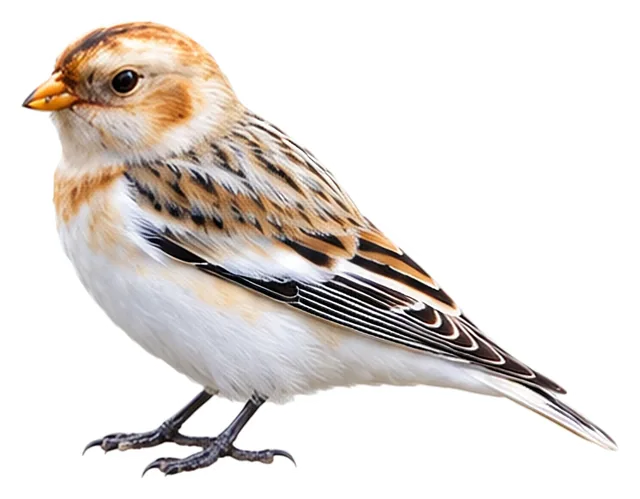
Snow Bunting
Plectrophenax nivalis (Linnaeus, 1758)
≈18 cmLength35 cmWingspan42 gWeight
This bunting has white underparts and feathered tarsi, an adaptation to extreme cold.
Busiest months: November · Most records: United States, Canada, United Kingdom
Looks like Lapland Longspur, Horned Lark
How to identify
Field marks
- Male in the breeding season has a white body, black wingtips and a black back
- White underparts; black-and-white wings and back
- Bill usually yellow with a black tip, entirely black in males in summer
- Feathered tarsi, unlike most passerines
Male, female and young
The sexes differ in plumage: in the breeding season, the male has a white body and black back, while the female has black back feathers with brown edges; in winter, both have broad orange-brown edges to the back feathers.
Voice
The call is a series of rolling whistles, rendered as “per,r,r,rit”.
Similar species
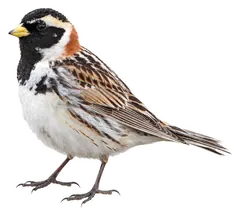
Lapland Longspur has almost no white on the wings; the calls are similar, but Snow Bunting sounds rounder and more flowing, while Lapland Longspur sounds drier and more rattling.
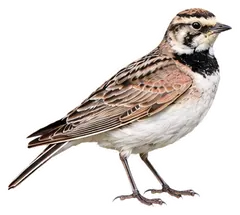
Horned Lark has conspicuous black-and-yellow head markings, a longer, partly black tail and no white on the wings.
Where and when it's recorded

Snow Bunting has been recorded at 844 of the 8,171 birding hotspots we track, in 49 countries and regions.
Records by month Northern Hemisphere
Where it's recorded most
- St. Paul IslandUnited States7,595 records
- GambellUnited States6,535 records
- RNF du Cap-TourmenteCanada2,774 records
More places
- Parker River NWRUnited States2,655 records
- Pointe-au-PèreCanada2,483 records
- Salisbury Beach State ReservationUnited States2,329 records
- Cimetière de Laval/Mt. PleasantCanada2,124 records
- Muskegon Wastewater SystemUnited States2,109 records
- Whitefish PointUnited States2,026 records
- Sandy HookUnited States1,806 records
Countries and regions with the most records
eBird records via GBIF up to 2024-12-31. A record means someone listed it; more records partly mean more birders, not more birds.
About
The snow bunting (Plectrophenax nivalis) is a passerine bird in the family Calcariidae. It is an Arctic specialist, with a circumpolar Arctic breeding range throughout the northern hemisphere. There are small isolated populations on a few high mountain tops south of the Arctic region, including the Cairngorms in central Scotland and the Saint Elias Mountains on the southern Alaska-Yukon border, as well as the Cape Breton Highlands.
Excerpt from Wikipedia, CC BY-SA 4.0 · authors · Read more on Wikipedia
Questions
How big is the Snow Bunting?
The Snow Bunting is about ≈18 cm long, with a wingspan of 35 cm and weighs around 42 g.
Where does the Snow Bunting live?
Its breeding range: North America, Palearctic: northern. It is most often recorded in United States, Canada and United Kingdom.
When is the best time to see the Snow Bunting?
At the hotspots we track, it is recorded most in November (Northern Hemisphere).
Is the Snow Bunting endangered?
The IUCN Red List classifies the Snow Bunting as Least Concern.
What does the Snow Bunting eat?
Main food: Seeds.
What family is the Snow Bunting in?
It belongs to the family Longspurs, Snow Buntings (Calcariidae), order Passerines (Passeriformes).
At a glance
- Length
- ≈18 cm
- Wingspan
- 35 cm
- Weight
- 42 g
- Habitat
- Grassland
- Diet
- Seeds
- Lifestyle
- Active on the ground
- Migration
- Migratory
- Conservation
- Least Concern
More measurements
- Wing
- 107 mm
- Tail
- 67 mm
- Bill
- 13 mm
- Tarsus
- 21 mm
Averages from the AVONET dataset; length from field guides where available.
Range
North America, Palearctic: northern
Breeding range, IOC World Bird List 15.2
Classification
- Order
- Passerines Passeriformes
- Family
- Longspurs, Snow Buntings Calcariidae
- Genus
- Plectrophenax
Other birds in the genus Plectrophenax
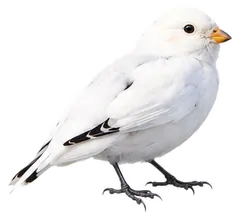 McKay's BuntingPlectrophenax hyperboreus
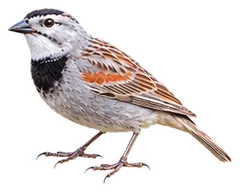 Thick-billed LongspurRhynchophanes mccownii
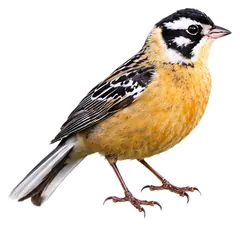 Smith's LongspurCalcarius pictus
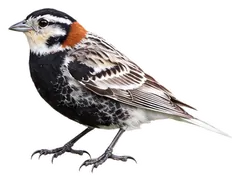 Chestnut-collared LongspurCalcarius ornatus
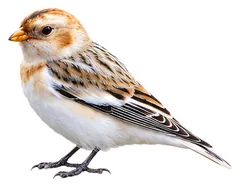
Download illustration
Free to use with credit: “Illustration: Bird Album (birdalbum.com)”. Drawn by AI from a reference photo by Viktor N. Chekan. ↗
Heard it but can't see it? Mingji identifies birds by sound and photo, on your phone.