Tickell's Thrush
Turdus unicolor Tickell, 1833
21–25 cmLength64 gWeight
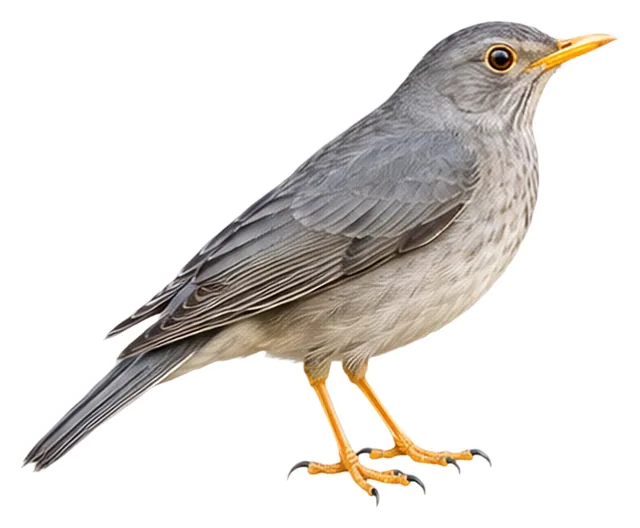
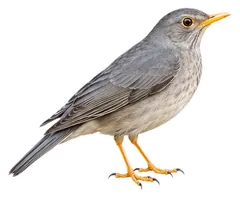
It is a small thrush whose adult male has blue-gray upperparts and a white belly; its bill, legs and feet are yellow.
Busiest months: February and April · Most records: India, Nepal, Bangladesh
How to identify
Field marks
- Male has uniform blue-gray upperparts
- Male has a whitish belly and vent
- Adult has a yellow bill and legs
- Yellow eye-ring, finer and paler than that of Indian Blackbird
Male, female and young
The adult male has blue-gray upperparts; females and juveniles have browner upperparts.
Where and when it's recorded
Busiest months: February and April · Most records: India, Nepal, Bangladesh

Tickell's Thrush has been recorded at 103 of the 8,276 birding hotspots we track, in 6 countries and regions.
Records by month Northern Hemisphere
Where it's recorded most
- SattalIndia680 records
- Bharatpur – Keoladeo Ghana NPIndia178 records
- Rabindra SarovarIndia166 records
More places
- Bhondsi Nature ParkIndia159 records
- Munsyari – Bheema WodeyarIndia151 records
- GKVK CampusIndia141 records
- Wildlife Institute of IndiaIndia104 records
- Ananthagiri Hills, VikarabadIndia102 records
- IISc BangaloreIndia86 records
- PangotIndia83 records
Countries and regions with the most records
eBird records via GBIF up to 2024-12-31. A record means someone listed it; more records partly mean more birders, not more birds.
About
Tickell's thrush (Turdus unicolor) is a passerine bird in the thrush family Turdidae. It is common in open forest in the Himalayas, and migrates seasonally into peninsular India, Nepal and rarely to Bangladesh.
Excerpt from Wikipedia, CC BY-SA 4.0 · authors · Read more on Wikipedia
Questions
How big is the Tickell's Thrush?
The Tickell's Thrush is about 21–25 cm long and weighs around 64 g.
Where does the Tickell's Thrush live?
Its breeding range: Oriental: western, central Himalayas. It is most often recorded in India, Nepal and Bangladesh.
When is the best time to see the Tickell's Thrush?
At the hotspots we track, it is recorded most in February and April (Northern Hemisphere).
Is the Tickell's Thrush endangered?
The IUCN Red List classifies the Tickell's Thrush as Least Concern.
What does the Tickell's Thrush eat?
Main food: Insects & other invertebrates.
What family is the Tickell's Thrush in?
It belongs to the family Thrushes (Turdidae), order Passerines (Passeriformes).
At a glance
- Length
- 21–25 cm
- Weight
- 64 g
- Habitat
- Forest
- Diet
- Insects & other invertebrates
- Lifestyle
- Active on the ground
- Migration
- Resident (barely migrates)
- Conservation
- Least Concern
More measurements
- Wing
- 120 mm
- Tail
- 82 mm
- Bill
- 23 mm
- Tarsus
- 30 mm
Averages from the AVONET dataset; length from field guides where available.
Range
Oriental: western, central Himalayas
Breeding range, IOC World Bird List 15.2
Classification
- Order
- Passerines Passeriformes
- Family
- Thrushes Turdidae
- Genus
- Turdus
Other birds in the genus Turdus
 Ethiopian ThrushTurdus simensis
 Groundscraper ThrushTurdus litsitsirupa
 Chinese ThrushTurdus mupinensis
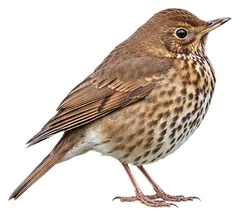 Song ThrushTurdus philomelos
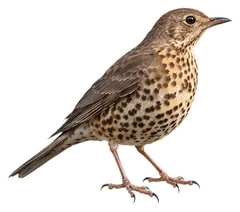 Mistle ThrushTurdus viscivorus
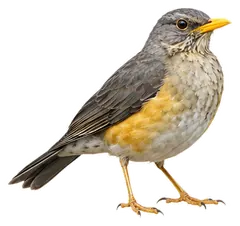 African ThrushTurdus pelios
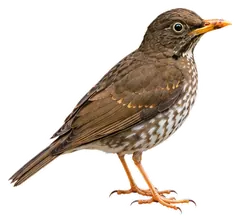 Principe ThrushTurdus xanthorhynchus
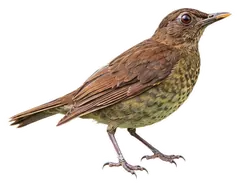 Sao Tome ThrushTurdus olivaceofuscus
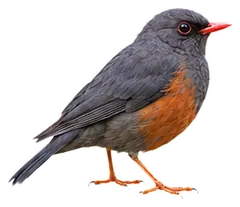 Abyssinian ThrushTurdus abyssinicus
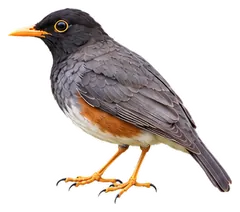 Taita ThrushTurdus helleri
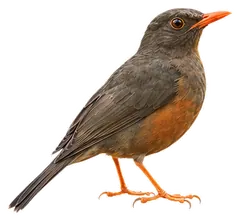 Usambara ThrushTurdus roehli
 Olive ThrushTurdus olivaceus
Download illustration
Free to use with credit: “Illustration: Bird Album (birdalbum.com)”. Drawn by AI from a reference photo by Avinash Bhagat. ↗
Heard it but can't see it? Mingji identifies birds by sound and photo, on your phone.