 Bird Album
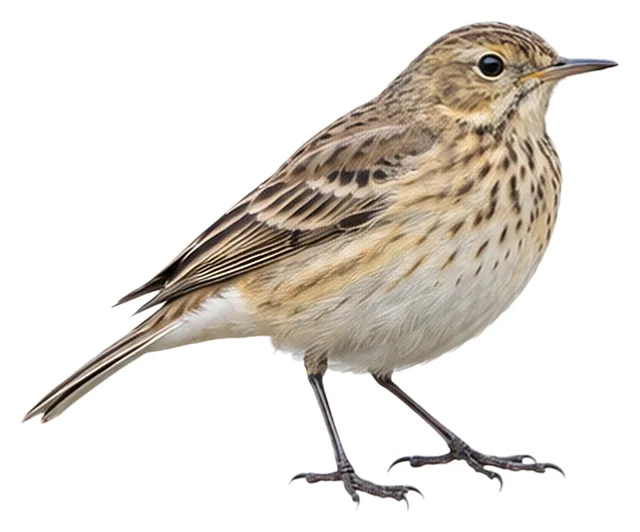
American Pipit
Anthus rubescens (Tunstall, 1771)
16 cmLength24 cmWingspan21 gWeight
This small gray-brown bird often runs about on the ground.
Busiest months: October–November · Most records: United States, Canada, Mexico
How to identify
Field marks
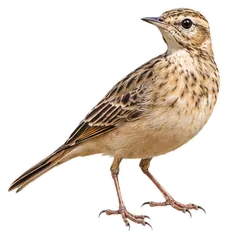
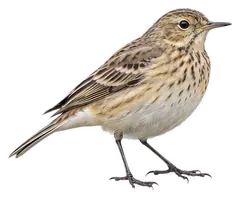
- Upperparts gray-brown with paler streaks
- Breast and flanks pale yellowish-brown with indistinct streaks
- Belly whitish
- Bill, legs and feet dark
Voice
The call is a thin, high-pitched “sip”.
Where and when it's recorded

American Pipit has been recorded at 794 of the 8,171 birding hotspots we track, in 15 countries and regions.
Records by month Northern Hemisphere
Where it's recorded most
- Southeast Farallon IslandUnited States4,816 records
- Hornsby BendUnited States4,698 records
- Riparian Preserve at Gilbert Water RanchUnited States4,074 records
More places
- San Jacinto Wildlife AreaUnited States3,773 records
- Whitefish PointUnited States3,703 records
- Glendale Recharge PondsUnited States3,314 records
- Piute PondsUnited States2,899 records
- IRWD San Joaquin Marsh & Wildlife Sanctuary, IrvineUnited States2,815 records
- Yolo Bypass Wildlife AreaUnited States2,807 records
- Hagerman NWRUnited States2,778 records
Countries and regions with the most records
eBird records via GBIF up to 2024-12-31. A record means someone listed it; more records partly mean more birders, not more birds.
About
The American pipit (Anthus rubescens), formerly known as the buff-bellied pipit, is a small songbird native to North America. It was first described by Marmaduke Tunstall in his 1771 Ornithologia Britannica. It was formerly classified as a form of the water pipit.
Excerpt from Wikipedia, CC BY-SA 4.0 · authors · Read more on Wikipedia
Questions
How big is the American Pipit?
The American Pipit is about 16 cm long, with a wingspan of 24 cm and weighs around 21 g.
Where does the American Pipit live?
Its breeding range: North America: Canada and Alaska to northeastern USA and Greenland. Also central, southern Rocky Mountains (western North America). It is most often recorded in United States, Canada and Mexico.
When is the best time to see the American Pipit?
At the hotspots we track, it is recorded most in October and November (Northern Hemisphere).
Is the American Pipit endangered?
The IUCN Red List classifies the American Pipit as Least Concern.
What does the American Pipit eat?
Main food: Insects & other invertebrates.
What family is the American Pipit in?
It belongs to the family Wagtails, Pipits (Motacillidae), order Passerines (Passeriformes).
At a glance
- Length
- 16 cm
- Wingspan
- 24 cm
- Weight
- 21 g
- Habitat
- Grassland
- Diet
- Insects & other invertebrates
- Lifestyle
- Active on the ground
- Migration
- Migratory
- Conservation
- Least Concern
More measurements
- Wing
- 85 mm
- Tail
- 68 mm
- Bill
- 14 mm
- Tarsus
- 21 mm
Averages from the AVONET dataset; length from field guides where available.
Range
North America: Canada and Alaska to northeastern USA and Greenland. Also central, southern Rocky Mountains (western North America)
Breeding range, IOC World Bird List 15.2
Classification
- Order
- Passerines Passeriformes
- Family
- Wagtails, Pipits Motacillidae
- Genus
- Anthus
Other birds in the genus Anthus
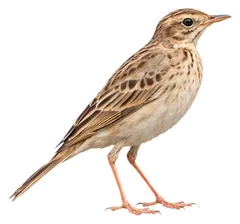 Richard's PipitAnthus richardi
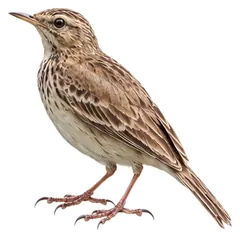 Paddyfield PipitAnthus rufulus
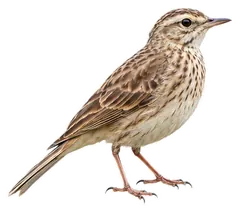 Australian PipitAnthus australis
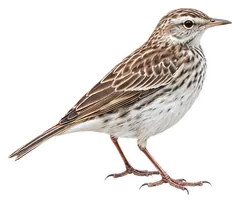 New Zealand PipitAnthus novaeseelandiae
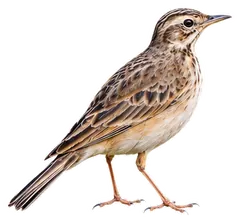 African PipitAnthus cinnamomeus
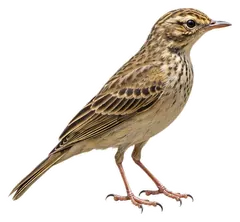 Mountain PipitAnthus hoeschi
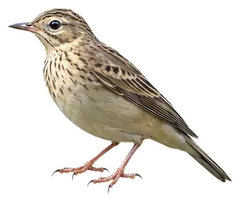 Blyth's PipitAnthus godlewskii
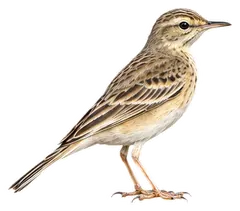 Tawny PipitAnthus campestris
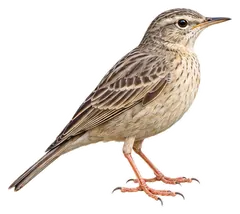 Long-billed PipitAnthus similis
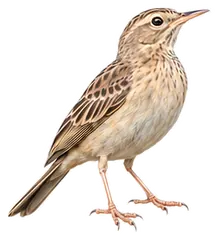 Nicholson's PipitAnthus nicholsoni
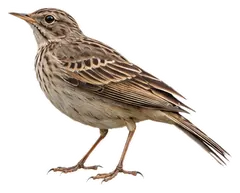 Wood PipitAnthus nyassae
 Buffy PipitAnthus vaalensis
Download illustration
Free to use with credit: “Illustration: Bird Album (birdalbum.com)”. Drawn by AI from a reference photo by Juan Miguel Artigas Azas. ↗
Heard it but can't see it? Mingji identifies birds by sound and photo, on your phone.
In other languages
- EnglishAmerican Pipit
- 简体中文美洲鹨
- 繁體中文黃腹鷚
- 日本語アメリカタヒバリ
- 한국어밭종다리
- DeutschPazifikpieper
- FrançaisPipit d’Amérique
- EspañolBisbita norteamericano
- Portuguêspetinha-americana
- ItalianoSpioncello del Pacifico
- NederlandsAmerikaanse Waterpieper
- РусскийГольцовый конёк
- Svenskaamerikansk piplärka
- DanskHedepiber
- Polskiświergotek bagienny