 Bird Album
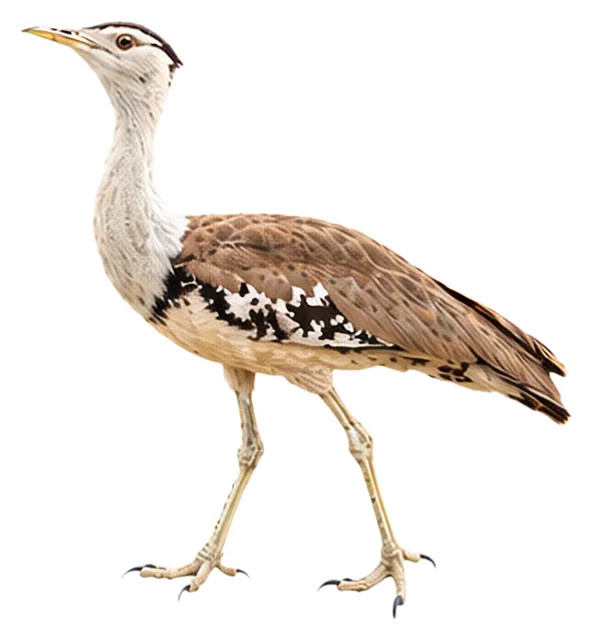
Australian Bustard
Ardeotis australis (Gray, JE, 1829)
4.2 kgWeight
The Australian bustard (Ardeotis australis) is a large ground-dwelling bird that is common in grassland, woodland and open agricultural country across northern Australia and southern New Guinea.
Busiest months: May–October · Most records: Australia
Where and when it's recorded

Australian Bustard has been recorded at 30 of the 8,171 birding hotspots we track, in 1 country or region.
Records by month Southern Hemisphere
Where it's recorded most
- Townsville Town Common Conservation ParkAustralia723 records
- Carlyle Gardens Retirement Resort, TownsvilleAustralia636 records
- Roebuck Plains StationAustralia479 records
More places
- Katherine Wastewater Treatment PlantAustralia448 records
- Bowra Wildlife SanctuaryAustralia279 records
- Taylors LagoonAustralia146 records
- Cumberland DamAustralia114 records
- Lake EdaAustralia53 records
- Broome Bird ObservatoryAustralia28 records
- Kingfisher Park Birdwatchers LodgeAustralia22 records
Countries and regions with the most records
eBird records via GBIF up to 2024-12-31. A record means someone listed it; more records partly mean more birders, not more birds.
About
The Australian bustard (Ardeotis australis) is a large ground-dwelling bird that is common in grassland, woodland and open agricultural country across northern Australia and southern New Guinea. It stands at about one metre (3 ft 3 in) high, and its wingspan is around twice that length. The species is nomadic, flying to areas when food becomes plentiful, and capable of travelling long distances.
Excerpt from Wikipedia, CC BY-SA 4.0 · authors · Read more on Wikipedia
Questions
How big is the Australian Bustard?
The Australian Bustard weighs around 4.2 kg.
Where does the Australian Bustard live?
Its breeding range: Australasia: Trans-Fly (south-central New Guinea) and Australia (except southeastern, Tasmania). It is most often recorded in Australia.
When is the best time to see the Australian Bustard?
At the hotspots we track, it is recorded most in May, June, July, August, September and October (Southern Hemisphere).
Is the Australian Bustard endangered?
The IUCN Red List classifies the Australian Bustard as Least Concern.
What does the Australian Bustard eat?
Main food: Omnivore.
What family is the Australian Bustard in?
It belongs to the family Bustards (Otididae), order Otidiformes.
At a glance
- Weight
- 4.2 kg
- Habitat
- Grassland
- Diet
- Omnivore
- Lifestyle
- Active on the ground
- Migration
- Resident (barely migrates)
- Conservation
- Least Concern
More measurements
- Wing
- 592 mm
- Tail
- 304 mm
- Bill
- 79 mm
- Tarsus
- 176 mm
Averages from the AVONET dataset; length from field guides where available.
Range
Australasia: Trans-Fly (south-central New Guinea) and Australia (except southeastern, Tasmania)
Breeding range, IOC World Bird List 15.2
Classification
- Order
- Otidiformes
- Family
- Bustards Otididae
- Genus
- Ardeotis
Other birds in the genus Ardeotis
 Arabian BustardArdeotis arabs
 Kori BustardArdeotis kori
 Great Indian BustardArdeotis nigriceps
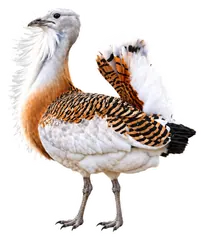 Great BustardOtis tarda
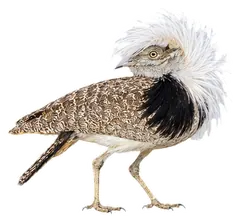 African HoubaraChlamydotis undulata
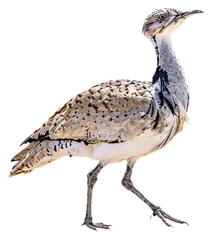 Asian HoubaraChlamydotis macqueenii
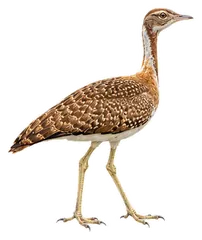 Ludwig's BustardNeotis ludwigii
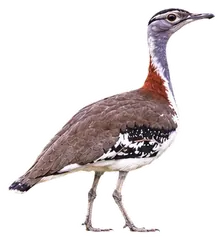 Denham's BustardNeotis denhami
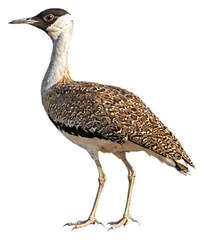 Heuglin's BustardNeotis heuglinii
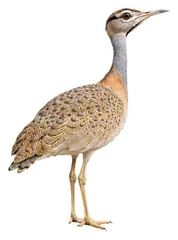 Nubian BustardNeotis nuba
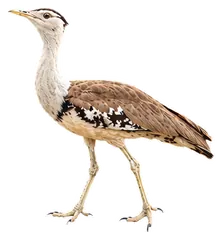
Download illustration
Free to use with credit: “Illustration: Bird Album (birdalbum.com)”. Drawn by AI from reference photos. ↗
Heard it but can't see it? Mingji identifies birds by sound and photo, on your phone.
In other languages
- EnglishAustralian Bustard
- 简体中文澳洲鹭鸨
- 繁體中文澳洲鷺鴇
- 日本語オーストラリアオオノガン
- DeutschWammentrappe
- FrançaisOutarde d’Australie
- EspañolAvutarda australiana
- Portuguêsabetarda-australiana
- ItalianoOtarda australiana
- NederlandsAustralische Trap
- РусскийАвстралийская дрофа
- Svenskaaustralisk trapp
- DanskAustralsk Trappe
- Polskidrop australijski