 Bird Album
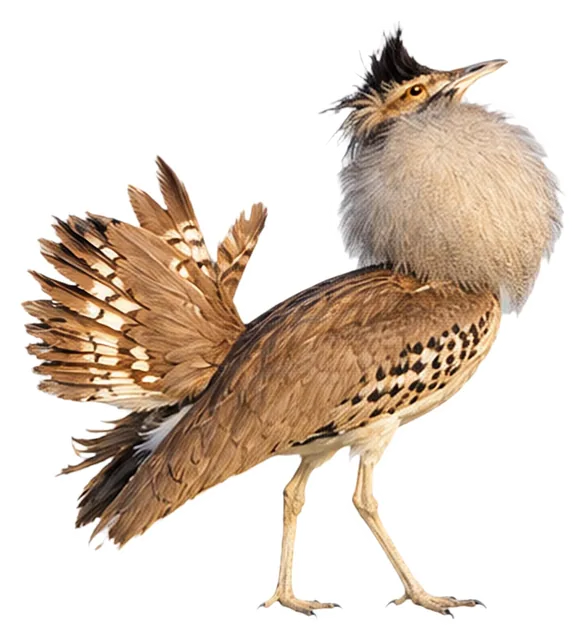
Kori Bustard
Ardeotis kori (Burchell, 1822)
8 kgWeight
The kori bustard (Ardeotis kori) is the largest flying bird native to Africa.
Busiest months: February, July–August and November · Most records: Tanzania, Kenya, South Africa
Where and when it's recorded

Kori Bustard has been recorded at 143 of the 8,171 birding hotspots we track, in 9 countries and regions.
Records by month Southern Hemisphere
Where it's recorded most
- Ngorongoro Conservation Area – Ngorongoro CraterTanzania1,755 records
- Amboseli NPKenya766 records
- Serengeti NPTanzania614 records
More places
- Nairobi NPKenya468 records
- Etosha NP – Okaukuejo CampNamibia461 records
- Chobe NPBotswana338 records
- Samburu NRKenya253 records
- Kruger NP – H1-4/Satara Camp to Olifants RiverSouth Africa246 records
- Ol Pejeta ConservancyKenya200 records
- Kruger NP – Satara CampSouth Africa199 records
Countries and regions with the most records
eBird records via GBIF up to 2024-12-31. A record means someone listed it; more records partly mean more birders, not more birds.
About
The kori bustard (Ardeotis kori) is the largest flying bird native to Africa. It is a member of the bustard family, which all belong to the order Otidiformes and are restricted in distribution to the Old World. It is one of the four species (ranging from Africa to India to Australia) in the large-bodied genus Ardeotis.
Excerpt from Wikipedia, CC BY-SA 4.0 · authors · Read more on Wikipedia
Questions
How big is the Kori Bustard?
The Kori Bustard weighs around 8 kg.
Where does the Kori Bustard live?
Its breeding range: Africa: eastern, southern. It is most often recorded in Tanzania, Kenya and South Africa.
When is the best time to see the Kori Bustard?
At the hotspots we track, it is recorded most in February, July, August and November (Southern Hemisphere).
Is the Kori Bustard endangered?
The IUCN Red List classifies the Kori Bustard as Near Threatened.
What does the Kori Bustard eat?
Main food: Omnivore.
What family is the Kori Bustard in?
It belongs to the family Bustards (Otididae), order Otidiformes.
At a glance
- Weight
- 8 kg
- Habitat
- Grassland
- Diet
- Omnivore
- Lifestyle
- Active on the ground
- Migration
- Resident (barely migrates)
- Conservation
- Near Threatened
More measurements
- Wing
- 710 mm
- Tail
- 353 mm
- Bill
- 112 mm
- Tarsus
- 210 mm
Averages from the AVONET dataset; length from field guides where available.
Range
Africa: eastern, southern
Breeding range, IOC World Bird List 15.2
Classification
- Order
- Otidiformes
- Family
- Bustards Otididae
- Genus
- Ardeotis
Other birds in the genus Ardeotis
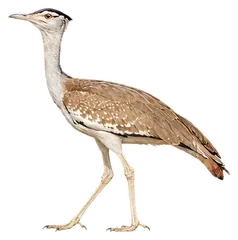 Arabian BustardArdeotis arabs
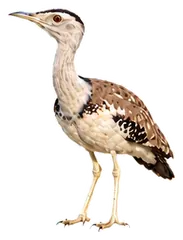 Great Indian BustardArdeotis nigriceps
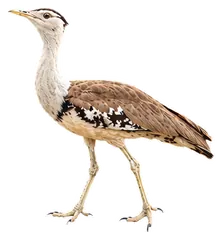 Australian BustardArdeotis australis
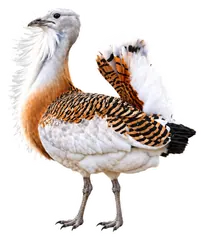 Great BustardOtis tarda
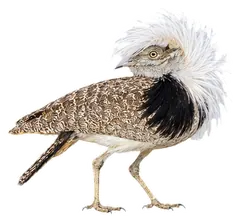 African HoubaraChlamydotis undulata
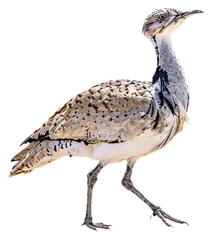 Asian HoubaraChlamydotis macqueenii
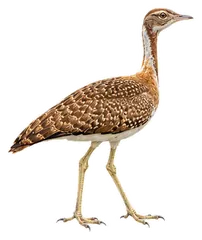 Ludwig's BustardNeotis ludwigii
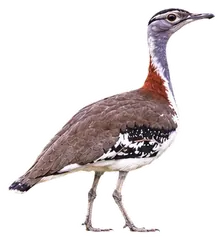 Denham's BustardNeotis denhami
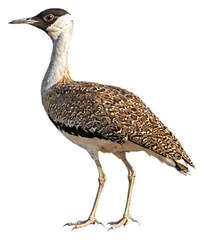 Heuglin's BustardNeotis heuglinii
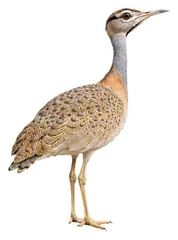 Nubian BustardNeotis nuba
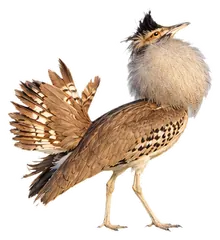
Download illustration
Free to use with credit: “Illustration: Bird Album (birdalbum.com)”. Drawn by AI from a reference photo by Doug Macdonald. ↗
Heard it but can't see it? Mingji identifies birds by sound and photo, on your phone.