 Bird Album
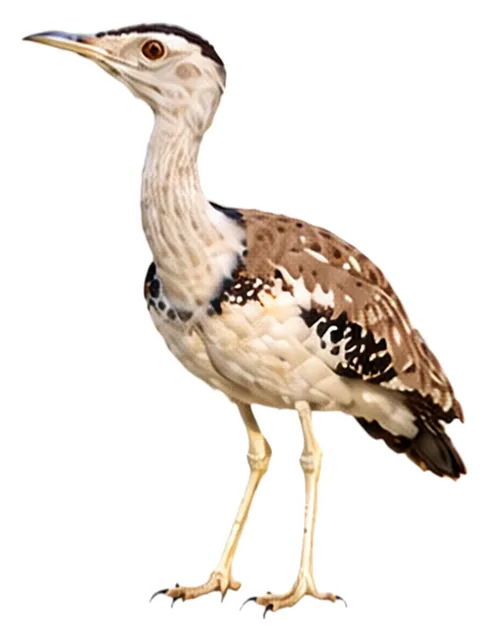
Great Indian Bustard
Ardeotis nigriceps (Vigors, 1831)
7.2 kgWeight
The great Indian bustard (Ardeotis nigriceps) or Indian bustard is a bustard occurring on the Indian subcontinent.
Where and when it's recorded
No records at the public birding hotspots we track. It may be rare, remote, or its locations protected.
About
The great Indian bustard (Ardeotis nigriceps) or Indian bustard is a bustard occurring on the Indian subcontinent. It is a large bird with a horizontal body, long bare legs and is among the heaviest of the flying birds. Once common on the dry grasslands and shrubland in India, as few as 150 individuals were estimated to survive as of 2018, reduced from an estimated 250 individuals in 2011.
Excerpt from Wikipedia, CC BY-SA 4.0 · authors · Read more on Wikipedia
Questions
How big is the Great Indian Bustard?
The Great Indian Bustard weighs around 7.2 kg.
Where does the Great Indian Bustard live?
Its breeding range: Oriental: India.
Is the Great Indian Bustard endangered?
The IUCN Red List classifies the Great Indian Bustard as Critically Endangered.
What does the Great Indian Bustard eat?
Main food: Omnivore.
What family is the Great Indian Bustard in?
It belongs to the family Bustards (Otididae), order Otidiformes.
At a glance
- Weight
- 7.2 kg
- Habitat
- Grassland
- Diet
- Omnivore
- Lifestyle
- Active on the ground
- Migration
- Resident (barely migrates)
- Conservation
- Critically Endangered
More measurements
- Wing
- 618 mm
- Tail
- 257 mm
- Bill
- 89 mm
- Tarsus
- 183 mm
Averages from the AVONET dataset; length from field guides where available.
Range
Oriental: India
Breeding range, IOC World Bird List 15.2
Classification
- Order
- Otidiformes
- Family
- Bustards Otididae
- Genus
- Ardeotis
Other birds in the genus Ardeotis
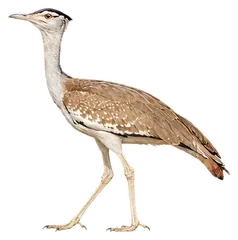 Arabian BustardArdeotis arabs
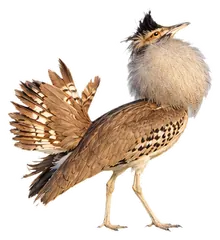 Kori BustardArdeotis kori
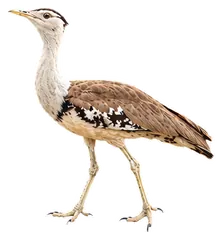 Australian BustardArdeotis australis
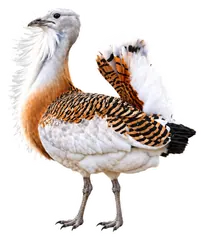 Great BustardOtis tarda
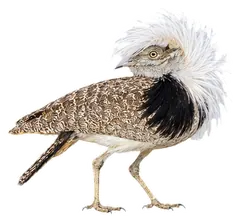 African HoubaraChlamydotis undulata
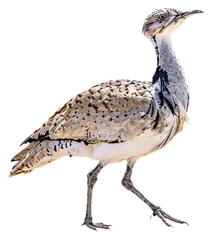 Asian HoubaraChlamydotis macqueenii
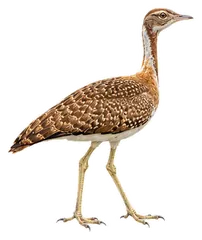 Ludwig's BustardNeotis ludwigii
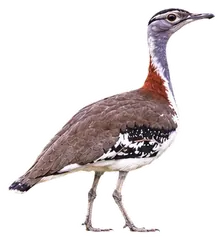 Denham's BustardNeotis denhami
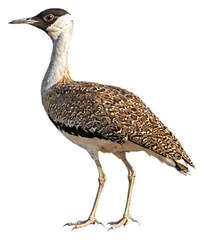 Heuglin's BustardNeotis heuglinii
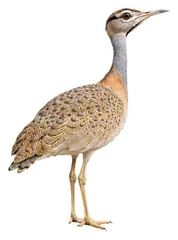 Nubian BustardNeotis nuba
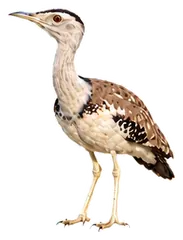
Download illustration
Free to use with credit: “Illustration: Bird Album (birdalbum.com)”. Drawn by AI from a reference photo by Radheshyam Pemani Bishnoi. ↗
Heard it but can't see it? Mingji identifies birds by sound and photo, on your phone.