 Bird Album
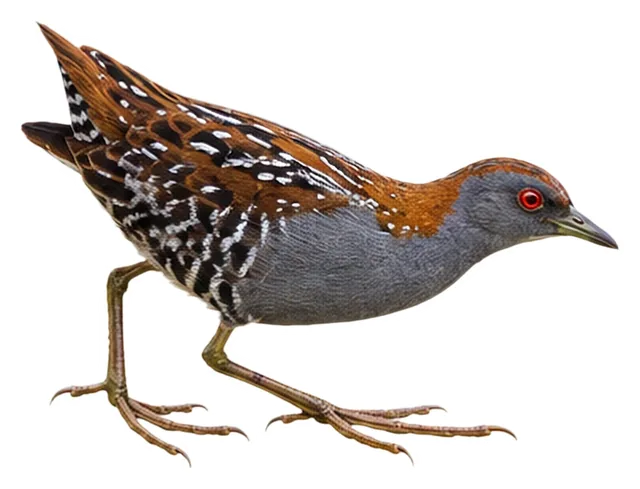
Baillon's Crake
Zapornia pusilla (Pallas, 1776)
16–18 cmLength35 gWeight
It is a small rail with a blue-gray face and underparts that remains well hidden in sedge marshes during the breeding season.
Most records: Australia, India, China
Looks like Little Crake
How to identify
Field marks
- Short, straight yellow or green bill, without a red base
- Blue-gray face and underparts
- Black-and-white barring on the flanks and undertail
- Rufous-brown upperparts with some white spots
Male, female and young
Juvenile resembles the adult but has more stripes on the underparts.
Voice
Loud clucking, like the call of a European Edible Frog or Garganey.
Similar species
Where and when it's recorded

Baillon's Crake has been recorded at 606 of the 8,276 birding hotspots we track, in 71 countries and regions.
Records by month Southern Hemisphere
Where it's recorded most
- Jerrabomberra Wetlands Nature ReserveAustralia1,244 records
- Western Treatment PlantAustralia1,182 records
- Sandy Camp Road WetlandsAustralia679 records
More places
- Changaram Wetlands – EzhupunnaIndia616 records
- Private estate near Green MubazzarahUnited Arab Emirates513 records
- Western Treatment Plant – T Section PondsAustralia509 records
- Anekal Dodda KereIndia437 records
- Baruipur MarshesIndia407 records
- Lake Cargelligo Wastewater Treatment PlantAustralia338 records
- Kannankurichi Mookaneri TankIndia314 records
Countries and regions with the most records
eBird records via GBIF up to 2024-12-31. A record means someone listed it; more records partly mean more birders, not more birds.
About
Baillon's crake (Zapornia pusilla), also known as the marsh crake, is a small waterbird of the family Rallidae.
Excerpt from Wikipedia, CC BY-SA 4.0 · authors · Read more on Wikipedia
Questions
How big is the Baillon's Crake?
The Baillon's Crake is about 16–18 cm long and weighs around 35 g.
Where does the Baillon's Crake live?
Its breeding range: Palearctic, Africa, Oriental, Australasia: widespread. It is most often recorded in Australia, India and China.
Is the Baillon's Crake endangered?
The IUCN Red List classifies the Baillon's Crake as Least Concern.
What does the Baillon's Crake eat?
Main food: Fish, shrimp & shellfish.
What family is the Baillon's Crake in?
It belongs to the family Rails, Crakes & Coots (Rallidae), order Gruiformes.
At a glance
- Length
- 16–18 cm
- Weight
- 35 g
- Habitat
- Wetland
- Diet
- Fish, shrimp & shellfish
- Lifestyle
- Active on the ground
- Migration
- Migratory
- Conservation
- Least Concern
More measurements
- Wing
- 84 mm
- Tail
- 32 mm
- Bill
- 17 mm
- Tarsus
- 25 mm
Averages from the AVONET dataset; length from field guides where available.
Range
Palearctic, Africa, Oriental, Australasia: widespread
Breeding range, IOC World Bird List 15.2
Subspecies · 1
- Zapornia pusilla pusilla e Europe to c, e Asia | non-breeding: s, se Asia to s China, Philippines and Indonesian Arch.
Classification
- Order
- Gruiformes
- Family
- Rails, Crakes & Coots Rallidae
- Genus
- Zapornia
Other birds in the genus Zapornia
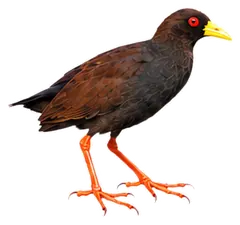 Black CrakeZapornia flavirostra
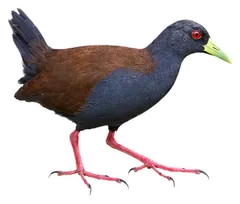 Sakalava RailZapornia olivieri
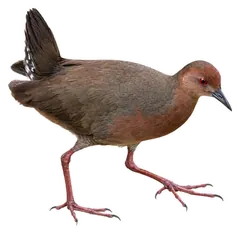 Ruddy-breasted CrakeZapornia fusca
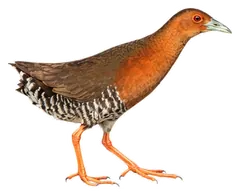 Band-bellied CrakeZapornia paykullii
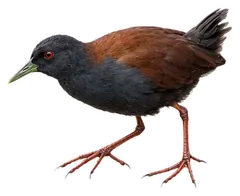 Black-tailed CrakeZapornia bicolor
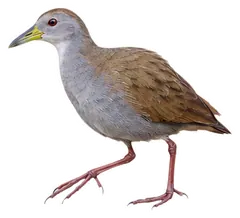 Brown CrakeZapornia akool
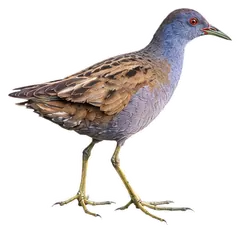 Little CrakeZapornia parva
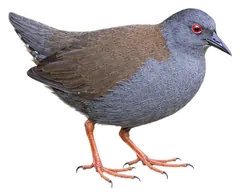 Spotless CrakeZapornia tabuensis
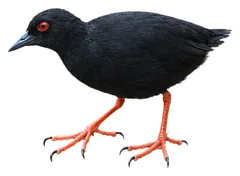 Henderson CrakeZapornia atra
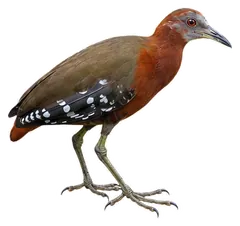 Grey-throated RailCanirallus oculeus
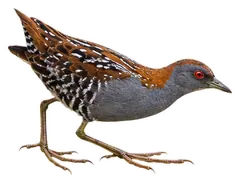
Download illustration
Free to use with credit: “Illustration: Bird Album (birdalbum.com)”. Drawn by AI from a reference photo by David Barros Cardona. ↗
Heard it but can't see it? Mingji identifies birds by sound and photo, on your phone.