 Bird Album
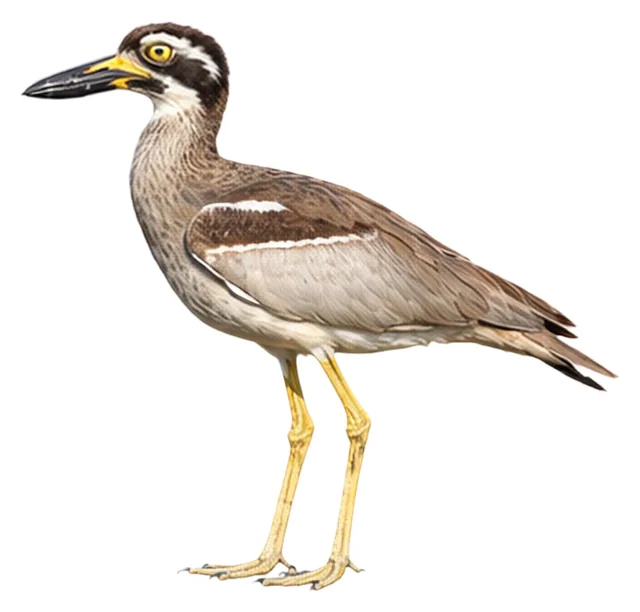
Beach Stone-curlew
Esacus magnirostris (Vieillot, 1818)
54–56 cmLength1 kgWeight
This large coastal bird walks slowly when foraging, occasionally breaking into a short run.
Busiest months: October · Most records: Australia, Indonesia, Timor-Leste
How to identify
Field marks
- Black-and-white face
- Yellow eyes
- Gray-brown upperparts
Voice
Gives “chwip-chwip” alarm calls to drive off intruders.
Where and when it's recorded

Beach Stone-curlew has been recorded at 48 of the 8,171 birding hotspots we track, in 7 countries and regions.
Records by month Southern Hemisphere
Where it's recorded most
- Kakadu BeachAustralia1,138 records
- Cairns EsplanadeAustralia742 records
- Cairns Esplanade – Northern EndAustralia285 records
More places
- Buffalo CreekAustralia203 records
- Bushland BeachAustralia200 records
- Cairns Esplanade – Southern EndAustralia170 records
- East PointAustralia152 records
- Shoalhaven Heads InletAustralia132 records
- Buckleys Hole Conservation Park – Buckleys HoleAustralia85 records
- Pulau SeranganIndonesia77 records
Countries and regions with the most records
eBird records via GBIF up to 2024-12-31. A record means someone listed it; more records partly mean more birders, not more birds.
About
The beach stone-curlew (Esacus magnirostris) or beach thick-knee is a large, ground-dwelling bird that occurs in Australasia, the islands of South-east Asia.
Excerpt from Wikipedia, CC BY-SA 4.0 · authors · Read more on Wikipedia
Questions
How big is the Beach Stone-curlew?
The Beach Stone-curlew is about 54–56 cm long and weighs around 1 kg.
Where does the Beach Stone-curlew live?
Its breeding range: Oriental, Australasia: coasts and islets of tropical eastern Indian and western Pacific oceans: Andaman Islands, Malay Peninsula and southwestern, southern Philippines, Indonesian Archipelago, New Guinea and satellites, north-central Western Australia to southeastern New South Wales (northwestern, northern, eastern Australia), Bismarck Archipelago (including Admiralty Islands), north to southeastern Solomon Islands (except Rennell). It is most often recorded in Australia, Indonesia and Timor-Leste.
When is the best time to see the Beach Stone-curlew?
At the hotspots we track, it is recorded most in October (Southern Hemisphere).
Is the Beach Stone-curlew endangered?
The IUCN Red List classifies the Beach Stone-curlew as Near Threatened.
What does the Beach Stone-curlew eat?
Main food: Insects & other invertebrates.
What family is the Beach Stone-curlew in?
It belongs to the family Stone-curlews, Thick-knees (Burhinidae), order Charadriiformes.
At a glance
- Length
- 54–56 cm
- Weight
- 1 kg
- Habitat
- Coast & tidal flats
- Diet
- Insects & other invertebrates
- Lifestyle
- Active on the ground
- Migration
- Partial migrant
- Conservation
- Near Threatened
More measurements
- Wing
- 271 mm
- Tail
- 116 mm
- Bill
- 76 mm
- Tarsus
- 89 mm
Averages from the AVONET dataset; length from field guides where available.
Range
Oriental, Australasia: coasts and islets of tropical eastern Indian and western Pacific oceans: Andaman Islands, Malay Peninsula and southwestern, southern Philippines, Indonesian Archipelago, New Guinea and satellites, north-central Western Australia to southeastern New South Wales (northwestern, northern, eastern Australia), Bismarck Archipelago (including Admiralty Islands), north to southeastern Solomon Islands (except Rennell)
Breeding range, IOC World Bird List 15.2
Classification
- Order
- Charadriiformes
- Family
- Stone-curlews, Thick-knees Burhinidae
- Genus
- Esacus
Other birds in the genus Esacus
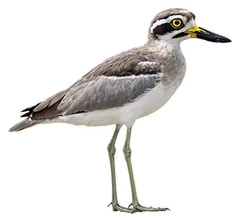 Great Stone-curlewEsacus recurvirostris
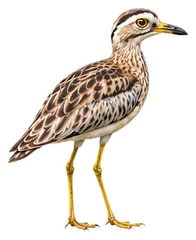 Double-striped Thick-kneeHesperoburhinus bistriatus
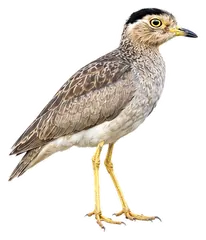 Peruvian Thick-kneeHesperoburhinus superciliaris
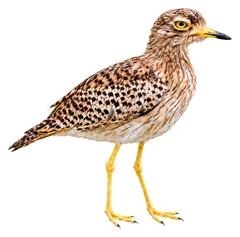 Spotted Thick-kneeBurhinus capensis
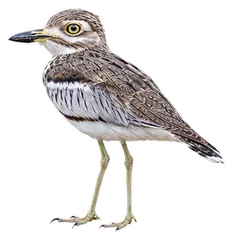 Water Thick-kneeBurhinus vermiculatus
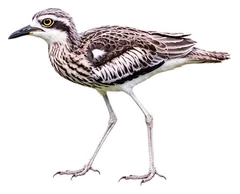 Bush Stone-curlewBurhinus grallarius
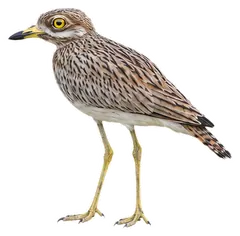 Eurasian Stone-curlewBurhinus oedicnemus
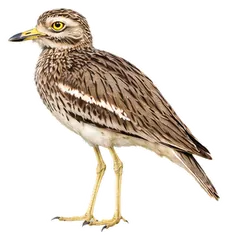 Indian Stone-curlewBurhinus indicus
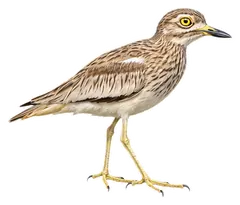 Senegal Thick-kneeBurhinus senegalensis
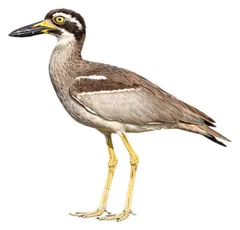
Download illustration
Free to use with credit: “Illustration: Bird Album (birdalbum.com)”. Drawn by AI from a reference photo by Carlos N. G. Bocos. ↗
Heard it but can't see it? Mingji identifies birds by sound and photo, on your phone.