 Bird Album
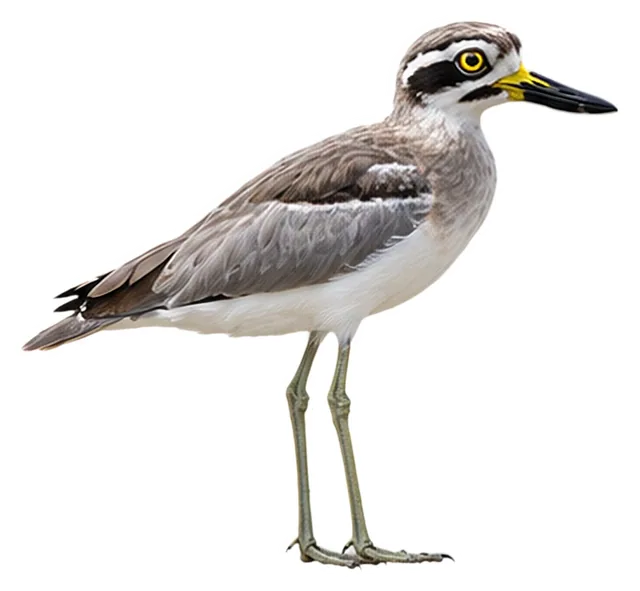
Great Stone-curlew
Esacus recurvirostris (Cuvier, 1829)
≈53 cmLength95 cmWingspan790 gWeight
It has a black-and-white face and a large bill that looks slightly upturned.
Busiest months: December–February · Most records: Sri Lanka, India, Thailand
How to identify
Field marks
- Conspicuous black-and-white facial markings
- Black bill with a yellow base
- Bright yellow eyes and greenish-yellow legs and feet
- Gray-brown upperparts and breast, without streaks
Male, female and young
Sexes similar; juveniles slightly paler than adults.
Voice
A wailing whistle, heard mainly at night.
Where and when it's recorded

Great Stone-curlew has been recorded at 112 of the 8,171 birding hotspots we track, in 14 countries and regions.
Records by month Northern Hemisphere
Where it's recorded most
- Bundala NPSri Lanka884 records
- Yala National ParkSri Lanka851 records
- Ranganathittu Bird SanctuaryIndia638 records
More places
- Nameri National Park & SurroundingsIndia324 records
- Ranthambore NPIndia286 records
- Khijadiya Bird SanctuaryIndia235 records
- Wilpattu National ParkSri Lanka192 records
- Bundala Freshwater MarshSri Lanka139 records
- Kaziranga NP & Surroundings – Western RangeIndia122 records
- Corbett NP – DhikalaIndia121 records
Countries and regions with the most records
eBird records via GBIF up to 2024-12-31. A record means someone listed it; more records partly mean more birders, not more birds.
About
The great stone-curlew or great thick-knee (Esacus recurvirostris) is a large wader which is a resident breeder in tropical southern Asia from India, Pakistan, Sri Lanka, Bangladesh into South-east Asia.
Excerpt from Wikipedia, CC BY-SA 4.0 · authors · Read more on Wikipedia
Questions
How big is the Great Stone-curlew?
The Great Stone-curlew is about ≈53 cm long, with a wingspan of 95 cm and weighs around 790 g.
Where does the Great Stone-curlew live?
Its breeding range: Oriental: river systems of southern, Southeast Asia: estuaries of southern Iran; inland Indus Valley (central Pakistan), sub-Himalayan India south to Sri Lanka and east to northern Thailand, northern Cambodia and northern, southern Vietnam. It is most often recorded in Sri Lanka, India and Thailand.
When is the best time to see the Great Stone-curlew?
At the hotspots we track, it is recorded most in January, February and December (Northern Hemisphere).
Is the Great Stone-curlew endangered?
The IUCN Red List classifies the Great Stone-curlew as Near Threatened.
What does the Great Stone-curlew eat?
Main food: Insects & other invertebrates.
What family is the Great Stone-curlew in?
It belongs to the family Stone-curlews, Thick-knees (Burhinidae), order Charadriiformes.
At a glance
- Length
- ≈53 cm
- Wingspan
- 95 cm
- Weight
- 790 g
- Habitat
- Rivers & streams
- Diet
- Insects & other invertebrates
- Lifestyle
- Active on the ground
- Migration
- Partial migrant
- Conservation
- Near Threatened
More measurements
- Wing
- 256 mm
- Tail
- 105 mm
- Bill
- 75 mm
- Tarsus
- 86 mm
Averages from the AVONET dataset; length from field guides where available.
Range
Oriental: river systems of southern, Southeast Asia: estuaries of southern Iran; inland Indus Valley (central Pakistan), sub-Himalayan India south to Sri Lanka and east to northern Thailand, northern Cambodia and northern, southern Vietnam
Breeding range, IOC World Bird List 15.2
Classification
- Order
- Charadriiformes
- Family
- Stone-curlews, Thick-knees Burhinidae
- Genus
- Esacus
Other birds in the genus Esacus
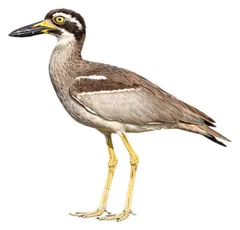 Beach Stone-curlewEsacus magnirostris
 Double-striped Thick-kneeHesperoburhinus bistriatus
 Peruvian Thick-kneeHesperoburhinus superciliaris
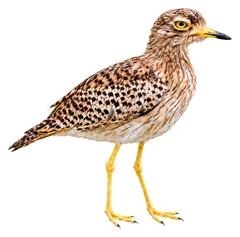 Spotted Thick-kneeBurhinus capensis
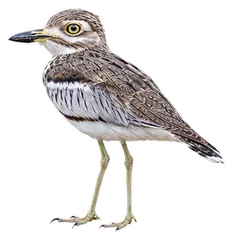 Water Thick-kneeBurhinus vermiculatus
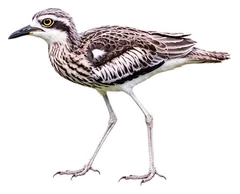 Bush Stone-curlewBurhinus grallarius
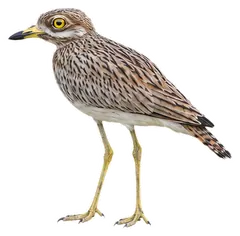 Eurasian Stone-curlewBurhinus oedicnemus
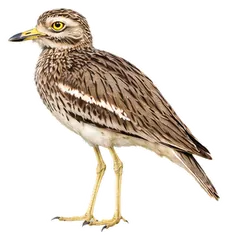 Indian Stone-curlewBurhinus indicus
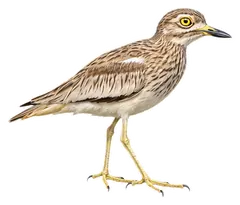 Senegal Thick-kneeBurhinus senegalensis
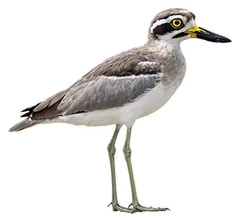
Download illustration
Free to use with credit: “Illustration: Bird Album (birdalbum.com)”. Drawn by AI from a reference photo by Faisal Nayakan. ↗
Heard it but can't see it? Mingji identifies birds by sound and photo, on your phone.