 Bird Album
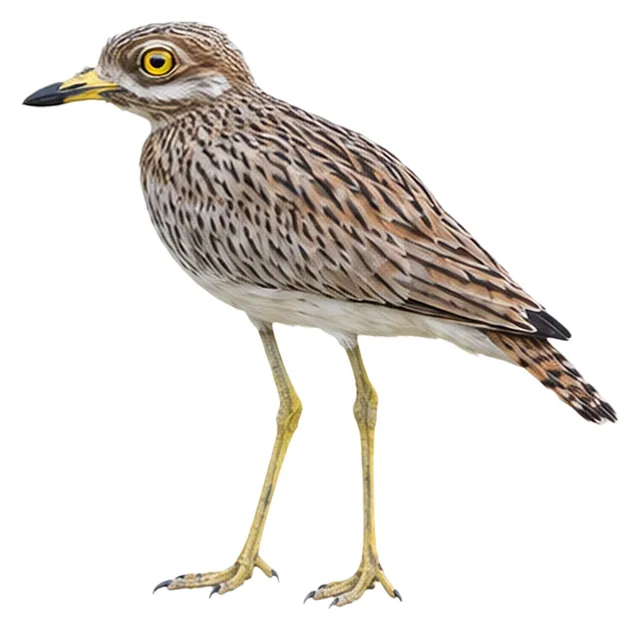
Eurasian Stone-curlew
Burhinus oedicnemus (Linnaeus, 1758)
38–46 cmLength81 cmWingspan459 gWeight
Its large yellow eyes resemble goggles, and it favors dry, open ground.
Busiest months: April · Most records: Spain, Israel, Portugal
How to identify
Field marks
- Large yellow eyes
- Stout, yellow-and-black bill
- Conspicuous black-and-white wing markings when taking flight
Voice
Loud, wailing vocalizations at night, sounding somewhat like curlews.
Where and when it's recorded
Busiest months: April · Most records: Spain, Israel, Portugal

Eurasian Stone-curlew has been recorded at 403 of the 8,276 birding hotspots we track, in 58 countries and regions.
Records by month Northern Hemisphere
Where it's recorded most
- La Breña y Marismas de Barbate PNat – El CañilloSpain948 records
- Poleg MarshIsrael895 records
- Hatzuk Beach TLVIsrael619 records
More places
- Fuente de Piedra – Centro de VisitantesSpain585 records
- Reserva Natural de l'Albufereta – ÀreaSpain543 records
- Hides de Sa Roca i C. Informació, P.N. s'Albufera de MallorcaSpain521 records
- Embalse de San SalvadorSpain475 records
- Txingudi – PlaiaundiSpain457 records
- Hulda ReservoirIsrael371 records
- Lagunas de Campotejar ZEPASpain321 records
Countries and regions with the most records
eBird records via GBIF up to 2024-12-31. A record means someone listed it; more records partly mean more birders, not more birds.
About
The Eurasian stone-curlew, Eurasian thick-knee, or simply stone-curlew (Burhinus oedicnemus), is a northern species of the Burhinidae (stone-curlew) bird family.
Excerpt from Wikipedia, CC BY-SA 4.0 · authors · Read more on Wikipedia
Questions
How big is the Eurasian Stone-curlew?
The Eurasian Stone-curlew is about 38–46 cm long, with a wingspan of 81 cm and weighs around 459 g.
Where does the Eurasian Stone-curlew live?
Its breeding range: Palearctic: western Europe, Canary Islands and northern Africa to Lithuania, northern Kazakhstan and far western China, south to Levant, Iraq and western Pakistan. It is most often recorded in Spain, Israel and Portugal.
When is the best time to see the Eurasian Stone-curlew?
At the hotspots we track, it is recorded most in April (Northern Hemisphere).
Is the Eurasian Stone-curlew endangered?
The IUCN Red List classifies the Eurasian Stone-curlew as Least Concern.
What does the Eurasian Stone-curlew eat?
Main food: Insects & other invertebrates.
What family is the Eurasian Stone-curlew in?
It belongs to the family Stone-curlews, Thick-knees (Burhinidae), order Charadriiformes.
At a glance
- Length
- 38–46 cm
- Wingspan
- 81 cm
- Weight
- 459 g
- Habitat
- Grassland
- Diet
- Insects & other invertebrates
- Lifestyle
- Active on the ground
- Migration
- Migratory
- Conservation
- Least Concern
More measurements
- Wing
- 233 mm
- Tail
- 117 mm
- Bill
- 43 mm
- Tarsus
- 75 mm
Averages from the AVONET dataset; length from field guides where available.
Range
Palearctic: western Europe, Canary Islands and northern Africa to Lithuania, northern Kazakhstan and far western China, south to Levant, Iraq and western Pakistan
Breeding range, IOC World Bird List 15.2
Subspecies · 1
- Burhinus oedicnemus harterti Volga River delta, w to e Kazakhstan to w Xinjiang (w China) and w, c Pakistan
Classification
- Order
- Charadriiformes
- Family
- Stone-curlews, Thick-knees Burhinidae
- Genus
- Burhinus
Other birds in the genus Burhinus
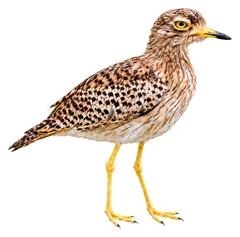 Spotted Thick-kneeBurhinus capensis
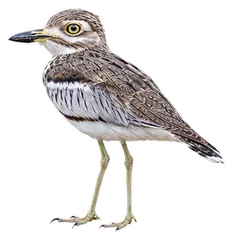 Water Thick-kneeBurhinus vermiculatus
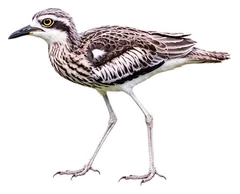 Bush Stone-curlewBurhinus grallarius
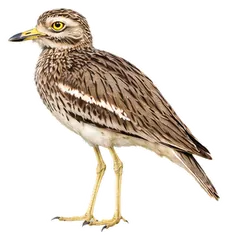 Indian Stone-curlewBurhinus indicus
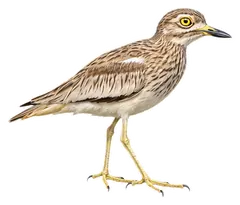 Senegal Thick-kneeBurhinus senegalensis
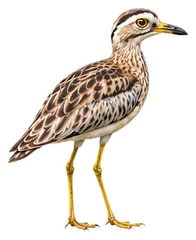 Double-striped Thick-kneeHesperoburhinus bistriatus
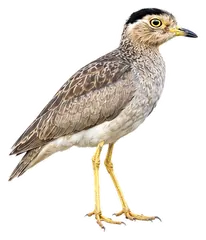 Peruvian Thick-kneeHesperoburhinus superciliaris
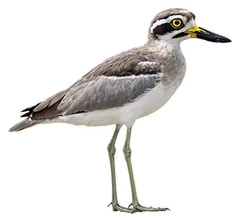 Great Stone-curlewEsacus recurvirostris
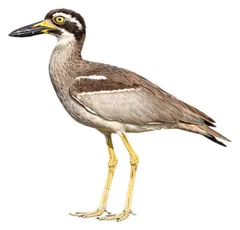 Beach Stone-curlewEsacus magnirostris
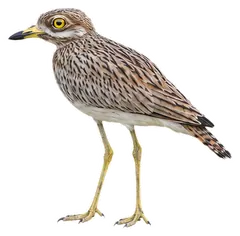
Download illustration
Free to use with credit: “Illustration: Bird Album (birdalbum.com)”. Drawn by AI from a reference photo by lanius2016. ↗
Heard it but can't see it? Mingji identifies birds by sound and photo, on your phone.