 Bird Album
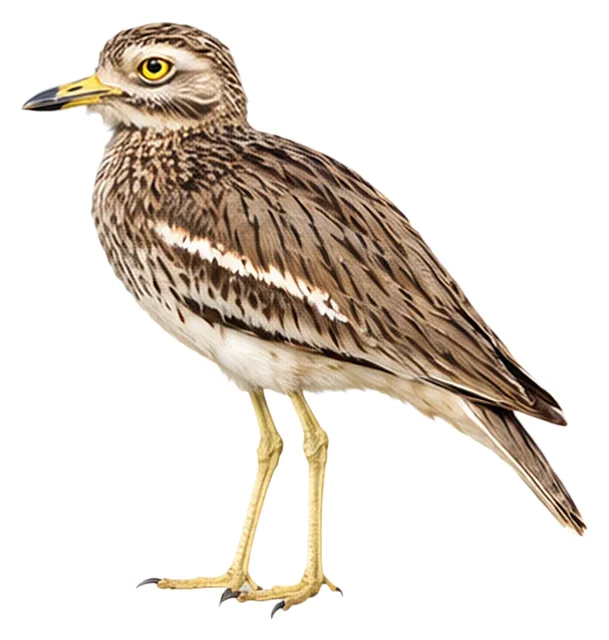
Indian Stone-curlew
Burhinus indicus (Salvadori, 1866)
41 cmLength307 gWeight
The Indian stone-curlew or Indian thick-knee (Burhinus indicus) is a species of bird in the family Burhinidae.
Busiest months: February · Most records: India, Sri Lanka, Nepal
Where and when it's recorded
Busiest months: February · Most records: India, Sri Lanka, Nepal

Indian Stone-curlew has been recorded at 200 of the 8,276 birding hotspots we track, in 10 countries and regions.
Records by month Northern Hemisphere
Where it's recorded most
- Bharatpur – Keoladeo Ghana NPIndia608 records
- Indroda Nature ParkIndia588 records
- Bundala NPSri Lanka514 records
More places
- Kanha NP – Mukki ZoneIndia421 records
- Sultanpur National ParkIndia368 records
- Mysore City Bird Atlas 30B, Srirampura 2nd StageIndia348 records
- Asola Wildlife SanctuaryIndia318 records
- Nameri National Park & SurroundingsIndia285 records
- Gujjar Basti, GaindikhataIndia231 records
- Thrissur Government Medical CollegeIndia217 records
Countries and regions with the most records
eBird records via GBIF up to 2024-12-31. A record means someone listed it; more records partly mean more birders, not more birds.
About
The Indian stone-curlew or Indian thick-knee (Burhinus indicus) is a species of bird in the family Burhinidae. It was formerly included as a subspecies of the Eurasian stone-curlew. This species is found in the plains of South and South-eastern Asia.
Excerpt from Wikipedia, CC BY-SA 4.0 · authors · Read more on Wikipedia
Questions
How big is the Indian Stone-curlew?
The Indian Stone-curlew is about 41 cm long and weighs around 307 g.
Where does the Indian Stone-curlew live?
Its breeding range: Oriental: inland northwestern, western India and Sri Lanka east to central Myanmar, central Thailand, Cambodia and southern Vietnam. It is most often recorded in India, Sri Lanka and Nepal.
When is the best time to see the Indian Stone-curlew?
At the hotspots we track, it is recorded most in February (Northern Hemisphere).
Is the Indian Stone-curlew endangered?
The IUCN Red List classifies the Indian Stone-curlew as Least Concern.
What does the Indian Stone-curlew eat?
Main food: Insects & other invertebrates.
What family is the Indian Stone-curlew in?
It belongs to the family Stone-curlews, Thick-knees (Burhinidae), order Charadriiformes.
At a glance
- Length
- 41 cm
- Weight
- 307 g
- Habitat
- Grassland
- Diet
- Insects & other invertebrates
- Lifestyle
- Active on the ground
- Migration
- Migratory
- Conservation
- Least Concern
More measurements
- Wing
- 204 mm
- Tail
- 98 mm
- Bill
- 42 mm
- Tarsus
- 73 mm
Averages from the AVONET dataset; length from field guides where available.
Range
Oriental: inland northwestern, western India and Sri Lanka east to central Myanmar, central Thailand, Cambodia and southern Vietnam
Breeding range, IOC World Bird List 15.2
Classification
- Order
- Charadriiformes
- Family
- Stone-curlews, Thick-knees Burhinidae
- Genus
- Burhinus
Other birds in the genus Burhinus
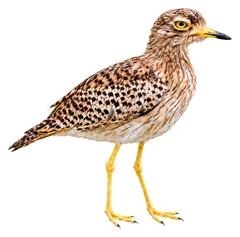 Spotted Thick-kneeBurhinus capensis
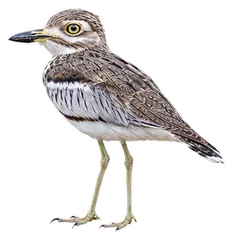 Water Thick-kneeBurhinus vermiculatus
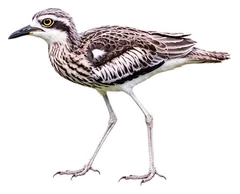 Bush Stone-curlewBurhinus grallarius
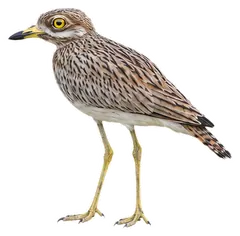 Eurasian Stone-curlewBurhinus oedicnemus
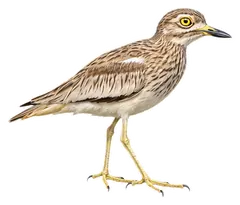 Senegal Thick-kneeBurhinus senegalensis
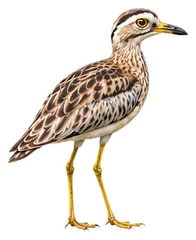 Double-striped Thick-kneeHesperoburhinus bistriatus
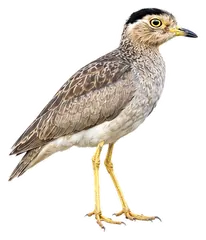 Peruvian Thick-kneeHesperoburhinus superciliaris
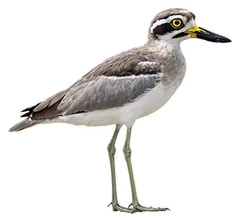 Great Stone-curlewEsacus recurvirostris
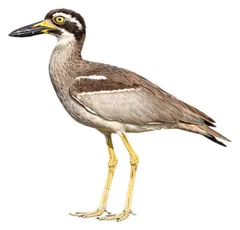 Beach Stone-curlewEsacus magnirostris
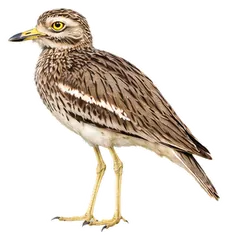
Download illustration
Free to use with credit: “Illustration: Bird Album (birdalbum.com)”. Drawn by AI from a reference photo by Saurabh Agrawal. ↗
Heard it but can't see it? Mingji identifies birds by sound and photo, on your phone.