 Bird Album
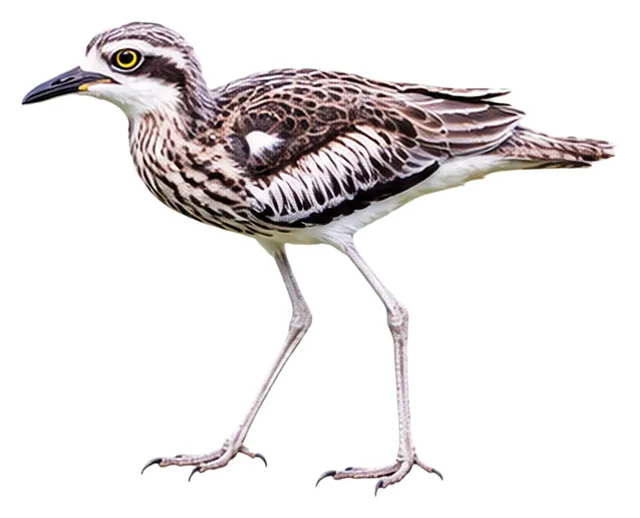
Bush Stone-curlew
Burhinus grallarius (Latham, 1801)
648 gWeight
The bush stone-curlew or bush thick-knee (Burhinus grallarius, obsolete name Burhinus magnirostris) is a large, ground-dwelling bird endemic to Australia.
Busiest months: October · Most records: Australia
Where and when it's recorded
Busiest months: October · Most records: Australia

Bush Stone-curlew has been recorded at 88 of the 8,276 birding hotspots we track, in 1 country or region.
Records by month Southern Hemisphere
Where it's recorded most
- Carlyle Gardens Retirement Resort, TownsvilleAustralia3,293 records
- Cairns EsplanadeAustralia1,212 records
- Cairns Botanical Gardens and Centenary LakesAustralia994 records
More places
- Townsville Town Common Conservation ParkAustralia989 records
- Tyto WetlandsAustralia931 records
- Cairns Esplanade – Southern EndAustralia550 records
- Cattana WetlandsAustralia537 records
- Freshwater and Saltwater LakesAustralia528 records
- East PointAustralia422 records
- Kingfisher Park Birdwatchers LodgeAustralia377 records
Countries and regions with the most records
eBird records via GBIF up to 2024-12-31. A record means someone listed it; more records partly mean more birders, not more birds.
About
The bush stone-curlew or bush thick-knee (Burhinus grallarius, obsolete name Burhinus magnirostris) is a large, ground-dwelling bird endemic to Australia. Its favoured habitat is open plains and woodlands, where it stalks slowly at night in search of invertebrates such as insects. Its grey-brown coloration is distinguished by dark streaks, its eyes are large and legs are long.
Excerpt from Wikipedia, CC BY-SA 4.0 · authors · Read more on Wikipedia
Questions
How big is the Bush Stone-curlew?
The Bush Stone-curlew weighs around 648 g.
Where does the Bush Stone-curlew live?
Its breeding range: Australasia: inland southern Trans-Fly (south-central New Guinea) and Australia (except south-central, Tasmania). It is most often recorded in Australia.
When is the best time to see the Bush Stone-curlew?
At the hotspots we track, it is recorded most in October (Southern Hemisphere).
Is the Bush Stone-curlew endangered?
The IUCN Red List classifies the Bush Stone-curlew as Least Concern.
What does the Bush Stone-curlew eat?
Main food: Insects & other invertebrates.
What family is the Bush Stone-curlew in?
It belongs to the family Stone-curlews, Thick-knees (Burhinidae), order Charadriiformes.
At a glance
- Weight
- 648 g
- Habitat
- Woodland
- Diet
- Insects & other invertebrates
- Lifestyle
- Active on the ground
- Migration
- Migratory
- Conservation
- Least Concern
More measurements
- Wing
- 291 mm
- Tail
- 174 mm
- Bill
- 57 mm
- Tarsus
- 132 mm
Averages from the AVONET dataset; length from field guides where available.
Range
Australasia: inland southern Trans-Fly (south-central New Guinea) and Australia (except south-central, Tasmania)
Breeding range, IOC World Bird List 15.2
Classification
- Order
- Charadriiformes
- Family
- Stone-curlews, Thick-knees Burhinidae
- Genus
- Burhinus
Other birds in the genus Burhinus
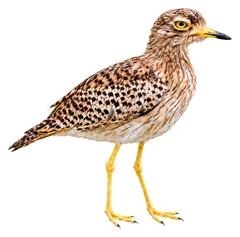 Spotted Thick-kneeBurhinus capensis
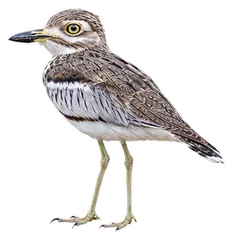 Water Thick-kneeBurhinus vermiculatus
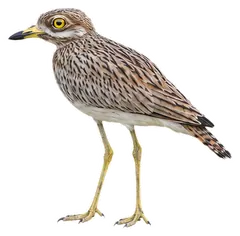 Eurasian Stone-curlewBurhinus oedicnemus
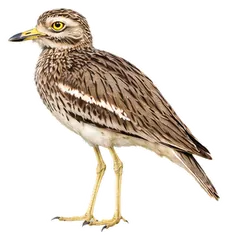 Indian Stone-curlewBurhinus indicus
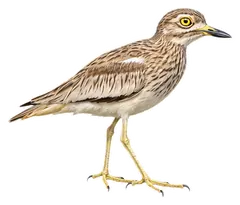 Senegal Thick-kneeBurhinus senegalensis
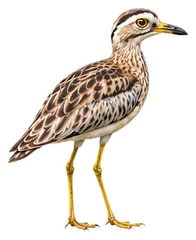 Double-striped Thick-kneeHesperoburhinus bistriatus
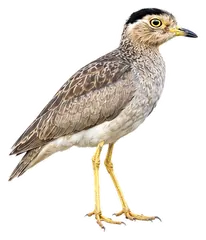 Peruvian Thick-kneeHesperoburhinus superciliaris
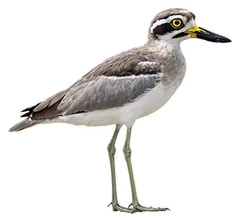 Great Stone-curlewEsacus recurvirostris
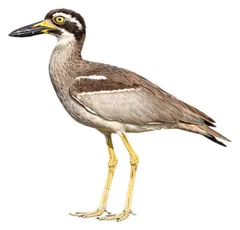 Beach Stone-curlewEsacus magnirostris
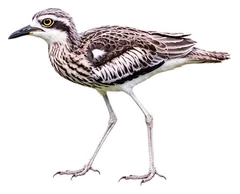
Download illustration
Free to use with credit: “Illustration: Bird Album (birdalbum.com)”. Drawn by AI from a reference photo by David Laurie. ↗
Heard it but can't see it? Mingji identifies birds by sound and photo, on your phone.