 Bird Album
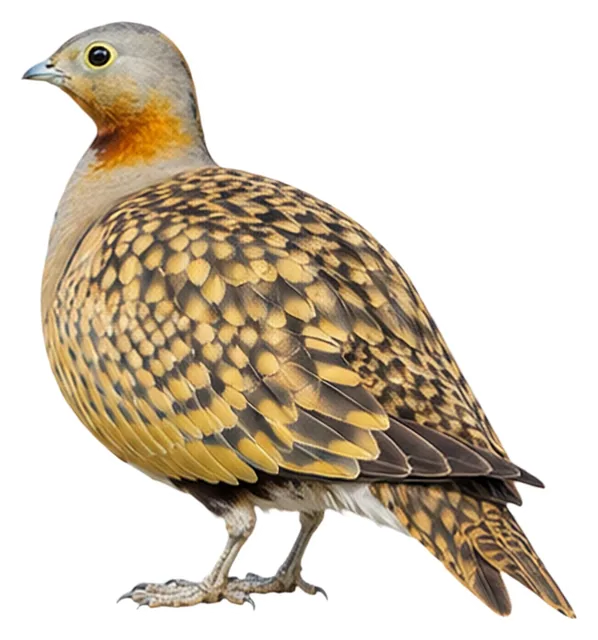
Black-bellied Sandgrouse
Pterocles orientalis (Linnaeus, 1758)
33–39 cmLength72 cmWingspan405 gWeight
In flight, white underwings contrast with a black belly.
Busiest months: May · Most records: Spain, Türkiye, Portugal
How to identify
Field marks
- Belly black
- Underwings white
- Male has a chestnut patch on the throat
- Male head, neck and breast gray
Male, female and young
Female browner, with more numerous fine markings on the upperparts, including the head and breast; belly and breast-band as in the male.
Voice
A soft call, like “chowrrr rrrr-rrrr”.
Where and when it's recorded
Busiest months: May · Most records: Spain, Türkiye, Portugal

Black-bellied Sandgrouse has been recorded at 78 of the 8,276 birding hotspots we track, in 15 countries and regions.
Records by month Northern Hemisphere
Where it's recorded most
- Aras Kuş Halkalama İstasyonuTürkiye688 records
- ZPE Castro Verde – Vale GonçalinhoPortugal378 records
- El Oso – Laguna y entornoSpain332 records
More places
- Azud de RiolobosSpain317 records
- Taukum DesertKazakhstan282 records
- Qanbarabad ReservoirIran265 records
- Tagdilt TrackMorocco264 records
- Lagunas de Villafáfila RNat – ÁreaSpain244 records
- ZPE Castro Verde – área geralPortugal206 records
- Laguna de Gallocanta RN – ÁreaSpain166 records
Countries and regions with the most records
eBird records via GBIF up to 2024-12-31. A record means someone listed it; more records partly mean more birders, not more birds.
Questions
How big is the Black-bellied Sandgrouse?
The Black-bellied Sandgrouse is about 33–39 cm long, with a wingspan of 72 cm and weighs around 405 g.
Where does the Black-bellied Sandgrouse live?
Its breeding range: Palearctic: southwestern, also northern Africa. It is most often recorded in Spain, Türkiye and Portugal.
When is the best time to see the Black-bellied Sandgrouse?
At the hotspots we track, it is recorded most in May (Northern Hemisphere).
Is the Black-bellied Sandgrouse endangered?
The IUCN Red List classifies the Black-bellied Sandgrouse as Least Concern.
What does the Black-bellied Sandgrouse eat?
Main food: Seeds.
What family is the Black-bellied Sandgrouse in?
It belongs to the family Sandgrouse (Pteroclidae), order Pterocliformes.
At a glance
- Length
- 33–39 cm
- Wingspan
- 72 cm
- Weight
- 405 g
- Habitat
- Grassland
- Diet
- Seeds
- Lifestyle
- Active on the ground
- Migration
- Partial migrant
- Conservation
- Least Concern
More measurements
- Wing
- 228 mm
- Tail
- 90 mm
- Bill
- 20 mm
- Tarsus
- 26 mm
Averages from the AVONET dataset; length from field guides where available.
Range
Palearctic: southwestern, also northern Africa
Breeding range, IOC World Bird List 15.2
Subspecies · 1
- Pterocles orientalis arenarius Kazakhstan to s Iran and Afghanistan, e to nw China
Classification
- Order
- Pterocliformes
- Family
- Sandgrouse Pteroclidae
- Genus
- Pterocles
Other birds in the genus Pterocles
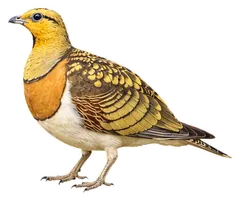 Pin-tailed SandgrousePterocles alchata
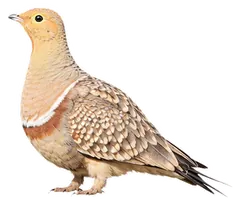 Namaqua SandgrousePterocles namaqua
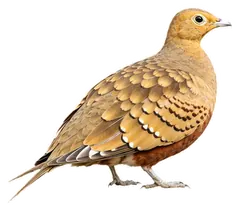 Chestnut-bellied SandgrousePterocles exustus
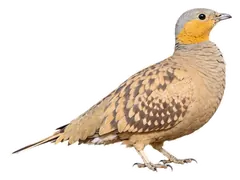 Spotted SandgrousePterocles senegallus
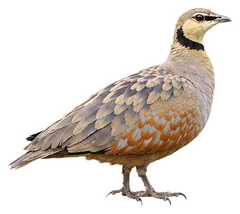 Yellow-throated SandgrousePterocles gutturalis
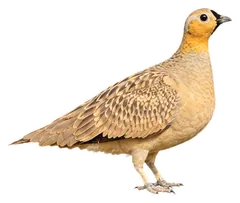 Crowned SandgrousePterocles coronatus
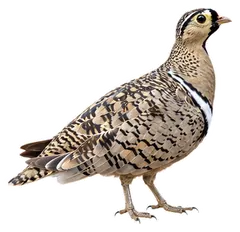 Black-faced SandgrousePterocles decoratus
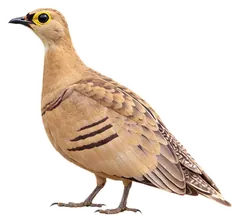 Madagascar SandgrousePterocles personatus
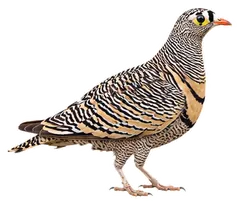 Lichtenstein's SandgrousePterocles lichtensteinii
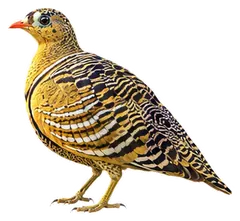 Painted SandgrousePterocles indicus
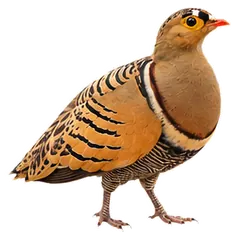 Four-banded SandgrousePterocles quadricinctus
 Double-banded SandgrousePterocles bicinctus
Download illustration
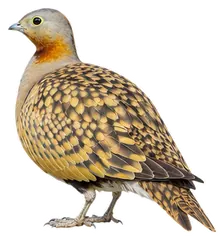
Free to use with credit: “Illustration: Bird Album (birdalbum.com)”. Drawn by AI from a reference photo by Toufik Lemoufek. ↗
Heard it but can't see it? Mingji identifies birds by sound and photo, on your phone.