 Bird Album
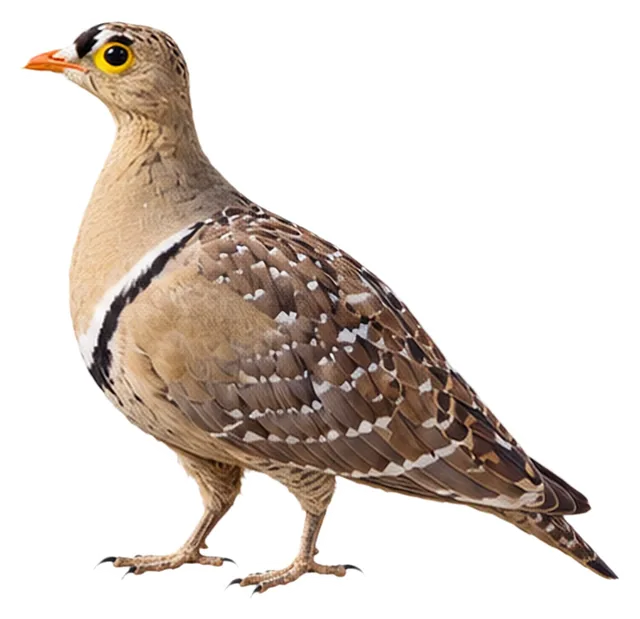
Double-banded Sandgrouse
Pterocles bicinctus Temminck, 1815
237 gWeight
The double-banded sandgrouse (Pterocles bicinctus) is a species of predominantly terrestrial, or ground-dwelling (though not flightless), bird in the family Pteroclidae.
Busiest months: August–September · Most records: Namibia, Botswana, South Africa
Where and when it's recorded
Busiest months: August–September · Most records: Namibia, Botswana, South Africa

Double-banded Sandgrouse has been recorded at 94 of the 8,276 birding hotspots we track, in 6 countries and regions.
Records by month Southern Hemisphere
Where it's recorded most
- Etosha NP – Okaukuejo CampNamibia308 records
- Etosha NP – Halali CampNamibia233 records
- Chobe NPBotswana148 records
More places
- Kruger NP – Satara CampSouth Africa144 records
- Hobatere – LodgeNamibia117 records
- Moremi Game Reserve – KhwaiBotswana105 records
- Moremi Game Reserve – XakanakaBotswana96 records
- Bwabwata NP – Mahango riverside loopNamibia95 records
- Ai Aiba Rock Painting LodgeNamibia92 records
- Okavango Delta – Moremi GRBotswana86 records
Countries and regions with the most records
eBird records via GBIF up to 2024-12-31. A record means someone listed it; more records partly mean more birders, not more birds.
About
The double-banded sandgrouse (Pterocles bicinctus) is a species of predominantly terrestrial, or ground-dwelling (though not flightless), bird in the family Pteroclidae. It is found in arid parts of southern Africa.
Excerpt from Wikipedia, CC BY-SA 4.0 · authors · Read more on Wikipedia
Questions
How big is the Double-banded Sandgrouse?
The Double-banded Sandgrouse weighs around 237 g.
Where does the Double-banded Sandgrouse live?
Its breeding range: Africa: southern. It is most often recorded in Namibia, Botswana and South Africa.
When is the best time to see the Double-banded Sandgrouse?
At the hotspots we track, it is recorded most in August and September (Southern Hemisphere).
Is the Double-banded Sandgrouse endangered?
The IUCN Red List classifies the Double-banded Sandgrouse as Least Concern.
What does the Double-banded Sandgrouse eat?
Main food: Seeds.
What family is the Double-banded Sandgrouse in?
It belongs to the family Sandgrouse (Pteroclidae), order Pterocliformes.
At a glance
- Weight
- 237 g
- Habitat
- Grassland
- Diet
- Seeds
- Lifestyle
- Active on the ground
- Migration
- Resident (barely migrates)
- Conservation
- Least Concern
More measurements
- Wing
- 170 mm
- Tail
- 75 mm
- Bill
- 19 mm
- Tarsus
- 24 mm
Averages from the AVONET dataset; length from field guides where available.
Range
Africa: southern
Breeding range, IOC World Bird List 15.2
Classification
- Order
- Pterocliformes
- Family
- Sandgrouse Pteroclidae
- Genus
- Pterocles
Other birds in the genus Pterocles
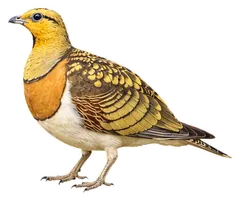 Pin-tailed SandgrousePterocles alchata
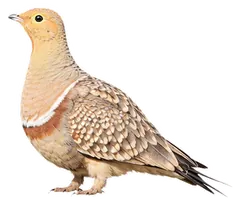 Namaqua SandgrousePterocles namaqua
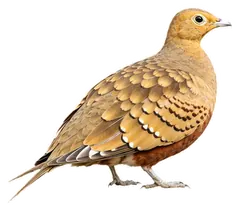 Chestnut-bellied SandgrousePterocles exustus
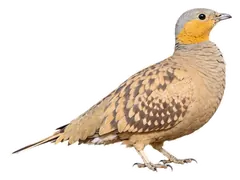 Spotted SandgrousePterocles senegallus
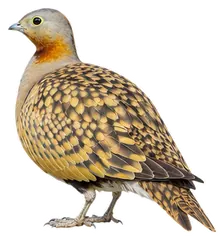 Black-bellied SandgrousePterocles orientalis
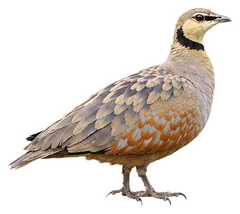 Yellow-throated SandgrousePterocles gutturalis
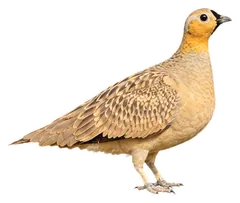 Crowned SandgrousePterocles coronatus
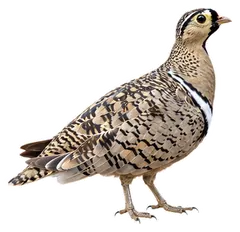 Black-faced SandgrousePterocles decoratus
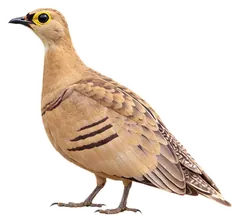 Madagascar SandgrousePterocles personatus
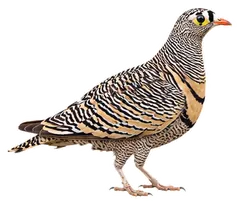 Lichtenstein's SandgrousePterocles lichtensteinii
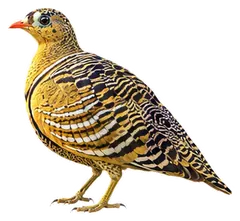 Painted SandgrousePterocles indicus
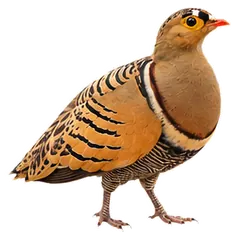 Four-banded SandgrousePterocles quadricinctus
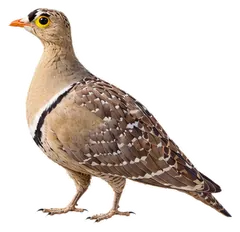
Download illustration
Free to use with credit: “Illustration: Bird Album (birdalbum.com)”. Drawn by AI from a reference photo by John Turner Cambridge. ↗
Heard it but can't see it? Mingji identifies birds by sound and photo, on your phone.
In other languages
- EnglishDouble-banded Sandgrouse
- 简体中文二斑沙鸡
- 繁體中文雙紋沙雞
- 日本語フタオビサケイ
- DeutschNachtflughuhn
- FrançaisGanga bibande
- EspañolGanga bicinta
- Portuguêscortiçol-de-duas-golas
- ItalianoGrandule doppiabanda
- NederlandsDubbelbandzandhoen
- РусскийДвуполосый рябок
- Svenskatvåbandad flyghöna
- DanskTobåndet Sandhøne
- Polskistepówka dwuwstęgowa