 Bird Album
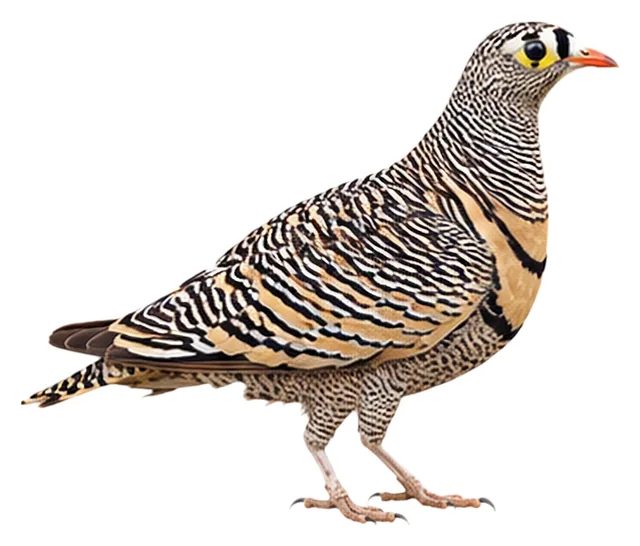
Lichtenstein's Sandgrouse
Pterocles lichtensteinii Temminck, 1825
25 cmLength209 gWeight
Lichtenstein's sandgrouse (Pterocles lichtensteinii) is a species of sandgrouse in the family Pteroclidae.
Busiest months: March · Most records: United Arab Emirates, Israel, Kenya
Where and when it's recorded

Lichtenstein's Sandgrouse has been recorded at 45 of the 8,171 birding hotspots we track, in 12 countries and regions.
Records by month Northern Hemisphere
Where it's recorded most
- Private estate near Green MubazzarahUnited Arab Emirates3,017 records
- Eilat – KM19 Sewage Ponds 19Israel295 records
- International Birding and Research Center Eilat (IBRCE)Israel237 records
More places
- Samburu NRKenya138 records
- Eilat – KM20 Flamingo Pools 20Israel120 records
- Buffalo Springs NRKenya118 records
- Shaba NRKenya82 records
- Doho LodgeEthiopia70 records
- Awash NPEthiopia48 records
- Buffalo Springs NR / Samburu NRKenya42 records
Countries and regions with the most records
eBird records via GBIF up to 2024-12-31. A record means someone listed it; more records partly mean more birders, not more birds.
About
Lichtenstein's sandgrouse (Pterocles lichtensteinii) is a species of sandgrouse in the family Pteroclidae. It is named after the German naturalist Martin Lichtenstein. A small, closely barred bird of stony deserts and arid hills, it ranges across northern and eastern Africa, the Middle East and south-western Asia to Pakistan.
Excerpt from Wikipedia, CC BY-SA 4.0 · authors · Read more on Wikipedia
Questions
How big is the Lichtenstein's Sandgrouse?
The Lichtenstein's Sandgrouse is about 25 cm long and weighs around 209 g.
Where does the Lichtenstein's Sandgrouse live?
Its breeding range: Africa, Palearctic: northwestern Africa to Pakistan. It is most often recorded in United Arab Emirates, Israel and Kenya.
When is the best time to see the Lichtenstein's Sandgrouse?
At the hotspots we track, it is recorded most in March (Northern Hemisphere).
Is the Lichtenstein's Sandgrouse endangered?
The IUCN Red List classifies the Lichtenstein's Sandgrouse as Least Concern.
What does the Lichtenstein's Sandgrouse eat?
Main food: Seeds.
What family is the Lichtenstein's Sandgrouse in?
It belongs to the family Sandgrouse (Pteroclidae), order Pterocliformes.
At a glance
- Length
- 25 cm
- Weight
- 209 g
- Habitat
- Grassland
- Diet
- Seeds
- Lifestyle
- Active on the ground
- Migration
- Resident (barely migrates)
- Conservation
- Least Concern
More measurements
- Wing
- 175 mm
- Tail
- 69 mm
- Bill
- 20 mm
- Tarsus
- 24 mm
Averages from the AVONET dataset; length from field guides where available.
Range
Africa, Palearctic: northwestern Africa to Pakistan
Breeding range, IOC World Bird List 15.2
Classification
- Order
- Pterocliformes
- Family
- Sandgrouse Pteroclidae
- Genus
- Pterocles
Other birds in the genus Pterocles
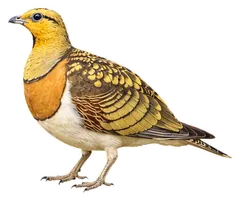 Pin-tailed SandgrousePterocles alchata
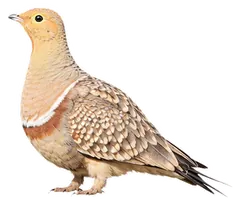 Namaqua SandgrousePterocles namaqua
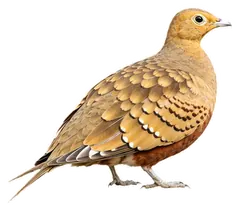 Chestnut-bellied SandgrousePterocles exustus
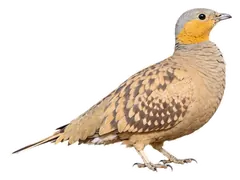 Spotted SandgrousePterocles senegallus
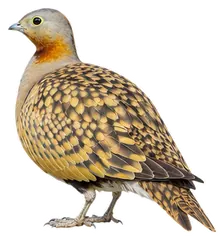 Black-bellied SandgrousePterocles orientalis
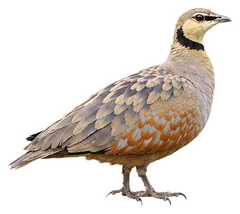 Yellow-throated SandgrousePterocles gutturalis
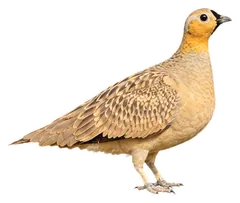 Crowned SandgrousePterocles coronatus
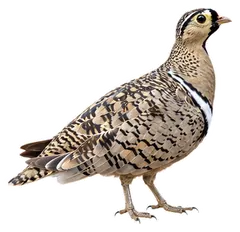 Black-faced SandgrousePterocles decoratus
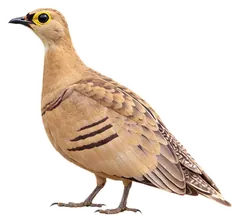 Madagascar SandgrousePterocles personatus
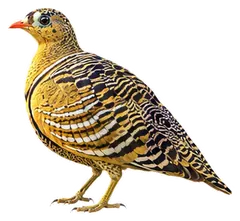 Painted SandgrousePterocles indicus
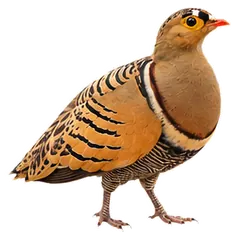 Four-banded SandgrousePterocles quadricinctus
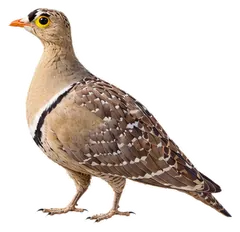 Double-banded SandgrousePterocles bicinctus
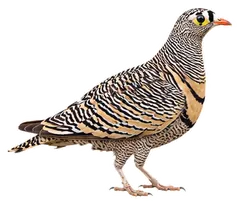
Download illustration
Free to use with credit: “Illustration: Bird Album (birdalbum.com)”. Drawn by AI from a reference photo by capracornelius. ↗
Heard it but can't see it? Mingji identifies birds by sound and photo, on your phone.
In other languages
- EnglishLichtenstein's Sandgrouse
- 简体中文里氏沙鸡
- 繁體中文橫斑沙雞
- 日本語クロビタイサケイ
- DeutschWellenflughuhn
- FrançaisGanga de Lichtenstein
- EspañolGanga de Lichtenstein
- Portuguêscortiçol-pedrês
- ItalianoGrandule di Lichtenstein
- NederlandsLichtensteins Zandhoen
- РусскийРябок Лихтенштейна
- Svenskastrimflyghöna
- DanskLichtenstein´ Sandhøne
- Polskistepówka prążkowana