 Bird Album
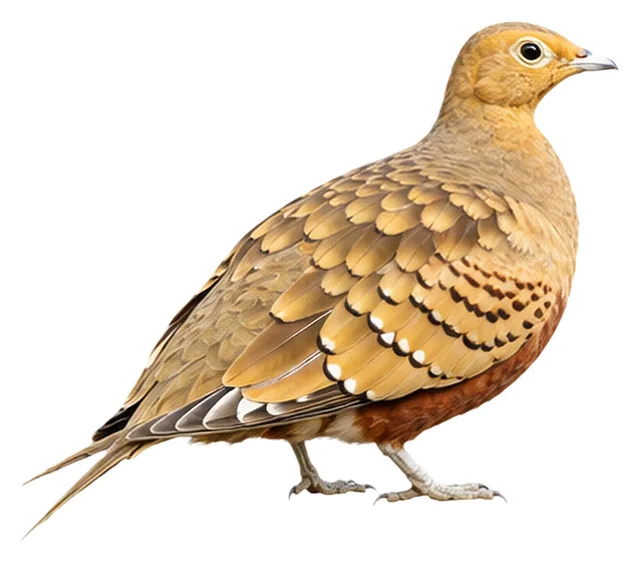
Chestnut-bellied Sandgrouse
Pterocles exustus Temminck, 1825
203 gWeight
The chestnut-bellied sandgrouse or common sandgrouse (Pterocles exustus) is a species of sandgrouse.
Busiest months: February and November · Most records: India, United Arab Emirates, Kenya
Where and when it's recorded
Busiest months: February and November · Most records: India, United Arab Emirates, Kenya

Chestnut-bellied Sandgrouse has been recorded at 137 of the 8,276 birding hotspots we track, in 18 countries and regions.
Records by month Northern Hemisphere
Where it's recorded most
- Wamm FarmsUnited Arab Emirates718 records
- Tal Chhapar SanctuaryIndia575 records
- Amboseli NPKenya551 records
More places
- Jayamangali Blackbuck Conservation ReserveIndia509 records
- Private estate near Green MubazzarahUnited Arab Emirates411 records
- Buffalo Springs NRKenya372 records
- Dubai Pivot FieldsUnited Arab Emirates349 records
- Nalsarovar Bird SanctuaryIndia261 records
- Engikaret Lark PlainsTanzania243 records
- Samburu NRKenya225 records
Countries and regions with the most records
eBird records via GBIF up to 2024-12-31. A record means someone listed it; more records partly mean more birders, not more birds.
About
The chestnut-bellied sandgrouse or common sandgrouse (Pterocles exustus) is a species of sandgrouse. It is a sedentary and nomadic species that ranges from northern and central Africa and further east towards western and southern Asia. There are six recognized subspecies.
Excerpt from Wikipedia, CC BY-SA 4.0 · authors · Read more on Wikipedia
Questions
How big is the Chestnut-bellied Sandgrouse?
The Chestnut-bellied Sandgrouse weighs around 203 g.
Where does the Chestnut-bellied Sandgrouse live?
Its breeding range: Africa, Palearctic, Oriental: western Africa to India. It is most often recorded in India, United Arab Emirates and Kenya.
When is the best time to see the Chestnut-bellied Sandgrouse?
At the hotspots we track, it is recorded most in February and November (Northern Hemisphere).
Is the Chestnut-bellied Sandgrouse endangered?
The IUCN Red List classifies the Chestnut-bellied Sandgrouse as Least Concern.
What does the Chestnut-bellied Sandgrouse eat?
Main food: Seeds.
What family is the Chestnut-bellied Sandgrouse in?
It belongs to the family Sandgrouse (Pteroclidae), order Pterocliformes.
At a glance
- Weight
- 203 g
- Habitat
- Grassland
- Diet
- Seeds
- Lifestyle
- Active on the ground
- Migration
- Partial migrant
- Conservation
- Least Concern
More measurements
- Wing
- 175 mm
- Tail
- 110 mm
- Bill
- 17 mm
- Tarsus
- 22 mm
Averages from the AVONET dataset; length from field guides where available.
Range
Africa, Palearctic, Oriental: western Africa to India
Breeding range, IOC World Bird List 15.2
Classification
- Order
- Pterocliformes
- Family
- Sandgrouse Pteroclidae
- Genus
- Pterocles
Other birds in the genus Pterocles
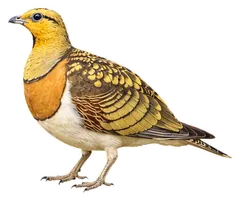 Pin-tailed SandgrousePterocles alchata
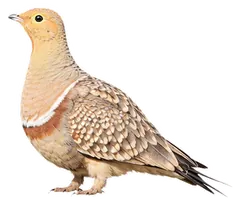 Namaqua SandgrousePterocles namaqua
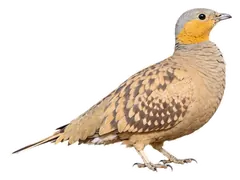 Spotted SandgrousePterocles senegallus
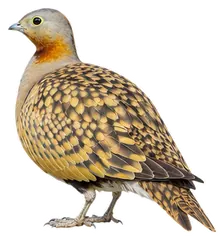 Black-bellied SandgrousePterocles orientalis
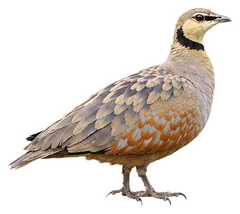 Yellow-throated SandgrousePterocles gutturalis
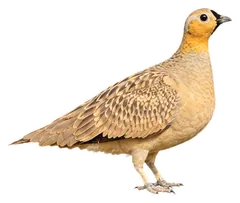 Crowned SandgrousePterocles coronatus
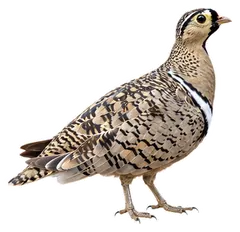 Black-faced SandgrousePterocles decoratus
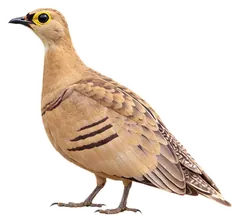 Madagascar SandgrousePterocles personatus
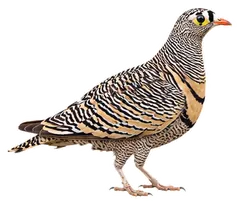 Lichtenstein's SandgrousePterocles lichtensteinii
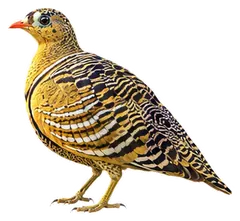 Painted SandgrousePterocles indicus
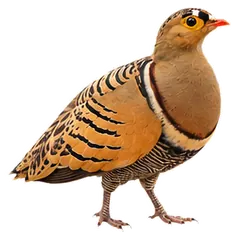 Four-banded SandgrousePterocles quadricinctus
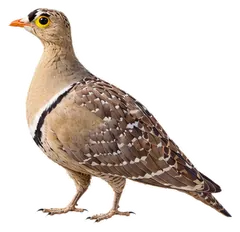 Double-banded SandgrousePterocles bicinctus
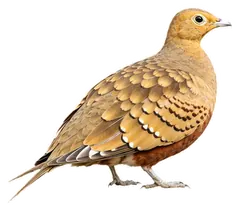
Download illustration
Free to use with credit: “Illustration: Bird Album (birdalbum.com)”. Drawn by AI from reference photos. ↗
Heard it but can't see it? Mingji identifies birds by sound and photo, on your phone.
In other languages
- EnglishChestnut-bellied Sandgrouse
- 简体中文栗腹沙鸡
- 繁體中文栗腹沙雞
- 日本語チャバラサケイ
- DeutschBraunbauch-Flughuhn
- FrançaisGanga à ventre brun
- EspañolGanga moruna
- Portuguêsganga-castanha
- ItalianoGrandule ventrecastano
- NederlandsRoodbuikzandhoen
- РусскийРыжебрюхий рябок
- Svenskabrunbukig flyghöna
- DanskBrunbuget Sandhøne
- Polskistepówka brunatnobrzucha