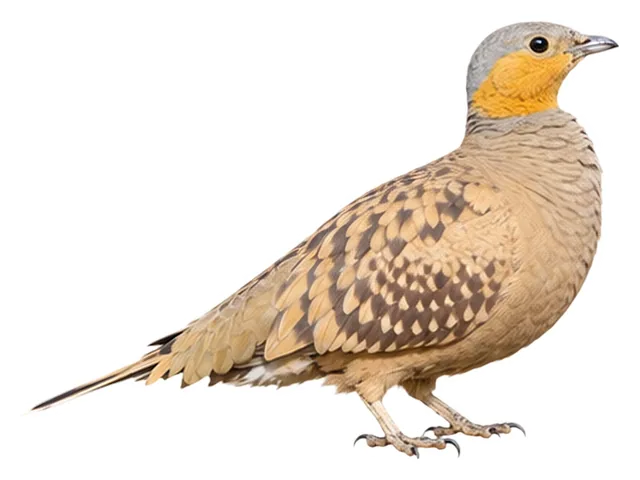
Spotted Sandgrouse
Pterocles senegallus (Linnaeus, 1771)
33 cmLength263 gWeight
The spotted sandgrouse (Pterocles senegallus) is a species of ground dwelling bird in the family Pteroclidae.
Busiest months: March–April · Most records: Egypt, Morocco, Western Sahara
Where and when it's recorded
Busiest months: March–April · Most records: Egypt, Morocco, Western Sahara

Spotted Sandgrouse has been recorded at 36 of the 8,276 birding hotspots we track, in 11 countries and regions.
Records by month Northern Hemisphere
Where it's recorded most
- Southern Wadi of Ras Shukeir SaltmarshesEgypt188 records
- Erg Chebbi – nordMorocco129 records
- Hurghada Sewage WorksEgypt87 records
More places
- Erg Chebbi – MerzougaMorocco68 records
- Gabal el ZaytEgypt65 records
- Sharm el-Sheikh – New WTPEgypt48 records
- Dayet SrijMorocco25 records
- Gleb JdianeWestern Sahara15 records
- Tagdilt TrackMorocco15 records
- Yeruham LakeIsrael11 records
Countries and regions with the most records
eBird records via GBIF up to 2024-12-31. A record means someone listed it; more records partly mean more birders, not more birds.
About
The spotted sandgrouse (Pterocles senegallus) is a species of ground dwelling bird in the family Pteroclidae. It is found in arid regions of northern and eastern Africa and across the Middle East and parts of Asia as far east as northwest India. It is a gregarious, diurnal bird and small flocks forage for seed and other vegetable matter on the ground, flying once a day to a waterhole for water.
Excerpt from Wikipedia, CC BY-SA 4.0 · authors · Read more on Wikipedia
Questions
How big is the Spotted Sandgrouse?
The Spotted Sandgrouse is about 33 cm long and weighs around 263 g.
Where does the Spotted Sandgrouse live?
Its breeding range: Africa, Palearctic: northwestern Africa to northwestern India. It is most often recorded in Egypt, Morocco and Western Sahara.
When is the best time to see the Spotted Sandgrouse?
At the hotspots we track, it is recorded most in March and April (Northern Hemisphere).
Is the Spotted Sandgrouse endangered?
The IUCN Red List classifies the Spotted Sandgrouse as Least Concern.
What does the Spotted Sandgrouse eat?
Main food: Seeds.
What family is the Spotted Sandgrouse in?
It belongs to the family Sandgrouse (Pteroclidae), order Pterocliformes.
At a glance
- Length
- 33 cm
- Weight
- 263 g
- Habitat
- Desert
- Diet
- Seeds
- Lifestyle
- Active on the ground
- Migration
- Partial migrant
- Conservation
- Least Concern
More measurements
- Wing
- 194 mm
- Tail
- 114 mm
- Bill
- 19 mm
- Tarsus
- 22 mm
Averages from the AVONET dataset; length from field guides where available.
Range
Africa, Palearctic: northwestern Africa to northwestern India
Breeding range, IOC World Bird List 15.2
Classification
- Order
- Pterocliformes
- Family
- Sandgrouse Pteroclidae
- Genus
- Pterocles
Other birds in the genus Pterocles
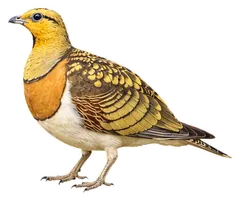 Pin-tailed SandgrousePterocles alchata
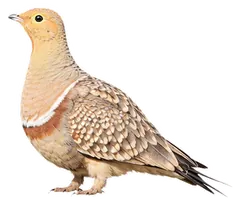 Namaqua SandgrousePterocles namaqua
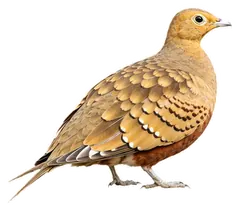 Chestnut-bellied SandgrousePterocles exustus
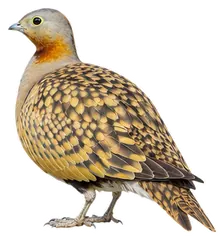 Black-bellied SandgrousePterocles orientalis
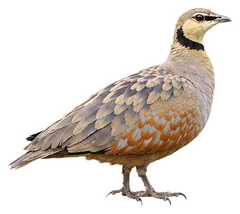 Yellow-throated SandgrousePterocles gutturalis
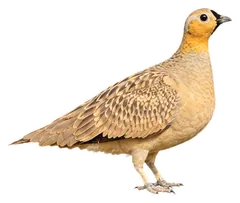 Crowned SandgrousePterocles coronatus
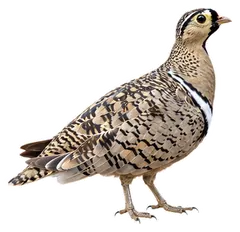 Black-faced SandgrousePterocles decoratus
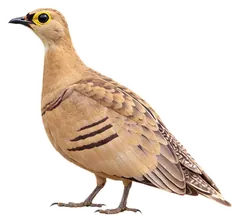 Madagascar SandgrousePterocles personatus
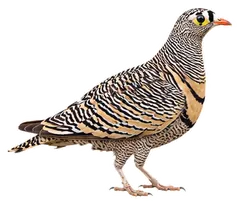 Lichtenstein's SandgrousePterocles lichtensteinii
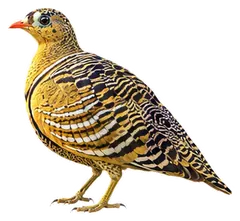 Painted SandgrousePterocles indicus
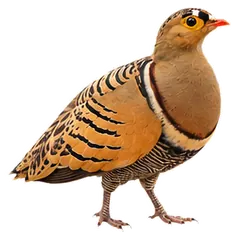 Four-banded SandgrousePterocles quadricinctus
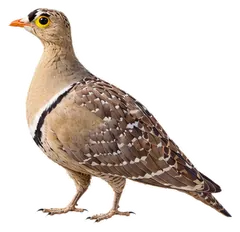 Double-banded SandgrousePterocles bicinctus
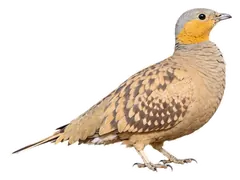
Download illustration
Free to use with credit: “Illustration: Bird Album (birdalbum.com)”. Drawn by AI from reference photos. ↗
Heard it but can't see it? Mingji identifies birds by sound and photo, on your phone.