 Bird Album
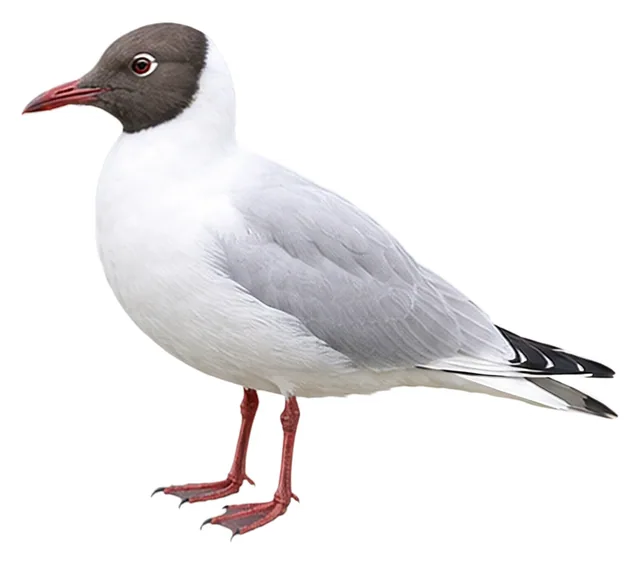
Black-headed Gull
Chroicocephalus ridibundus (Linnaeus, 1766)
34–39 cmLength97 cmWingspan284 gWeight
The adult has a rufous head and red bill and legs in summer; in winter, only two dark spots remain on the head.
Busiest months: January, March–May and September–October · Most records: United Kingdom, Spain, Portugal
How to identify
Field marks
- Head chocolate-rufous in summer, appearing black at a distance
- Rufous disappears in winter, leaving two dark spots
- Adult bill and legs red in summer
- Leading edge of outer wing white in flight
Male, female and young
Sexes identical in plumage; in the first month or two after fledging, juveniles have rufous spots over most of the body and a black band on the tail.
Voice
Noisy; the familiar “kree-ar” is often heard in breeding colonies.
Where and when it's recorded
Busiest months: January, March–May and September–October · Most records: United Kingdom, Spain, Portugal

Black-headed Gull has been recorded at 2,714 of the 8,276 birding hotspots we track, in 136 countries and regions.
Records by month Northern Hemisphere
Where it's recorded most
- Amwell HMWT NRUnited Kingdom8,193 records
- Titchwell Marsh RSPB ReserveUnited Kingdom8,066 records
- Minsmere RSPB ReserveUnited Kingdom5,874 records
More places
- Desembocadura del Guadalhorce – ÁreaSpain5,361 records
- Txingudi – PlaiaundiSpain5,326 records
- Húsavík – hafnarsvæðiIceland5,191 records
- Beddington FarmlandsUnited Kingdom4,560 records
- Cley & Salthouse Marshes NWT NR – Cley Marshes including Hides and Visitor CentreUnited Kingdom4,396 records
- WWT London Wetland CentreUnited Kingdom3,920 records
- Walthamstow WetlandsUnited Kingdom3,802 records
Countries and regions with the most records
eBird records via GBIF up to 2024-12-31. A record means someone listed it; more records partly mean more birders, not more birds.
About
The black-headed gull (Chroicocephalus ridibundus) is a small gull that breeds in much of the Palearctic in Europe and Asia, and also locally in smaller numbers in coastal eastern Canada. Most of the population is migratory and winters further south, but many also remain in the milder areas of northwestern Europe. It was formerly sometimes cited as "common black-headed gull" to distinguish it from "great black-headed gull" (an old name for Pallas's gull).
Excerpt from Wikipedia, CC BY-SA 4.0 · authors · Read more on Wikipedia
Questions
How big is the Black-headed Gull?
The Black-headed Gull is about 34–39 cm long, with a wingspan of 97 cm and weighs around 284 g.
Where does the Black-headed Gull live?
Its breeding range: Palearctic: coastal far southern Greenland, inland Iceland, temperate and subarctic western Europe across Russia to Yakutsk region, Kamchatka, Sakhalin (eastern Russia); in south through Caspian Sea, northern Central Asia, northern, central Mongolia and northeastern China; also west-central Newfoundland (southeastern Canada). It is most often recorded in United Kingdom, Spain and Portugal.
When is the best time to see the Black-headed Gull?
At the hotspots we track, it is recorded most in January, March, April, May, September and October (Northern Hemisphere).
Is the Black-headed Gull endangered?
The IUCN Red List classifies the Black-headed Gull as Least Concern.
What does the Black-headed Gull eat?
Main food: Fish, shrimp & shellfish.
What family is the Black-headed Gull in?
It belongs to the family Gulls, Terns, Skimmers (Laridae), order Charadriiformes.
At a glance
- Length
- 34–39 cm
- Wingspan
- 97 cm
- Weight
- 284 g
- Habitat
- Wetland
- Diet
- Fish, shrimp & shellfish
- Lifestyle
- Varied
- Migration
- Partial migrant
- Conservation
- Least Concern
More measurements
- Wing
- 291 mm
- Tail
- 110 mm
- Bill
- 43 mm
- Tarsus
- 41 mm
Averages from the AVONET dataset; length from field guides where available.
Range
Palearctic: coastal far southern Greenland, inland Iceland, temperate and subarctic western Europe across Russia to Yakutsk region, Kamchatka, Sakhalin (eastern Russia); in south through Caspian Sea, northern Central Asia, northern, central Mongolia and northeastern China; also west-central Newfoundland (southeastern Canada)
Breeding range, IOC World Bird List 15.2
Classification
- Order
- Charadriiformes
- Family
- Gulls, Terns, Skimmers Laridae
- Genus
- Chroicocephalus
Other birds in the genus Chroicocephalus
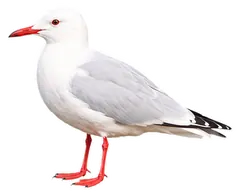 Slender-billed GullChroicocephalus genei
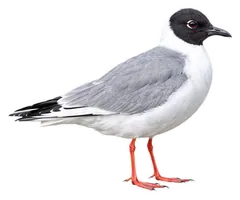 Bonaparte's GullChroicocephalus philadelphia
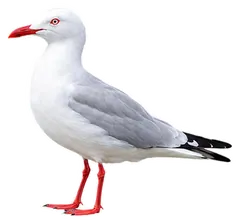 Silver GullChroicocephalus novaehollandiae
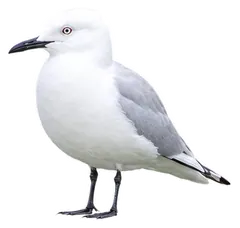 Black-billed GullChroicocephalus bulleri
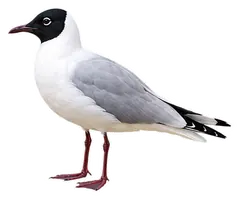 Andean GullChroicocephalus serranus
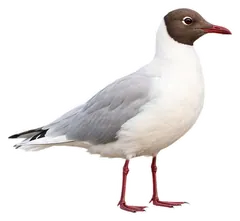 Brown-hooded GullChroicocephalus maculipennis
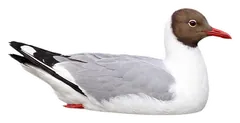 Brown-headed GullChroicocephalus brunnicephalus
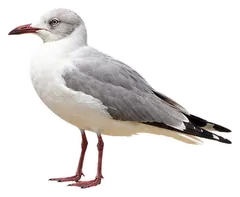 Grey-headed GullChroicocephalus cirrocephalus
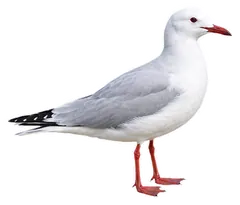 Hartlaub's GullChroicocephalus hartlaubii
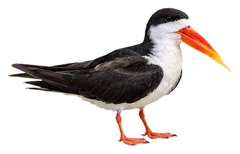 African SkimmerRynchops flavirostris
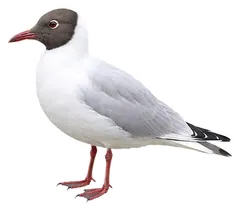
Download illustration
Free to use with credit: “Illustration: Bird Album (birdalbum.com)”. Drawn by AI from a reference photo by Hans Hillewaert. ↗

Heard it but can't see it? Mingji identifies birds by sound and photo, on your phone.