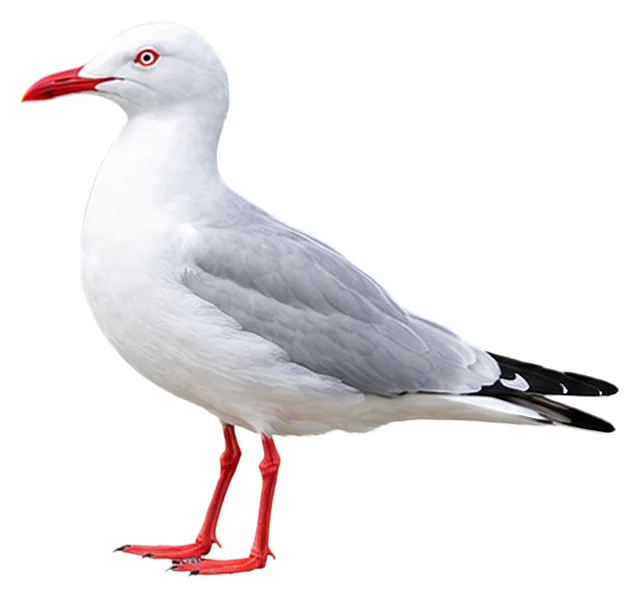
Silver Gull
Chroicocephalus novaehollandiae (Stephens, 1826)
40–45 cmLength94 cmWingspan269 gWeight
The adult has a white head, body and tail, pale gray wings, black wingtips with white patches, and a bright red bill.
Busiest months: October–January · Most records: Australia, New Zealand, New Caledonia
How to identify
Field marks
- Adult head, body and tail white
- Adult wings pale gray; wingtips black with white spots
- Adult bill bright red, brighter when breeding or older
Male, female and young
Juvenile has brown markings on the wings and a dark bill.
Voice
Sharp calls; the most frequent is a grating, high-pitched “kwarwh”.
Where and when it's recorded
Busiest months: October–January · Most records: Australia, New Zealand, New Caledonia

Silver Gull has been recorded at 304 of the 8,276 birding hotspots we track, in 6 countries and regions.
Records by month Southern Hemisphere
Where it's recorded most
- Western Treatment PlantAustralia8,834 records
- Cairns EsplanadeAustralia6,683 records
- Kaikoura – offshore – Albatross Encounter pelagicNew Zealand6,185 records
More places
- Jerrabomberra Wetlands Nature ReserveAustralia5,576 records
- Royal ParkAustralia4,471 records
- Royal Botanic Gardens MelbourneAustralia4,251 records
- Centennial ParkAustralia3,518 records
- Banyule Flats ReserveAustralia3,219 records
- Albert ParkAustralia3,208 records
- Royal Botanic GardensAustralia2,589 records
Countries and regions with the most records
eBird records via GBIF up to 2024-12-31. A record means someone listed it; more records partly mean more birders, not more birds.
About
The silver gull (Chroicocephalus novaehollandiae) is a gull in Oceania. It is the most common gull of Australia. It has been found throughout the continent, but particularly at or near coastal areas.
Excerpt from Wikipedia, CC BY-SA 4.0 · authors · Read more on Wikipedia
Questions
How big is the Silver Gull?
The Silver Gull is about 40–45 cm long, with a wingspan of 94 cm and weighs around 269 g.
Where does the Silver Gull live?
Its breeding range: Australasia: inland southern Australia and coastal throughout Australia; coastal New Zealand and outlying islands and New Caledonia. It is most often recorded in Australia, New Zealand and New Caledonia.
When is the best time to see the Silver Gull?
At the hotspots we track, it is recorded most in January, October, November and December (Southern Hemisphere).
Is the Silver Gull endangered?
The IUCN Red List classifies the Silver Gull as Least Concern.
What does the Silver Gull eat?
Main food: Omnivore.
What family is the Silver Gull in?
It belongs to the family Gulls, Terns, Skimmers (Laridae), order Charadriiformes.
At a glance
- Length
- 40–45 cm
- Wingspan
- 94 cm
- Weight
- 269 g
- Habitat
- Coast & tidal flats
- Diet
- Omnivore
- Lifestyle
- Varied
- Migration
- Resident (barely migrates)
- Conservation
- Least Concern
More measurements
- Wing
- 277 mm
- Tail
- 108 mm
- Bill
- 40 mm
- Tarsus
- 44 mm
Averages from the AVONET dataset; length from field guides where available.
Range
Australasia: inland southern Australia and coastal throughout Australia; coastal New Zealand and outlying islands and New Caledonia
Breeding range, IOC World Bird List 15.2
Classification
- Order
- Charadriiformes
- Family
- Gulls, Terns, Skimmers Laridae
- Genus
- Chroicocephalus
Other birds in the genus Chroicocephalus
 Slender-billed GullChroicocephalus genei
 Bonaparte's GullChroicocephalus philadelphia
 Black-billed GullChroicocephalus bulleri
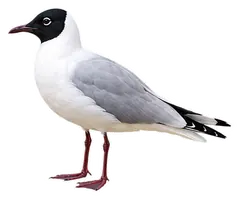 Andean GullChroicocephalus serranus
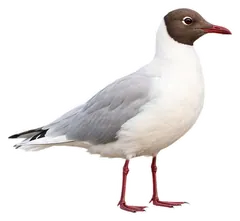 Brown-hooded GullChroicocephalus maculipennis
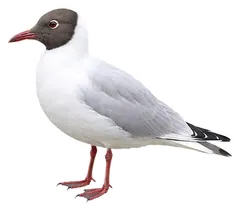 Black-headed GullChroicocephalus ridibundus
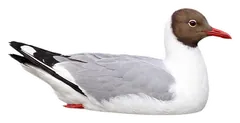 Brown-headed GullChroicocephalus brunnicephalus
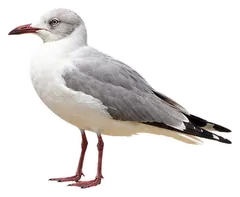 Grey-headed GullChroicocephalus cirrocephalus
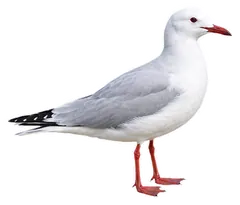 Hartlaub's GullChroicocephalus hartlaubii
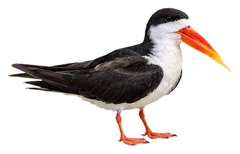 African SkimmerRynchops flavirostris
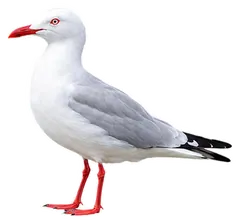
Download illustration
Free to use with credit: “Illustration: Bird Album (birdalbum.com)”. Drawn by AI from a reference photo by marlenekraml. ↗
Heard it but can't see it? Mingji identifies birds by sound and photo, on your phone.