 Bird Album
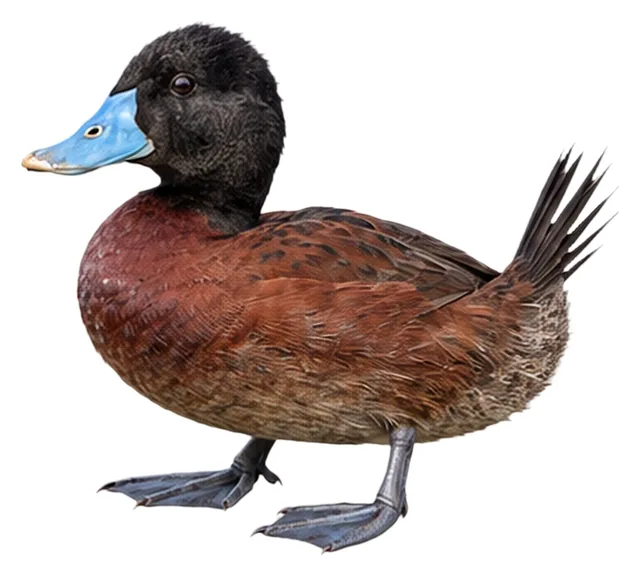
Blue-billed Duck
Oxyura australis Gould, 1837
798 gWeight
The blue-billed duck (Oxyura australis) is a small Australian stiff-tailed duck, with both the male and female growing to a length of 40 cm (16 in).
Busiest months: January · Most records: Australia
Where and when it's recorded
Busiest months: January · Most records: Australia

Blue-billed Duck has been recorded at 77 of the 8,276 birding hotspots we track, in 1 country or region.
Records by month Southern Hemisphere
Where it's recorded most
- Western Treatment PlantAustralia4,869 records
- Jawbone Flora and Fauna ReserveAustralia1,620 records
- Herdsman LakeAustralia1,250 records
More places
- Braeside ParkAustralia1,106 records
- Lake GalletlyAustralia980 records
- Lake Monger ReserveAustralia891 records
- Lake LorneAustralia784 records
- Karkarook ParkAustralia723 records
- Braeside Park WetlandsAustralia672 records
- Laratinga WetlandsAustralia596 records
Countries and regions with the most records
eBird records via GBIF up to 2024-12-31. A record means someone listed it; more records partly mean more birders, not more birds.
About
The blue-billed duck (Oxyura australis) is a small Australian stiff-tailed duck, with both the male and female growing to a length of 40 cm (16 in). The male has a slate-blue bill which changes to bright-blue during the breeding season, hence the duck's common name. The male has deep chestnut plumage during breeding season, reverting to a dark grey.
Excerpt from Wikipedia, CC BY-SA 4.0 · authors · Read more on Wikipedia
Questions
How big is the Blue-billed Duck?
The Blue-billed Duck weighs around 798 g.
Where does the Blue-billed Duck live?
Its breeding range: Australasia: southwestern Western Australia, southwestern Queensland to southern Victoria and southeastern South Australia and Tasmania (southwestern, southeastern Australia). It is most often recorded in Australia.
When is the best time to see the Blue-billed Duck?
At the hotspots we track, it is recorded most in January (Southern Hemisphere).
Is the Blue-billed Duck endangered?
The IUCN Red List classifies the Blue-billed Duck as Least Concern.
What does the Blue-billed Duck eat?
Main food: Aquatic plants.
What family is the Blue-billed Duck in?
It belongs to the family Ducks, Geese, Swans (Anatidae), order Anseriformes.
At a glance
- Weight
- 798 g
- Habitat
- Wetland
- Diet
- Aquatic plants
- Lifestyle
- On the water surface
- Migration
- Partial migrant
- Conservation
- Least Concern
More measurements
- Wing
- 154 mm
- Tail
- 62 mm
- Bill
- 44 mm
- Tarsus
- 33 mm
Averages from the AVONET dataset; length from field guides where available.
Range
Australasia: southwestern Western Australia, southwestern Queensland to southern Victoria and southeastern South Australia and Tasmania (southwestern, southeastern Australia)
Breeding range, IOC World Bird List 15.2
Classification
- Order
- Anseriformes
- Family
- Ducks, Geese, Swans Anatidae
- Genus
- Oxyura
Other birds in the genus Oxyura
 Ruddy DuckOxyura jamaicensis
 Andean DuckOxyura ferruginea
 Lake DuckOxyura vittata
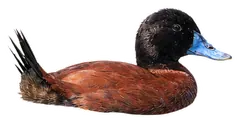 Maccoa DuckOxyura maccoa
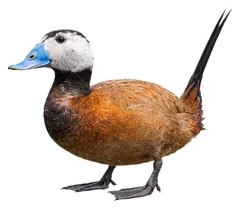 White-headed DuckOxyura leucocephala
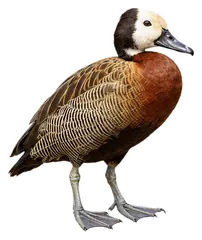 White-faced Whistling DuckDendrocygna viduata
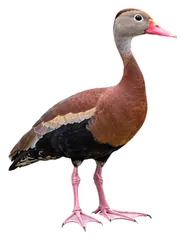 Black-bellied Whistling DuckDendrocygna autumnalis
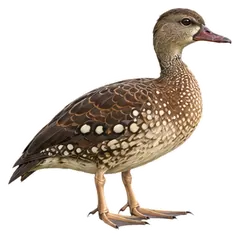 Spotted Whistling DuckDendrocygna guttata
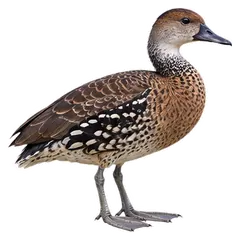 West Indian Whistling DuckDendrocygna arborea
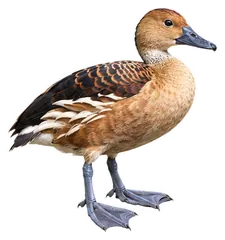 Fulvous Whistling DuckDendrocygna bicolor
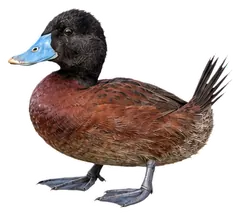
Download illustration
Free to use with credit: “Illustration: Bird Album (birdalbum.com)”. Drawn by AI from a reference photo by Elaine McDonald. ↗
Heard it but can't see it? Mingji identifies birds by sound and photo, on your phone.
In other languages
- EnglishBlue-billed Duck
- 简体中文澳洲硬尾鸭
- 繁體中文藍嘴硬尾鴨
- 日本語オーストラリアオタテガモ
- DeutschSchwarzkinn-Ruderente
- FrançaisÉrismature australe
- EspañolMalvasía australiana
- Portuguêspato-de-bico-azul
- ItalianoGobbo beccazzurro
- NederlandsAustralische Stekelstaart
- РусскийАвстралийская савка
- Svenskaaustralisk kopparand
- DanskAustralsk Skarveand
- Polskisterniczka australijska