 Bird Album
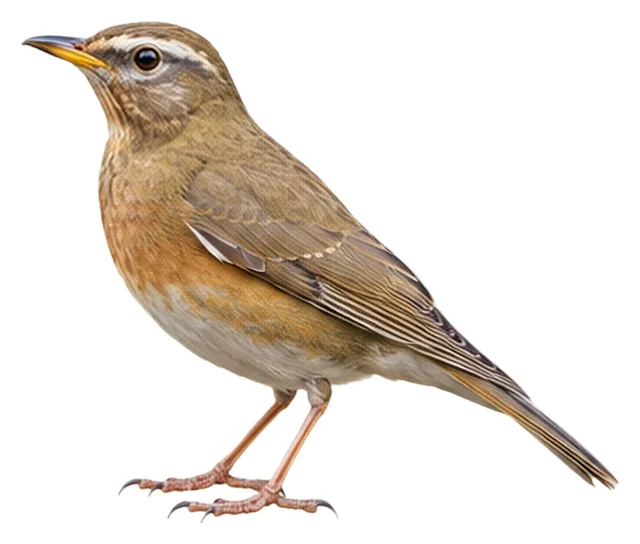
Eyebrowed Thrush
Turdus obscurus Gmelin, JF, 1789
22 cmLength63 gWeight
It has a gray-brown head and back, a white supercilium above the eye, an orange breast and flanks and a white belly.
Busiest months: May · Most records: China, Thailand, Japan
How to identify
Field marks
- White supercilium around the eye
- Orange breast and flanks, white belly
- Gray-brown back, head and neck
- Yellow bill with a black tip
Male, female and young
Sexes look broadly similar; juvenile has a rufous-brown back.
Voice
Call is thin, like “zip-zip”, lengthening to a drawn-out “tseep” for contact; male’s song is a simple whistle.
Where and when it's recorded
Busiest months: May · Most records: China, Thailand, Japan

Eyebrowed Thrush has been recorded at 778 of the 8,276 birding hotspots we track, in 32 countries and regions.
Records by month Northern Hemisphere
Where it's recorded most
- St. Paul IslandUnited States464 records
- Doi Inthanon NP – summitThailand425 records
- Nanhui DongtanChina355 records
More places
- Wajima – Hegurajima (island)Japan275 records
- Doi Inthanon NPThailand268 records
- Taipei – Da'an Forest ParkTaiwan (China)265 records
- Yeliu IBATaiwan (China)262 records
- Man Nai IslandThailand254 records
- GambellUnited States203 records
- Po ToiHong Kong (China)180 records
Countries and regions with the most records
eBird records via GBIF up to 2024-12-31. A record means someone listed it; more records partly mean more birders, not more birds.
About
The eyebrowed thrush (Turdus obscurus) is a member of the thrush family Turdidae. It breeds in dense coniferous forest and taiga eastwards from Siberia and Mongolia to Japan. It is strongly migratory, wintering south to China and Southeast Asia.
Excerpt from Wikipedia, CC BY-SA 4.0 · authors · Read more on Wikipedia
Questions
How big is the Eyebrowed Thrush?
The Eyebrowed Thrush is about 22 cm long and weighs around 63 g.
Where does the Eyebrowed Thrush live?
Its breeding range: Palearctic: central to southeastern Russia. It is most often recorded in China, Thailand and Japan.
When is the best time to see the Eyebrowed Thrush?
At the hotspots we track, it is recorded most in May (Northern Hemisphere).
Is the Eyebrowed Thrush endangered?
The IUCN Red List classifies the Eyebrowed Thrush as Least Concern.
What does the Eyebrowed Thrush eat?
Main food: Insects & other invertebrates.
What family is the Eyebrowed Thrush in?
It belongs to the family Thrushes (Turdidae), order Passerines (Passeriformes).
At a glance
- Length
- 22 cm
- Weight
- 63 g
- Habitat
- Forest
- Diet
- Insects & other invertebrates
- Lifestyle
- Perches in trees
- Migration
- Migratory
- Conservation
- Least Concern
More measurements
- Wing
- 120 mm
- Tail
- 82 mm
- Bill
- 22 mm
- Tarsus
- 30 mm
Averages from the AVONET dataset; length from field guides where available.
Range
Palearctic: central to southeastern Russia
Breeding range, IOC World Bird List 15.2
Classification
- Order
- Passerines Passeriformes
- Family
- Thrushes Turdidae
- Genus
- Turdus
Other birds in the genus Turdus
 Ethiopian ThrushTurdus simensis
 Groundscraper ThrushTurdus litsitsirupa
 Chinese ThrushTurdus mupinensis
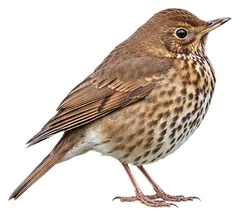 Song ThrushTurdus philomelos
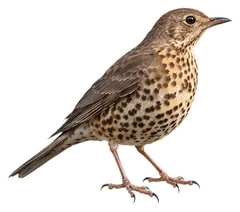 Mistle ThrushTurdus viscivorus
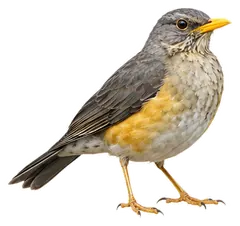 African ThrushTurdus pelios
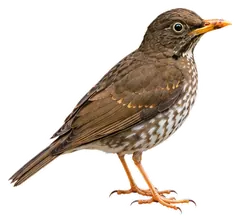 Principe ThrushTurdus xanthorhynchus
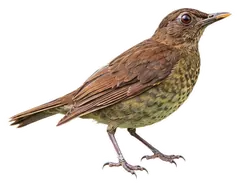 Sao Tome ThrushTurdus olivaceofuscus
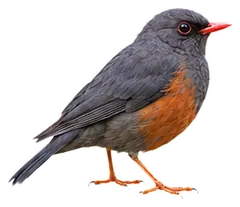 Abyssinian ThrushTurdus abyssinicus
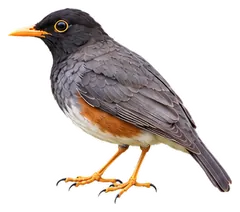 Taita ThrushTurdus helleri
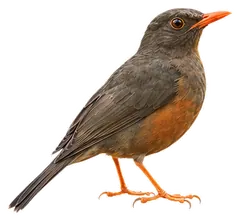 Usambara ThrushTurdus roehli
 Olive ThrushTurdus olivaceus
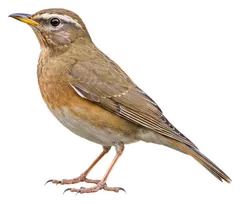
Download illustration
Free to use with credit: “Illustration: Bird Album (birdalbum.com)”. Drawn by AI from a reference photo by Robert tdc. ↗

Heard it but can't see it? Mingji identifies birds by sound and photo, on your phone.