 Bird Album
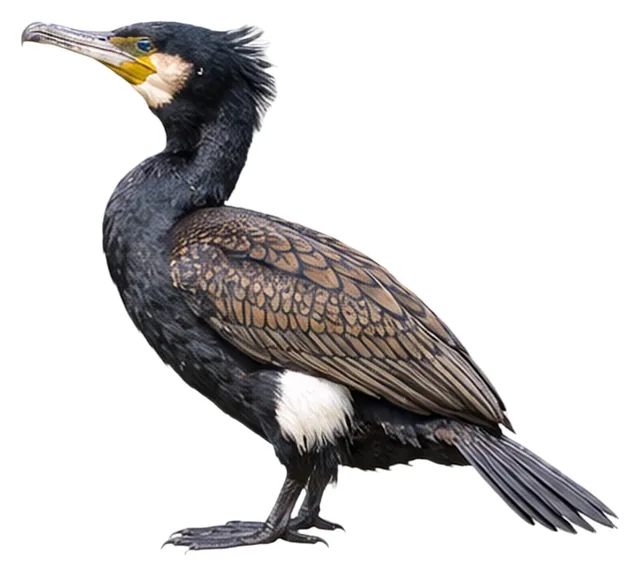
Great Cormorant
Phalacrocorax carbo (Linnaeus, 1758)
90 cmLength140 cmWingspan2.5 kgWeight
This large waterbird is blackish and glossy overall, often perching on rocks or branches to dry its wings.
Busiest months: October–March · Most records: United Kingdom, Spain, Australia
How to identify
Field marks
- Blackish overall, with a gloss
- Bill heavy, with yellow bare skin at the base of the lower mandible
- Cheeks and throat white
- White filamentous feathers on the head and neck and white patches on the flanks in the breeding season
Male, female and young
Male usually larger than female; juvenile dark brown with dirty-white underparts.
Where and when it's recorded
Busiest months: October–March · Most records: United Kingdom, Spain, Australia

Great Cormorant has been recorded at 3,747 of the 8,276 birding hotspots we track, in 134 countries and regions.
Records by month Northern Hemisphere
Where it's recorded most
- Amwell HMWT NRUnited Kingdom8,517 records
- Titchwell Marsh RSPB ReserveUnited Kingdom6,276 records
- Txingudi – PlaiaundiSpain5,803 records
More places
- Desembocadura del Guadalhorce – ÁreaSpain5,201 records
- Minsmere RSPB ReserveUnited Kingdom5,002 records
- Western Treatment PlantAustralia4,780 records
- Beddington FarmlandsUnited Kingdom4,452 records
- Barnegat Lighthouse SPUnited States4,255 records
- Walthamstow WetlandsUnited Kingdom3,982 records
- Rutland WaterUnited Kingdom3,669 records
Countries and regions with the most records
eBird records via GBIF up to 2024-12-31. A record means someone listed it; more records partly mean more birders, not more birds.
About
The great cormorant (Phalacrocorax carbo), also known as just cormorant in Britain, as black shag or kawau in New Zealand, formerly also known as the great black cormorant across the Northern Hemisphere, the black cormorant in Australia, and the large cormorant in India, is a widespread member of the cormorant family of seabirds. It breeds in much of the Old World, Australasia, and the Atlantic coast of North America.
Excerpt from Wikipedia, CC BY-SA 4.0 · authors · Read more on Wikipedia
Questions
How big is the Great Cormorant?
The Great Cormorant is about 90 cm long, with a wingspan of 140 cm and weighs around 2.5 kg.
Where does the Great Cormorant live?
Its breeding range: Palearctic, Australasia, Oriental, North America, Africa: worldwide in temperate and tropical zones, coastal and inland, except in Western Hemisphere where northwestern North Atlantic coast only.. It is most often recorded in United Kingdom, Spain and Australia.
When is the best time to see the Great Cormorant?
At the hotspots we track, it is recorded most in January, February, March, October, November and December (Northern Hemisphere).
Is the Great Cormorant endangered?
The IUCN Red List classifies the Great Cormorant as Least Concern.
What does the Great Cormorant eat?
Main food: Fish, shrimp & shellfish.
What family is the Great Cormorant in?
It belongs to the family Cormorants, Shags (Phalacrocoracidae), order Suliformes.
At a glance
- Length
- 90 cm
- Wingspan
- 140 cm
- Weight
- 2.5 kg
- Habitat
- Wetland
- Diet
- Fish, shrimp & shellfish
- Lifestyle
- On the water surface
- Migration
- Partial migrant
- Conservation
- Least Concern
More measurements
- Wing
- 340 mm
- Tail
- 148 mm
- Bill
- 83 mm
- Tarsus
- 64 mm
Averages from the AVONET dataset; length from field guides where available.
Range
Palearctic, Australasia, Oriental, North America, Africa: worldwide in temperate and tropical zones, coastal and inland, except in Western Hemisphere where northwestern North Atlantic coast only.
Breeding range, IOC World Bird List 15.2
Subspecies · 1
- Phalacrocorax carbo sinensis inland c Europe to n, s, India and Sri Lanka to ne Russia, ne China and Korean Pen., s to Turkey, c Asia and n Mongolia; disjunctly sc Cambodia and s Vietnam, ne Borneo
Classification
- Order
- Suliformes
- Family
- Cormorants, Shags Phalacrocoracidae
- Genus
- Phalacrocorax
Other birds in the genus Phalacrocorax
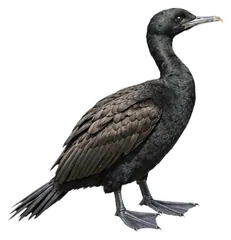 Bank CormorantPhalacrocorax neglectus
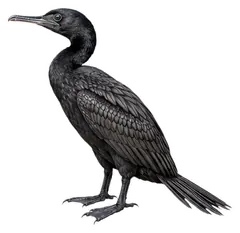 Socotra CormorantPhalacrocorax nigrogularis
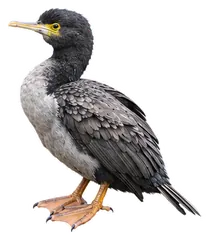 Pitt ShagPhalacrocorax featherstoni
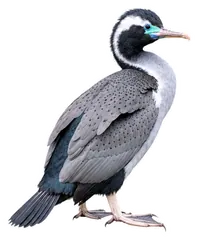 Spotted ShagPhalacrocorax punctatus
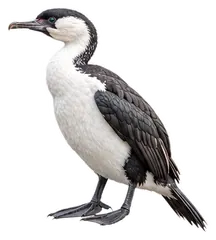 Black-faced CormorantPhalacrocorax fuscescens
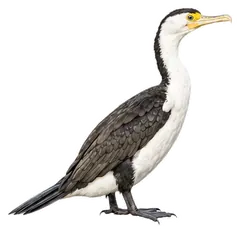 Australian Pied CormorantPhalacrocorax varius
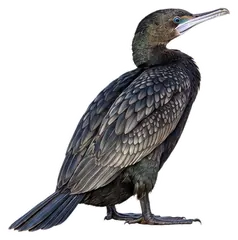 Little Black CormorantPhalacrocorax sulcirostris
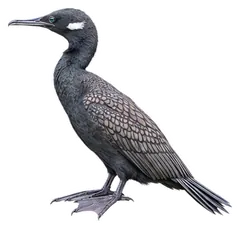 Indian CormorantPhalacrocorax fuscicollis
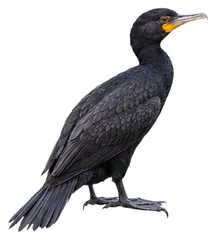 Cape CormorantPhalacrocorax capensis
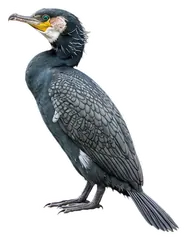 Japanese CormorantPhalacrocorax capillatus
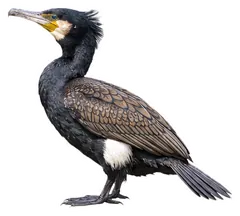
Download illustration
Free to use with credit: “Illustration: Bird Album (birdalbum.com)”. Drawn by AI from a reference photo by MPF. ↗

Heard it but can't see it? Mingji identifies birds by sound and photo, on your phone.