 Bird Album
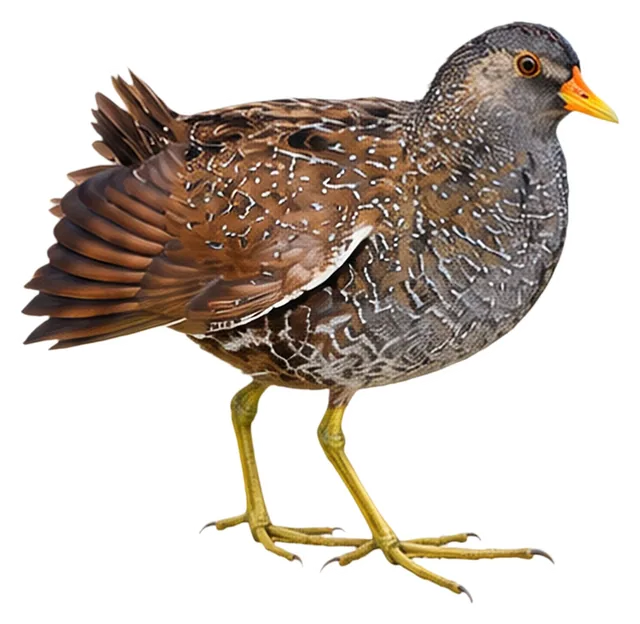
Spotted Crake
Porzana porzana (Linnaeus, 1766)
19–22 cmLength38 cmWingspan87 gWeight
It has a short, straight yellow bill with a red base, a blue-gray breast and white spots on the flanks.
Busiest months: March–April · Most records: Spain, Israel, United Kingdom
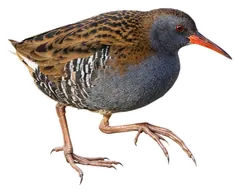
Looks like Water Rail
How to identify
Field marks
- Short, straight yellow bill with a red base
- Mainly brown upperparts and blue-gray breast
- Dark barring and white spots on the flanks
- Green legs and feet, long toes, short tail and buff undertail
Male, female and young
Juvenile similar, but brown replaces the blue-gray.
Voice
Repeated “hwuit, hwuit”, like the crack of a whip.
Similar species
Where and when it's recorded

Spotted Crake has been recorded at 611 of the 8,171 birding hotspots we track, in 77 countries and regions.
Records by month Northern Hemisphere
Where it's recorded most
- Private estate near Green MubazzarahUnited Arab Emirates412 records
- Poleg MarshIsrael323 records
- Al Jahra Reserve (Restricted access)Kuwait300 records
More places
- Fuente de Piedra – Centro de VisitantesSpain200 records
- Aras Kuş Halkalama İstasyonuTürkiye200 records
- International Birding and Research Center Eilat (IBRCE)Israel178 records
- Hama'apil FishpondsIsrael121 records
- Yeruham LakeIsrael119 records
- Al Wathba Wetland ReserveUnited Arab Emirates115 records
- Alberca de LoretoSpain113 records
Countries and regions with the most records
eBird records via GBIF up to 2024-12-31. A record means someone listed it; more records partly mean more birders, not more birds.
About
The spotted crake (Porzana porzana) is a small waterbird of the family Rallidae. The scientific name is derived from Venetian terms for small rails.
Excerpt from Wikipedia, CC BY-SA 4.0 · authors · Read more on Wikipedia
Questions
How big is the Spotted Crake?
The Spotted Crake is about 19–22 cm long, with a wingspan of 38 cm and weighs around 87 g.
Where does the Spotted Crake live?
Its breeding range: Palearctic: western Europe to Central Asia. It is most often recorded in Spain, Israel and United Kingdom.
When is the best time to see the Spotted Crake?
At the hotspots we track, it is recorded most in March and April (Northern Hemisphere).
Is the Spotted Crake endangered?
The IUCN Red List classifies the Spotted Crake as Least Concern.
What does the Spotted Crake eat?
Main food: Fish, shrimp & shellfish.
What family is the Spotted Crake in?
It belongs to the family Rails, Crakes & Coots (Rallidae), order Gruiformes.
At a glance
- Length
- 19–22 cm
- Wingspan
- 38 cm
- Weight
- 87 g
- Habitat
- Wetland
- Diet
- Fish, shrimp & shellfish
- Lifestyle
- Active on the ground
- Migration
- Migratory
- Conservation
- Least Concern
More measurements
- Wing
- 113 mm
- Tail
- 45 mm
- Bill
- 20 mm
- Tarsus
- 29 mm
Averages from the AVONET dataset; length from field guides where available.
Range
Palearctic: western Europe to Central Asia
Breeding range, IOC World Bird List 15.2
Classification
- Order
- Gruiformes
- Family
- Rails, Crakes & Coots Rallidae
- Genus
- Porzana
Other birds in the genus Porzana
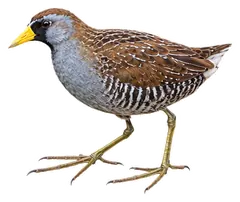 SoraPorzana carolina
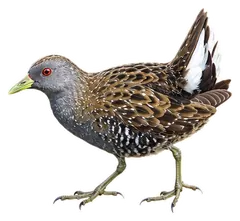 Australian CrakePorzana fluminea
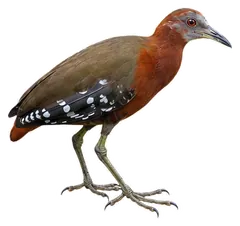 Grey-throated RailCanirallus oculeus
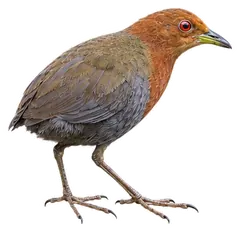 Chestnut-headed CrakeAnurolimnas castaneiceps
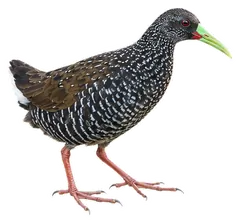 Spotted RailPardirallus maculatus
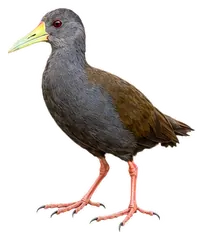 Blackish RailPardirallus nigricans
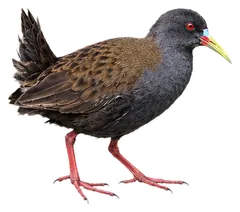 Plumbeous RailPardirallus sanguinolentus
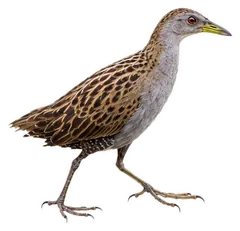 Ash-throated CrakeMustelirallus albicollis
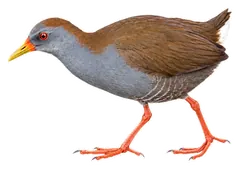 Zapata RailMustelirallus cerverai
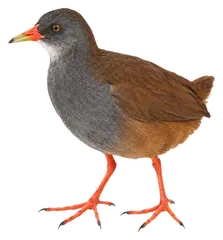 Colombian CrakeMustelirallus colombianus
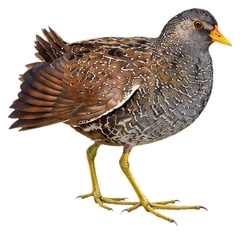
Download illustration
Free to use with credit: “Illustration: Bird Album (birdalbum.com)”. Drawn by AI from a reference photo by Татьяна Спицына. ↗
Heard it but can't see it? Mingji identifies birds by sound and photo, on your phone.